Universytet | |||||||||||
|---|---|---|---|---|---|---|---|---|---|---|---|
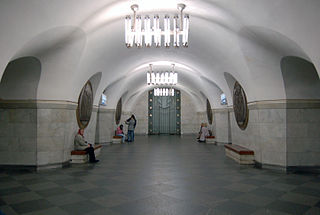
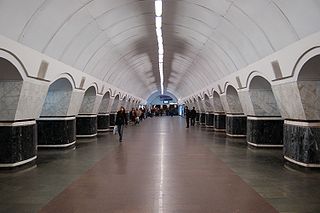
The central station hall with niches featuring busts of important academics. | |||||||||||
| Location | Shevchenkivskyi District Kiev Ukraine | ||||||||||
| Coordinates | 50°26′39″N30°30′22″E / 50.44417°N 30.50611°E Coordinates: 50°26′39″N30°30′22″E / 50.44417°N 30.50611°E | ||||||||||
| Owned by | Kiev Metro | ||||||||||
| Line(s) | |||||||||||
| Platforms | 1 | ||||||||||
| Tracks | 2 | ||||||||||
| Construction | |||||||||||
| Structure type | underground | ||||||||||
| Depth | 87 m (285 ft) | ||||||||||
| Platform levels | 1 | ||||||||||
| Other information | |||||||||||
| Station code | 118 | ||||||||||
| History | |||||||||||
| Opened | 6 November 1960 | ||||||||||
| Electrified | Yes | ||||||||||
| Traffic | |||||||||||
| Passengers (2008) | 23,900 [1] | ||||||||||
| Services | |||||||||||
| |||||||||||
Universytet (Ukrainian : Унiверситет) is a station on the Kiev Metro's Sviatoshynsko-Brovarska Line. The station was opened on November 6, 1960 as part of the first stage of the metro's construction. [2] [1] It is named after the Taras Shevchenko National University of Kyiv, which is located in direct proximity to the station itself.
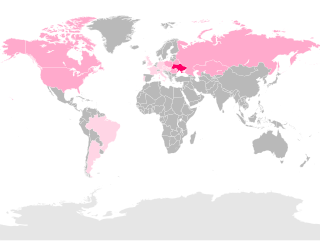
Ukrainian is an East Slavic language. It is the official state language of Ukraine, one of the three official languages in the unrecognized state of Transnistria, the other two being Romanian and Russian. Written Ukrainian uses a variant of the Cyrillic script.
The Kiev Metro is a rapid transit system that is the mainstay of Kiev's public transport. It was the first rapid transit system in Ukraine and the third system in the Soviet Union, after Moscow and St. Petersburg. It has three lines with a total length of 67.56 kilometers (41.98 mi) and 52 stations. The system carries 1.331 million passengers daily (2015), accounting for 46.7% of Kiev's public transport load. In 2016, the metro carried 484.56 million passengers. The deepest station in the world, Arsenalna, is found on the system.
Shevchenko University or officially the Taras Shevchenko National University of Kyiv, colloquially known in Ukrainian as KNU is located in Kiev, the capital of Ukraine. KNU is ranked within top 500 Universities in the world. It is the third oldest university in Ukraine after the University of Lviv and University of Kharkiv. Currently, its structure consists of fifteen faculties and five institutes. It was founded in 1834 as the Kiev Imperial University of Saint Vladimir, and since then it has changed its name several times. During the Soviet Union era, Taras Shevchenko University was one of the top-three universities in the USSR, along with Moscow State University and Leningrad State University. It is ranked as the best university in Ukraine in many rankings. Throughout history, the university has produced many famous alumni including Nikolay Bunge, Mykhailo Drahomanov, Mykhailo Hrushevskyi, Nikolai Berdyaev, Mikhail Bulgakov, Viacheslav Chornovil, Leonid Kravchuk, and many others. Taras Shevchenko himself, banned from educational activities for political reasons, worked for the Kyiv University as a field researcher.
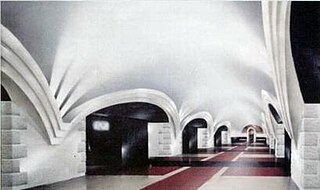
The station is a pylon trivault and is considered to be amongst the most beautiful stations in the system, and is currently the only one in Kiev that is the closest in appearance to the famous Stalinist architecture used in the Moscow and Saint Petersburg Metros of the 1950s. It was designed by architects H.Holovka, M.Syrkin, Ye.Ivanov, Zh.Yegulashvili, L.Semenyuk and O.Lozynska. [1] The red marbled pylons are adorned with white marble busts of famous scientists and Ukrainian literature poets, attributed to sculptors M.Dekermendzhi, A.Bilostotsky, V.Znoba, A.Kobalyov, Ye.Kuntsevych, M.Lysenko, P.Ostapenko, O.Suprun and A.Shapran.
Stalinist architecture, mostly known in the former Eastern Bloc as Stalinist Empire style or Socialist Classicism, is a term given to architecture of the Soviet Union under the leadership of Joseph Stalin, between 1933, when Boris Iofan's draft for Palace of the Soviets was officially approved, and 1955, when Nikita Khrushchev condemned "excesses" of the past decades and disbanded the Soviet Academy of Architecture. Stalinist architecture is associated with the socialist realism school of art and architecture.
The Moscow Metro is a rapid transit system serving Moscow, Russia and the neighbouring Moscow Oblast cities of Krasnogorsk, Reutov, Lyubertsy and Kotelniki. Opened in 1935 with one 11-kilometre (6.8 mi) line and 13 stations, it was the first underground railway system in the Soviet Union. As of 2018, the Moscow Metro excluding the Moscow Central Circle and Moscow Monorail has 224 stations and its route length is 381 km (237 mi), making it the fifth longest in the world. The system is mostly underground, with the deepest section 84 metres (276 ft) underground at the Park Pobedy station, one of the world's deepest.
The Saint Petersburg Metro is a rapid transit system in Saint Petersburg and Leningrad Oblast, Russia. It has been open since 15 November 1955. Formerly known as the V.I. Lenin Order of Lenin Leningrad Metropoliten, the system exhibits many typical Soviet designs and features exquisite decorations and artwork making it one of the most attractive and elegant metros in the world. Due to the city's unique geology, the Saint Petersburg Metro is one of the deepest metro systems in the world and the deepest by the average depth of all the stations. The system's deepest station, Admiralteyskaya, is 86 metres below ground. Serving about 2 million passengers daily, it is also the 19th busiest metro system in the world.
The white marble friezes also decorate the pylons and lighting is achieved by hidden lamps in the niches of the central vault, and by lamps on the platforms. The walls are covered with orange tiles and the floor is made of various shades of granite arranged in a traditional Ukrainian ornament layout. In the end of the station is white marbled wall, before which a large statue of Vladimir Lenin used to sit. However this was dismantled in the early 1990s, making the station lose its original look.
Vladimir Ilyich Ulyanov, better known by the alias Lenin, was a Russian revolutionary, politician, and political theorist. He served as head of government of Soviet Russia from 1917 to 1924 and of the Soviet Union from 1922 to 1924. Under his administration, Russia and then the wider Soviet Union became a one-party communist state governed by the Russian Communist Party. Ideologically a communist, he developed a variant of Marxism known as Leninism; his ideas were posthumously codified as Marxism-Leninism.
The station's large vestibule (monument to architecture) is situated in the middle of the A.V. Fomin Botanical Garden with a gallery allowing direct access to the gardens or to Taras Shevchenko Boulevard. The escalator ride consists of two separate tunnels linked in between by a smaller hall. [3]
The A.V. Fomin Botanical Garden is one of the oldest botanical gardens in Ukraine, located in Kiev, the capital of Ukraine. In 1839 the Kiev Taras Shevchenko University opened its own botanical garden. The botanical garden is 22.5 hectares (0.225 km²), with 8,000 plant species, including 143 recorded in the Ukraine's Red Book of Rare Species. The Garden is famous for its exotic plants: it has the biggest collection of succulents among the countries of the former Soviet Union. The greenhouse, which was built for the largest and the oldest palm trees in Northern Eurasia, is among the highest in the world. In 1935 the garden was named after the academician and botanist Aleksandr Vasiljevich Fomin, who directed the garden for years. The vestibule of the Kiev Metro station Universytet, is located on the northern edge of the garden, which was opened in 1960.(Google Maps link).
On April 15, 2011 a suspicious package was discovered at Universytet. The station was evacuated and Ukrainian Security Services investigated, determining that the package was not dangerous. [4] The scare followed the April 11th 2011 Minsk Metro bombing.
The 2011 Minsk Metro bombing occurred on 11 April 2011 when at least 15 people were killed and more than two hundred were injured in an explosion on the Minsk Metro, Belarus. The explosion happened at the central Kastryčnickaja station at 17:55 local time.
The Sviatoshynsko–Brovarska line is the first line of the Kiev Metro, dating back to 1960. It includes some of the system's more historically significant stations, like Arsenalna, which at 105.5 meters is the deepest in the world and the next station Dnipro, which although the tunnel follows a descent, appears above ground level.
Vokzalna is a station on Kiev Metro's Sviatoshynsko-Brovarska Line. The station was opened along with the Metro on 6 November 1960 It, and is named after Kiev's Central rail station (Vokzal)
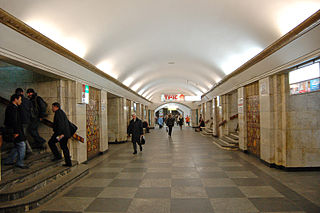
Khreshchatyk is a station on the Sviatoshynsko-Brovarska Line of the Kiev Metro. The station is named for the Khreshchatyk street, the most central street in Kiev. The station was opened in 1960 along with the first stage of the Metro. It The station is pylon trivault that features ceramic Ukrainian ornaments framed by metallic grills on the central hall sides of the pylons. White marble is used elsewhere, particularly for the walls and the main pylon frames. The ceiling is covered in white plaster and lighting comes from hidden lamps in the niches of the central vault and a central row of lamps.
Arsenalna is a station on Kiev Metro’s Sviatoshynsko-Brovarska Line. The station was opened along with the first stage and is currently the deepest station in the world. This is attributed to Kiev’s geography where the high bank of the Dnieper River rises above the rest of the city. Also unusual is the station’s design, which lacks a central concourse and is thus similar in layout to stations on the London Underground.
Teatralna is a station on the Sviatoshynsko-Brovarska Line of the Kiev Metro system. The station serves as a transfer point, via a pedestrian walkway connecting it to the Zoloti Vorota station on the Syretsko-Pecherska Line. The station was opened in 1987, between the Universytet and Khreshchatyk stations which were opened 27 years earlier. Currently there is a proposal for a second entrance to the station.
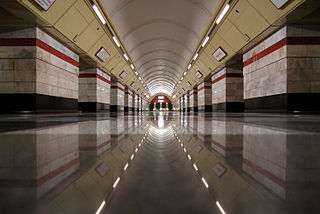
Syrets is a Kiev Metro station on the Syretsko-Pecherska Line. Opened in 2004, it is the northwestern terminus. Traditionally all of the Metro stations in Kiev were built in several stages including a few stations each. The Syretsky radius was started in the early 1990s, in the midst of economic hardships as a result of which, not only was it many years behind schedule it was also very slow to open new stations.
Dorohozhychi is a Kiev Metro station on the Syretsko-Pecherska Line. Opened on 30 March 2000, the station represents the second extension of the Syretsky radius to the northwest.
Lukianivska is a station on Kiev Metro's Syretsko-Pecherska Line. The station was opened on December 30, 1996, as part of the first stage extension of the Syretsky radius.
Lvivska Brama is a station on the Syretsko-Pecherska Line of the Kiev Metro between the stations Lukianivska and Zoloti Vorota, that was built but never opened.
Zoloti Vorota is the 29th station of the Kiev Metro system that serves the Ukrainian capital Kiev. The station was opened as part of the first segment of the Syretsko-Pecherska Line on 31 December 1989. It serves as a transfer station to the Teatralna station of the Sviatoshynsko-Brovarska Line. It is located near the city's Golden Gate, from which the station takes its name.
Palats Sportu is a station on the Syretsko-Pecherska Line of the Kiev Metro. Opened on December 31, 1989 as part of the first stage of the line, it formed third and last transfer point of the system.
Tarasa Shevchenka is a station on Kiev Metro's Obolonsko–Teremkivska Line. The station was opened on December 19, 1980 in the northern part of the historic Podil neighbourhood and is named after the famous Ukrainian poet, writer, and painter, Taras Shevchenko. It was designed by T.A. Tselikovska, A.S. Krushynskyi, and A. Pratsiuk.
Klovska — is a station on Kiev Metro's Syretsko-Pecherska Line. Originally the station was a temporary terminus of the line between its opening date December 31, 1989 and prior to the expansion of the line to Vydubichy in December 1991.
Pecherska — is a station on Kiev Metro's Syretsko-Pecherska Line. Originally planned to open along with the main section of the line which in late 1991, problems with the escalator tunnel meant that work was delayed, and the station finally opened only six years later on December 27, 1997.
The Bessarabska Square is a square located at the southwest end of Khreshchatyk, the main thoroughfare of Kiev, the capital of Ukraine. It is located in the city's Shevchenko Raion (district), at the busy intersection of Khreshchatyk, Taras Shevchenko Boulevard, Velyka Vasylkivska Street, and the Krutyi Descent streets.
The Vyshhorodsko–Darnytska line is a proposed sixth line to the Kiev Metro system serving the Ukrainian capital Kiev. The line is proposed to begin near the Taras Shevchenko Square in the city's north, and is to run south, connecting to the system's four other lines. It will later run east, and will cross over the Dnipro River and ending at the Darnytsia Railway Station on the city's left bank.