The Washington Metro, or locally simply Metro, is the common name of Metrorail, the rapid transit system serving the Washington metropolitan area of the United States. It is administered by the Washington Metropolitan Area Transit Authority (WMATA), which also operates the Metrobus service under the Metro name. Opened in 1976, the network now includes six lines, 91 stations, and 117 miles (188 km) of route.

The Metro Blue Line is a 12-mile (19.3 km) light rail line in Hennepin County, Minnesota that extends from downtown Minneapolis to the southern suburb of Bloomington. The line was originally named after Hiawatha Avenue which runs parallel to a good portion of the line. Major locations on the line include the Mall of America, Minneapolis–St. Paul International Airport and Target Field in downtown Minneapolis.

The Red Line is a rapid transit line of the Washington Metro system, consisting of 27 stations in Montgomery County, Maryland, and Washington, D.C. in the United States. It is a primary line through downtown Washington and the oldest and busiest line in the system. It forms a long, narrow "U", capped by its terminal stations at Shady Grove and Glenmont.

L'Enfant Plaza is an intermodal transit station located at L'Enfant Plaza in the Southwest Federal Center neighborhood of Washington, DC. It consists of an underground Washington Metro rapid transit station and an elevated Virginia Railway Express commuter rail station.

Hollywood/Highland is a heavy rail subway station in the Los Angeles County Metro Rail system. It is located at the intersection of Hollywood Boulevard and Highland Avenue in the Hollywood section of Los Angeles. This station is served by the Red Line.

Balboa Park is a Bay Area Rapid Transit (BART) and Muni Metro station complex located south of Balboa Park in southern San Francisco, California. It is an intermodal hub served by four BART routes, three Muni Metro lines, and a number of Muni bus routes. The station complex also includes two rail yards, Cameron Beach Yard and Green Light Rail Center, where Muni maintains Muni Metro trains and heritage streetcars. BART uses a below-grade island platform on the west side of the complex; Muni Metro routes use several smaller side platforms located on surface-level rail loops around the yards.

The Kaluzhsko–Rizhskaya line is a line of the Moscow Metro, that originally existed as two separate radial lines, Rizhskaya and Kaluzhskaya opened in 1958 and 1962, respectively. Only in 1971 were they united into a single line as the central section connecting the stations Oktyabrskaya to Prospekt Mira was completed. It was also the first line in Moscow to have a cross-platform transfer. The Rizhsky radius is roughly aligned with a northern avenue Prospekt Mira, while the Kaluzhskiy radius generally follows a southwestern street Profsoyuznaya Ulitsa. Presently, the Kaluzhsko–Rizhskaya line is the third busiest in the system with a passenger traffic rate of 1.015 million per day. It has a bi-directional length of 37.8 kilometres (23.5 mi), and a travel time of 56 minutes, typically it is coloured orange on Metro maps and numbered 6.

The Tagansko–Krasnopresnenskaya line is the busiest line of the Moscow Metro. Built in 1966-1975 and extended in 2013–15, it cuts Moscow on a northwest-southeast axis and contains 23 stations.
The 7 Subway Extension is a subway extension of the New York City Subway's IRT Flushing Line, which is served by the 7 local and <7> express services. The extension stretches 1 mile (1.6 km) southwest from its previous terminus at Times Square, at Seventh Avenue and 41st Street, to one new station at 34th Street and Eleventh Avenue. A second station at 10th Avenue and 41st Street was dropped from the plans in October 2007. The entirety of the extension is located within the New York City borough of Manhattan. The extension, a key part of the Hudson Yards Redevelopment Project, is expected to bring business and entertainment into the area, as well as aid redevelopment of nearby Chelsea and Hell's Kitchen, located around the Long Island Rail Road's West Side Yard. The extension also serves the nearby Jacob K. Javits Convention Center.
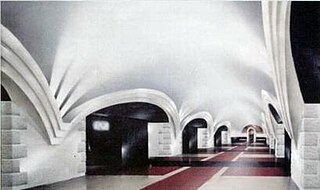
Lvivska Brama is a station on the Syretsko-Pecherska Line of the Kiev Metro between the stations Lukianivska and Zoloti Vorota, that was built but never opened.

Target Field Station is a multimodal commuter train and light rail station in Minneapolis, Minnesota. Located in the North Loop area of Downtown Minneapolis, the station is named for Target Field, the Minnesota Twins baseball stadium. METRO Blue Line light rail service started November 14, 2009; Northstar Line commuter rail service started November 16, 2009; METRO Green Line light rail service started on June 14, 2014.

Vasylkivska is station on Kiev Metro's Obolonsko–Teremkivska Line. It is named after the street which leads to Vasylkiv, south-west to capital Kiev. The station was opened on 15 December 2010.

Holosiivska is the second station on the Kiev Metro's Obolonsko–Teremkivska Line's Holosiiv-Teremky extension. It opened on December 15, 2010. The station is situated in the Holosiiv Raion near the Holosiivska Square.

Ipodrom is a station on the Kiev Metro's Obolonsko–Teremkivska Line that opened on 25 October 2012. It is located towards the southern end of the line, located just after the Vystavkovyi Tsentr station, opened a year earlier in late 2011, and before the Teremky station which opened on 6 November 2013.

Teremky is a station on the Kiev Metro's Obolonsko–Teremkivska Line opened on 6 November 2013. It is the southern end of the line, located just after the Ipodrom station. The station is named after the Teremky neighborhood of Kiev.

34th Street–Hudson Yards is a New York City Subway station in Manhattan's West Side on the IRT Flushing Line, and is the western terminus for the 7 local and <7> express services. It has two tracks and one island platform, with two levels of mezzanines: one directly above the platform and the other directly below street level. The station directly serves the Hudson Yards mega-development above it, and is located within the greater Hudson Yards neighborhood. The station contains two entrances along Hudson Boulevard: a primary entrance south of 34th Street, and a secondary entrance south of 35th Street.

The Edmonton LRT Capital Line is a light rail transit line running from northeast Edmonton to the south. Operated by the Edmonton Transit System, the line provides access to Downtown Edmonton and the University of Alberta. The Capital Line currently consists of fifteen stations, six of which are underground. Seven stations are shared with the Metro Line.

Teremky is a neighborhood located in the Holosiiv Raion (district) of Kiev, the capital of Ukraine. It is located in the southern part of the city, in between the city's Holosiiv, Feofaniya, and Zhuliany neighborhoods.