Espionage, spying, or intelligence gathering is the act of obtaining secret or confidential information (intelligence). A person who commits espionage is called an espionage agent or spy. Any individual or spy ring, in the service of a government, company, criminal organization, or independent operation, can commit espionage. The practice is clandestine, as it is by definition unwelcome. In some circumstances, it may be a legal tool of law enforcement and in others, it may be illegal and punishable by law.

Cold War espionage describes the intelligence gathering activities during the Cold War between the Western allies and the Eastern Bloc. Both relied on a wide variety of military and civilian agencies in this pursuit.

Operation Paperclip was a secret United States intelligence program in which more than 1,600 German scientists, engineers, and technicians were taken from the former Nazi Germany to the U.S. for government employment after the end of World War II in Europe, between 1945–59. Some were former members and leaders of the Nazi Party.

SMERSH was an umbrella organization for three independent counter-intelligence agencies in the Red Army formed in late 1942 or even earlier, but officially announced only on 14 April 1943. The name SMERSH was coined by Joseph Stalin. The formal justification for its creation was to subvert German attempts to infiltrate the Red Army on the Eastern Front.

Operation Gold was a joint operation conducted by the American Central Intelligence Agency (CIA) and the British MI6 Secret Intelligence Service (SIS) in the 1950s to tap into landline communication of the Soviet Army headquarters in Berlin using a tunnel into the Soviet-occupied zone. This was a much more complex variation of the earlier Operation Silver project in Vienna.
A sleeper agent is a spy or operative who is placed in a target country or organization, not to undertake an immediate mission, but instead to act as a potential asset on short notice if activated. Even if not activated, the "sleeper agent" is still an asset and can still play an active role in sedition, espionage, or possibly treason by virtue of agreeing to act if activated. A team of sleeper agents may be referred to as a sleeper cell. A sleeper cell or agent may possibly be working with others in a clandestine cell system.

Oleg Vladimirovich Penkovsky, codenamed Hero and Yoga was a Soviet military intelligence (GRU) colonel during the late 1950s and early 1960s. Penkovsky informed the United States and the United Kingdom about Soviet military secrets, including the appearance and footprint of Soviet intermediate-range ballistic missile installations and the weakness of the Soviet intercontinental ballistic missile program. This information was decisive in allowing the US to recognize that the Soviets were placing missiles in Cuba before most of them were operational. It also gave US President John F. Kennedy, during the Cuban Missile Crisis that followed, valuable information about Soviet weakness that allowed him to face down Soviet leader Nikita Khrushchev and resolve the crisis without a nuclear war.
Operation Ivy Bells was a joint United States Navy, Central Intelligence Agency (CIA), and National Security Agency (NSA) mission whose objective was to place wire taps on Soviet underwater communication lines during the Cold War.
The British Commanders'-in-Chief Mission to the Soviet Forces in Germany (BRIXMIS) was a military liaison mission which operated behind the Iron Curtain in East Germany during the Cold War.

The military liaison missions arose from reciprocal agreements formed between the Western allied nations and the USSR, shortly after the end of the Second World War. The missions were active from 1946 until 1990.
The Central Intelligence Agency, known informally as the Agency and historically as the Company, is a civilian foreign intelligence service of the federal government of the United States, officially tasked with gathering, processing, and analyzing national security information from around the world, primarily through the use of human intelligence (HUMINT) and conducting covert action through its Directorate of Operations. As a principal member of the United States Intelligence Community (IC), the CIA reports to the Director of National Intelligence and is primarily focused on providing intelligence for the President and Cabinet of the United States. Following the dissolution of the Office of Strategic Services (OSS) at the end of World War II, President Harry S. Truman created the Central Intelligence Group under the direction of a Director of Central Intelligence by presidential directive on January 22, 1946, and this group was transformed into the Central Intelligence Agency by implementation of the National Security Act of 1947.
James W. Hall III is a former United States Army warrant officer and signals intelligence analyst in Germany who sold eavesdropping and code secrets to East Germany and the Soviet Union from 1983 to 1988.

Lieutenant-Commander Lionel Kenneth Phillip Crabb,, known as Buster Crabb, was a Royal Navy frogman and diver who vanished during a reconnaissance mission for MI6 around a Soviet cruiser berthed at Portsmouth Dockyard in 1956.

An aircraft lavatory or plane toilet is a small room on an aircraft with a toilet and sink. They are commonplace on passenger flights except some short-haul flights. Aircraft toilets were historically chemical toilets, but many now use a vacuum flush system instead.
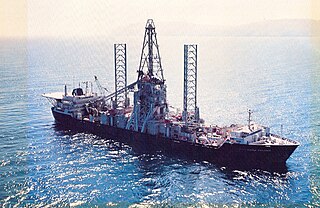
Project Azorian was a U.S. Central Intelligence Agency (CIA) project to recover the sunken Soviet submarine K-129 from the Pacific Ocean floor in 1974 using the purpose-built ship Hughes Glomar Explorer. The 1968 sinking of K-129 occurred approximately 1,600 miles (2,600 km) northwest of Hawaii. Project Azorian was one of the most complex, expensive, and secretive intelligence operations of the Cold War at a cost of about $800 million, or $4.7 billion today.
The Committee for State Security (CSS) was the main security agency for the Soviet Union from 13 March 1954 until 3 December 1991. As a direct successor of preceding agencies such as the Cheka, GPU, OGPU, NKGB, NKVD and MGB, it was attached to the Council of Ministers. It was the chief government agency of "union-republican jurisdiction", carrying out internal security, foreign intelligence, counter-intelligence and secret police functions. Similar agencies operated in each of the republics of the Soviet Union aside from the Russian SFSR, where the KGB was headquartered, with many associated ministries, state committees and state commissions.

Pakistan was alleged to have provided support for Osama bin Laden. These claims have been made both before and after Osama was found living in a compound in Abbottabad, Pakistan and was killed by a team of United States Navy SEALs on 2 May 2011. The compound itself was located just half a mile from Pakistan's premier military training academy Kakul Military Academy (PMA) in Abbottabad. In the aftermath of bin Laden's death, American president Barack Obama asked Pakistan to investigate the network that sustained bin Laden. "We think that there had to be some sort of support network for bin Laden inside of Pakistan", Obama said in a 60 Minutes interview with CBS News. He also added that the United States was not sure "who or what that support network was." In addition to this, in an interview with Time magazine, CIA Director Leon Panetta stated that US-officials did not alert Pakistani counterparts to the raid because they feared the terrorist leader would be warned. However, the documents recovered from bin Laden's compound 'contained nothing to support the idea that bin Laden was protected or supported by the Pakistani officials'. Instead, the documents contained criticism of Pakistani military and future plans for attack against the Pakistani military installations.

The Secret Intelligence Service (SIS), commonly known as MI6, is the foreign intelligence service of the United Kingdom, tasked mainly with the covert overseas collection and analysis of human intelligence on foreign nationals in support of its Five Eyes partners. SIS is one of the British intelligence agencies and the Chief of the Secret Intelligence Service ("C") is directly accountable to the Foreign Secretary.

Team Sone Pet (Diamond Arrow) was the code name for a spying foray directed against the People's Republic of China in 1967 and 1968. This classified military operation in the Kingdom of Laos during the Laotian Civil War was an infiltration of spies into Yunnan Province of the People's Republic of China. The operation was run jointly by Lao General Ouane Rattikone and the Republic of China, using an espionage team recruited by the American Central Intelligence Agency. The first mission in 1967 was successful; however, the second mission in 1968 disappeared.
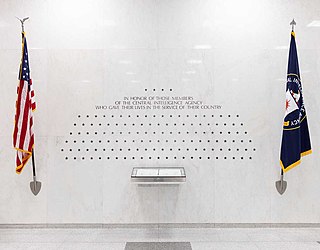
The United States Central Intelligence Agency (CIA) dates from September 18, 1947, when President Harry S. Truman signed the National Security Act of 1947 into law. A major impetus that has been cited over the years for the creation of the CIA was the unforeseen attack on Pearl Harbor, but whatever Pearl Harbor's role, at the close of World War II government circles identified a need for a group to coordinate government intelligence efforts, and the Federal Bureau of Investigation (FBI), the State Department, the War Department, and even the Post Office were all jockeying for that new power.

