Related Research Articles

Delftware or Delft pottery, also known as Delft Blue or as delf, is a general term now used for Dutch tin-glazed earthenware, a form of faience. Most of it is blue and white pottery, and the city of Delft in the Netherlands was the major centre of production, but the term covers wares with other colours, and made elsewhere. It is also used for similar pottery, English delftware.

Orvieto is a city and comune in the Province of Terni, southwestern Umbria, Italy, situated on the flat summit of a large butte of volcanic tuff. The city rises dramatically above the almost-vertical faces of tuff cliffs that are completed by defensive walls built of the same stone.
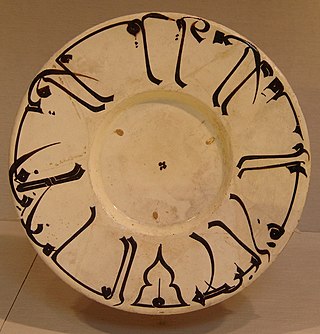
Earthenware is glazed or unglazed nonvitreous pottery that has normally been fired below 1,200 °C (2,190 °F). Basic earthenware, often called terracotta, absorbs liquids such as water. However, earthenware can be made impervious to liquids by coating it with a ceramic glaze, and is used for the great majority of modern domestic earthenware. The main other important types of pottery are porcelain, bone china, and stoneware, all fired at high enough temperatures to vitrify. End applications include tableware and decorative ware such as figurines.

Faience or faïence is the general English language term for fine tin-glazed pottery. The invention of a white pottery glaze suitable for painted decoration, by the addition of an oxide of tin to the slip of a lead glaze, was a major advance in the history of pottery. The invention seems to have been made in Iran or the Middle East before the ninth century. A kiln capable of producing temperatures exceeding 1,000 °C (1,830 °F) was required to achieve this result, the result of millennia of refined pottery-making traditions. The term is now used for a wide variety of pottery from several parts of the world, including many types of European painted wares, often produced as cheaper versions of porcelain styles.

William Frend De Morgan was an English potter, tile designer and novelist. A lifelong friend of William Morris, he designed tiles, stained glass and furniture for Morris & Co. from 1863 to 1872. His tiles often recall medieval or Islamic design patterns. He applied innovative glazes and firing techniques. Galleons and fish were common motifs, as were "fantastical" birds and animals. Many of De Morgan's tiles were designed to create intricate patterns when several were laid together.

In different periods of time and in different countries, the term majolica has been used for two distinct types of pottery.
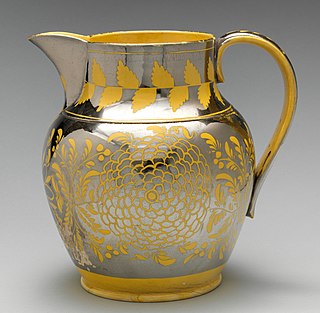
Lustreware or lusterware is a type of pottery or porcelain with a metallic glaze that gives the effect of iridescence. It is produced by metallic oxides in an overglaze finish, which is given a second firing at a lower temperature in a "muffle kiln", or a reduction kiln, excluding oxygen.

Armorial ware or heraldic china are ceramics decorated with a coat of arms, either that of a family, or an institution or place. Armorials have been popular on European pottery from the Middle Ages with examples seen on Spanish Hispano-Moresque ware, Italian maiolica, slipware, English and Dutch Delft, and on porcelain from the 18th century. Earlier examples were mostly large pieces such as jugs or basins and ewers, but later whole table services, all painted with the arms, were produced.

Islamic pottery occupied a geographical position between Chinese ceramics, the unchallenged leaders of Eurasian production, and the pottery of the Byzantine Empire and Europe. For most of the period, it can fairly be said to have been between the two in terms of aesthetic achievement and influence as well, borrowing from China and exporting to and influencing Byzantium and Europe. The use of drinking and eating vessels in gold and silver, the ideal in ancient Rome and Persia as well as medieval Christian societies, is prohibited by the Hadiths, with the result that pottery and glass were used for tableware by Muslim elites, as pottery also was in China but was much rarer in Europe and Byzantium. In the same way, Islamic restrictions greatly discouraged figurative wall painting, encouraging the architectural use of schemes of decorative and often geometrically patterned titles, which are the most distinctive and original specialty of Islamic ceramics.

Maiolica is tin-glazed pottery decorated in colours on a white background. The most renowned Italian maiolica is from the Renaissance period. These works were known as istoriato wares when depicting historical and mythical scenes. By the late 15th century, multiple locations, mainly in northern and central Italy, were producing sophisticated pieces for a luxury market in Italy and beyond. In France, maiolica developed as faience, in the Netherlands and England as delftware, and in Spain as talavera. In English, the spelling was anglicised to majolica, but the pronunciation usually preserved the vowel with an i as in kite.

Hispano-Moresque ware is a style of initially Islamic pottery created in Al-Andalus, which continued to be produced under Christian rule in styles blending Islamic and European elements. It was the most elaborate and luxurious pottery being produced in Europe until the Italian maiolica industry developed sophisticated styles in the 15th century, and was exported over most of Europe. The industry's most successful period was the 14th and 15th centuries.

Tin-glazing is the process of giving tin-glazed pottery items a ceramic glaze that is white, glossy and opaque, which is normally applied to red or buff earthenware. Tin-glaze is plain lead glaze with a small amount of tin oxide added. The opacity and whiteness of tin glaze encourage its frequent decoration. Historically this has mostly been done before the single firing, when the colours blend into the glaze, but since the 17th century also using overglaze enamels, with a light second firing, allowing a wider range of colours. Majolica, maiolica, delftware and faience are among the terms used for common types of tin-glazed pottery.

Praiano is a town and comune of the province of Salerno in the Campania region of southwest Italy. It is situated on the Amalfi Coast, a prime tourist location for the region and Italy alike, between the towns of Amalfi and Positano.

Ceramic glaze, or simply glaze, is a glassy coating on ceramics. It is used for decoration, to ensure the item is impermeable to liquids and to minimise the adherence of pollutants.

Bucchero is a class of ceramics produced in central Italy by the region's pre-Roman Etruscan population. This Italian word is derived from the Latin poculum, a drinking-vessel, perhaps through the Spanish búcaro, or the Portuguese púcaro.

Alan Caiger-Smith MBE was a British ceramicist, studio potter and writer on pottery.
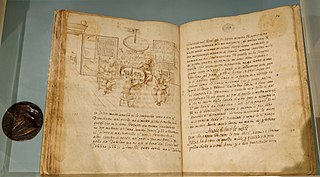
Cipriano di Michele Piccolpasso was a member of an Italian patrician family of Bologna that had been settled since the mid-fifteenth century in Castel Durante, which was an important center for the manufacture of maiolica. Today he is remembered for writing Li tre libri dell'arte del vasajo, which are a storehouse of information on the techniques of maiolica from the choice of clays and their refinement, the shaping of the body, the composition of the glazes, to the preparation of the colors. The work "is now widely accepted as the first comprehensive account of the manufacture of any kind of pottery ever produced in Europe".
Victorian majolica properly refers to two types of majolica made in the second half of the 19th century in Europe and America.
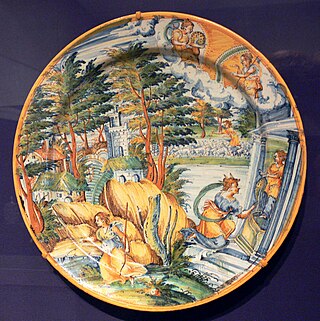
Tin-glazed pottery is earthenware covered in lead glaze with added tin oxide which is white, shiny and opaque ; usually this provides a background for brightly painted decoration. It has been important in Islamic and European pottery, but very little used in East Asia. The pottery body is usually made of red or buff-colored earthenware and the white glaze imitated Chinese porcelain. The decoration on tin-glazed pottery is usually applied to the unfired glaze surface by brush with metallic oxides, commonly cobalt oxide, copper oxide, iron oxide, manganese dioxide and antimony oxide. The makers of Italian tin-glazed pottery from the late Renaissance blended oxides to produce detailed and realistic polychrome paintings.

Lead-glazed earthenware is one of the traditional types of earthenware with a ceramic glaze, which coats the ceramic bisque body and renders it impervious to liquids, as terracotta itself is not. Plain lead glaze is shiny and transparent after firing. Coloured lead glazes are shiny and either translucent or opaque after firing. Three other traditional techniques are tin-glazed, which coats the ware with an opaque white glaze suited for overglaze brush-painted colored enamel designs; salt glaze pottery, also often stoneware; and the feldspathic glazes of Asian porcelain. Modern materials technology has invented new glazes that do not fall into these traditional categories.
References
- 1 2 3 M. L. Solon (1909). The Ceramic Art of Orvieto during the Thirteenth and Fourteenth Centuries. The Burlington Magazine for Connoisseurs , 16 (79): 10–13, 16–17 JSTOR 858137
- 1 2 David M. Whitehouse (1978). The Origins of Italian Maiolica. Archaeology 31 (2): 42–49 JSTOR 41726560
- ↑ David Whitehouse (1976). Ceramica Laziale. Papers of the British School at Rome 44: 157–170 JSTOR 40310740
 | This ceramic art and design-related article is a stub. You can help Wikipedia by expanding it. |
 | This article related to the art of Italy is a stub. You can help Wikipedia by expanding it. |