The Basques are a Southwestern European ethnic group, characterised by the Basque language, a common culture and shared genetic ancestry to the ancient Vascones and Aquitanians. Basques are indigenous to, and primarily inhabit, an area traditionally known as the Basque Country —a region that is located around the western end of the Pyrenees on the coast of the Bay of Biscay and straddles parts of north-central Spain and south-western France.
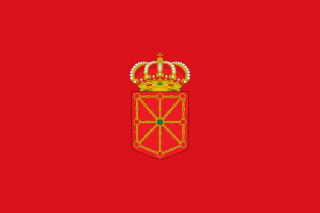
Navarre, officially the Chartered Community of Navarre, is a landlocked foral autonomous community and province in northern Spain, bordering the Basque Autonomous Community, La Rioja, and Aragon in Spain and Nouvelle-Aquitaine in France. The capital city is Pamplona. The present-day province makes up the majority of the territory of the medieval Kingdom of Navarre, a long-standing Pyrenean kingdom that occupied lands on both sides of the western Pyrenees, with its northernmost part, Lower Navarre, located in the southwest corner of France.

Basque nationalism is a form of nationalism that asserts that Basques, an ethnic group indigenous to the western Pyrenees, are a nation and promotes the political unity of the Basques, today scattered between Spain and France. Since its inception in the late 19th century, Basque nationalism has included Basque independence movements.
The Basque Country is the name given to the home of the Basque people. The Basque Country is located in the western Pyrenees, straddling the border between France and Spain on the coast of the Bay of Biscay.

Lower Navarre is a traditional region of the present-day French département of Pyrénées-Atlantiques. It corresponds to the northernmost region of the Kingdom of Navarre during the Middle Ages. After the Spanish conquest of Iberian Navarre (1512–24), this merindad was restored to the rule of the native king, Henry II. Its capitals were Saint-Jean-Pied-de-Port and Saint-Palais. In the extreme north there was the little sovereign Principality of Bidache, with an area of 1,284 km2 (496 sq mi) and a decreasing population of 44,450, 25,356.

Labourd is a former French province and part of the present-day Pyrénées Atlantiques département of Nouvelle-Aquitaine region. It is one of the traditional Basque provinces, and identified as one of the territorial component parts of the Basque Country by many, especially by the Basque nationalists.

The Kingdom of Navarre, originally the Kingdom of Pamplona occupied lands on both sides of the western Pyrenees, with its northernmost areas originally reaching the Atlantic Ocean, between present-day Spain and France.

Fuero, Fur, Foro or Foru is a Spanish legal term and concept. The word comes from Latin forum, an open space used as a market, tribunal and meeting place. The same Latin root is the origin of the French terms for and foire, and the Portuguese terms foro and foral; all of these words have related, but somewhat different meanings.

The Navarrese People's Union, abbreviated to UPN, is a regional conservative political party in Navarre, Spain. Until 2008, it was a fraternal party of the People's Party (PP), acting as the latter's Navarrese branch.

Patxaran is a sloe-flavoured liqueur commonly drunk in Navarre, as well as in the Basque Country. It is usually served as a digestif either chilled or on ice.

Ainhoa is a commune in the Pyrénées-Atlantiques department in the Nouvelle-Aquitaine region in southwestern France. It is a member of Les Plus Beaux Villages de France Association.
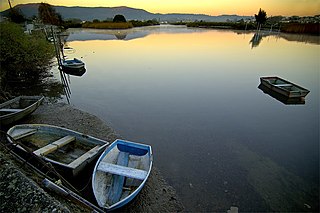
The Bidasoa is a river in the Basque Country of northern Spain and southern France that runs largely south to north. Named as such downstream of the village of Oronoz-Mugairi in the province of Navarre, the river actually results from the merger of several streams near the village Erratzu, with the stream Baztan that rises at the north-eastern side of the mount Autza being considered the source of the Bidasoa. It joins the Cantabrian Sea between the towns of Hendaye and Hondarribia.
Gipuzkoan is a dialect of the Basque language spoken mainly in the central and eastern parts of the province of Gipuzkoa in Basque Country and also in the northernmost part of Navarre. It is a central dialect of Basque according to the traditional dialectal classification of the language based on research carried out by Lucien Bonaparte in the 19th century. He included varieties spoken in the Sakana and Burunda valleys also in the Gipuzkoan dialect, however this approach has been disputed by modern Basque linguists.
Upper Navarrese is a dialect of the Basque language spoken in the Navarre community of Spain, as established by linguist Louis Lucien Bonaparte in his famous 1869 map. He actually distinguished two dialects: Meridional and Septentrional. However, the southern varieties became extinct early in the 20th century mainly after becoming absorbed by Northern Spanish or Aragonese. So documentation of the Meridional subgroup is rendered impossible. It is unknown whether the extinction was due to Francisco Franco's fierce suppression of Basque culture.
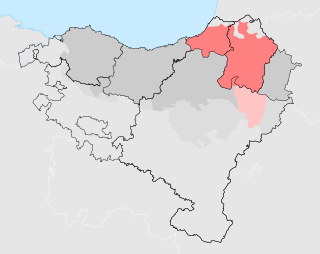
Navarro-Labourdin or Navarro-Lapurdian is a Basque dialect spoken in the Lower Navarre and Labourd (Lapurdi) former provinces of the French Basque Country. It consists of two dialects in older classifications, Lower Navarrese and Labourdin. It differs somewhat from Upper Navarrese spoken in the Peninsular Basque Country.

The Southern Basque Country refers to the Basque territories southside of the Pyrenees, within the iberian peninsula.

Basque dialects are linguistic varieties of the Basque language which differ in pronunciation, vocabulary and grammar from each other and from Standard Basque. Between six and nine Basque dialects have been historically distinguished:

Navarro-Aragonese was a Romance language once spoken in a large part of the Ebro River basin, south of the middle Pyrenees; the dialects of the modern Aragonese language, spoken in a small portion of that territory, and the Navarrese dialect can be seen as its last remaining forms. The areas where Navarro-Aragonese was spoken might have included most of Aragon, southern Navarre, and La Rioja. It was also spoken across several towns of central Navarre in a multilingual environment with Occitan, where Basque was the native language.

United Left of Navarre is the Navarrese federation of the Spanish left-wing political and social movement United Left. José Miguel Nuin Moreno is the current General Coordinator. The major member of the coalition is the Communist Party of Euskadi.

Navarrese nationalism is a political and social movement that claims Navarre to be a nation.