
Proposition 215, or the Compassionate Use Act of 1996, is a California law permitting the use of medical cannabis despite marijuana's lack of the normal Food and Drug Administration testing for safety and efficacy. It was enacted, on November 5, 1996, by means of the initiative process, and passed with 5,382,915 (55.6%) votes in favor and 4,301,960 (44.4%) against.

The Emerald Triangle is a region in Northern California that derives its name from being the largest cannabis-producing region in the United States. The region includes three counties in an upside-down triangular configuration:
Oaksterdam is a cultural district on the north end of Downtown Oakland, California, where medical cannabis is available for purchase in cafés, clubs, and patient dispensaries. Oaksterdam is located between downtown proper, the Lakeside, and the financial district. It is roughly bordered by 14th Street on the southwest, Harrison Street on the southeast, 19th Street on the northeast, and Telegraph Avenue on the northwest. The name is a portmanteau of "Oakland" and "Amsterdam," due to the Dutch city's cannabis coffee shops and the drug policy of the Netherlands.

Dennis Robert Peron was an American activist and businessman who became a leader in the movement for the legalization of cannabis throughout the 1990s. He influenced many in California and thus changed the political debate on marijuana in the United States.

Dana Albert Larsen is a Canadian author, businessman, philanthropist and activist for cannabis and drug policy reform. Larsen currently operates businesses and non-profit societies in Vancouver including The Medicinal Cannabis Dispensary, The Medicinal Mushroom Dispensary, The Coca Leaf Cafe, Pothead Books, and the Get Your Drugs Tested centre.
Valerie Leveroni Corral is an American medical cannabis activist and writer. As a young adult she experienced a traumatic head injury that left her with a seizure disorder that antiepileptic medication could not ameliorate. Her experimental use of cannabis to treat her seizures led her to grow it on her property in Santa Cruz, California. In 1992, she was arrested for cannabis cultivation, becoming the first person in that state to argue the medical necessity defense. Following her success, she founded the Wo/Men's Alliance for Medical Marijuana (WAMM) and was a coauthor of Proposition 215, the first medical cannabis state ballot initiative to pass in the United States.

Cannabis in Oregon is legal for both medical and recreational use. In recent decades, the U.S. state of Oregon has had a number of legislative, legal and cultural events surrounding the use of cannabis. Oregon was the first state to decriminalize the possession of small amounts of cannabis and authorize its use for medical purposes. An attempt to recriminalize the possession of small amounts of cannabis was turned down by Oregon voters in 1997.
Oaksterdam University is an unaccredited trade school located in Oakland, California. It was founded in 2007 by marijuana rights activist Richard Lee. The school offers asynchronous, online, and in-person courses covering cannabis horticulture, the business of cannabis, cannabis extraction and manufacturing, and bud-tending.

Cannabis in California has been legal for medical use since 1996, and for recreational use since late 2016. The state of California has been at the forefront of efforts to liberalize cannabis laws in the United States, beginning in 1972 with the nation's first ballot initiative attempting to legalize cannabis. Although it was unsuccessful, California would later become the first state to legalize medical cannabis through the Compassionate Use Act of 1996, which passed with 56% voter approval. In November 2016, California voters approved the Adult Use of Marijuana Act with 57% of the vote, which legalized the recreational use of cannabis.
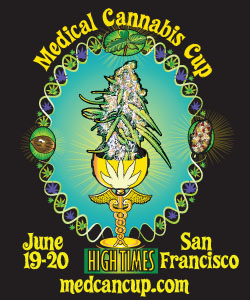
The High TimesMedical Cannabis Cup is an annual event celebrating medical marijuana. The first Medical Cannabis Cup took place in San Francisco, California, on June 19–20, 2010.

Leafly is a website focused on cannabis use and education. The company says it has more than 120 million annual visitors and over 10 million monthly active users. Leafly provides a wide range of information on cannabis including 1.5 million consumer product reviews, more than 9,000 cannabis articles and resources, and over 5,000 verified strains in its database. Leafly additionally provides 4,500+ retailers and 8,000+ cannabis brands with e-commerce tools such as digital storefronts, embedded menus, point-of-sale integrations, targeted advertising, and more. The company is headquartered in Seattle, Washington and from 2012 to 2019 was owned by Privateer Holdings, a private equity firm focused on the emerging legal cannabis industry. Leafly is now a publicly traded company with 160 employees.

Cannabis in Massachusetts is legal for medical and recreational use. It also relates to the legal and cultural events surrounding the use of cannabis. A century after becoming the first U.S. state to criminalize recreational cannabis, Massachusetts voters elected to legalize it in 2016.

Wikileaf Technologies is a Seattle business providing data services to the cannabis industry and information to consumers. The company provides price indexes and cannabis strain reviews and information.

Cannabis on American Indian reservations was historically regulated under United States federal law. However, the August 2013 issuance of the Cole Memorandum opened discussion on tribal sovereignty pertaining to cannabis legalization. A clarifying memo in December 2014 stated that the federal government's non-interference policies that applied to the 50 states, would also apply to the 326 recognized American Indian reservations. Reservations are therefore able to independently regulate cannabis possession and sale irrespective of laws in any bordering US states.

Cannabis in Arkansas is illegal for recreational use. First-time possession of up to four ounces (110 g) is punished with a fine of up to $2,500, imprisonment of up to a year, and a mandatory six month driver's license suspension. Medical use was legalized in 2016 by way of a ballot measure to amend the state constitution.
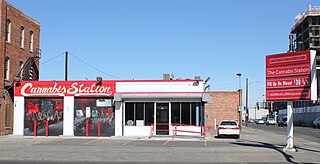
Cannabis dispensaries in the United States or marijuana dispensaries are a type of cannabis retail outlet, local government-regulated physical location, typically inside a retail storefront or office building, in which a person can purchase cannabis and cannabis-related items for medical or recreational use.

A cannabis retail outlet is a location at which cannabis is sold or otherwise dispensed, either for recreational or for medical use.
Cannabis is legal in Illinois for both medical and recreational use. Illinois became the eleventh state in the US to legalize recreational marijuana effective January 1, 2020.

Cannabis in Washington relates to a number of legislative, legal, and cultural events surrounding the use of cannabis. On December 6, 2012, Washington became the first U.S. state to legalize recreational use of marijuana and the first to allow recreational marijuana sales, alongside Colorado. The state had previously legalized medical marijuana in 1998. Under state law, cannabis is legal for medical purposes and for any purpose by adults over 21.

The COVID-19 pandemic had a significant impact on the cannabis industry. Investor's Business Daily said the industry was affected as "customers stock up on prescriptions and recreational customers load up on something to make the lockdown a little more mellow or a little less boring".
