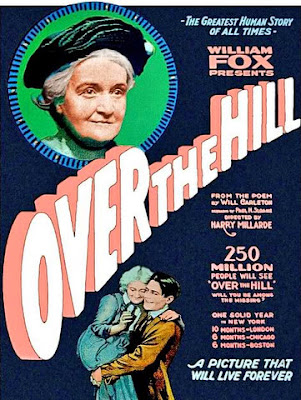
| Over the Hill to the Poorhouse | |
|---|---|
 Film still with Carr and her children | |
| Directed by | Harry Millarde |
| Written by | Paul H. Sloane (scenario) |
| Based on | poems "Over the Hill to the Poorhouse" and "Over the Hill from the Poorhouse" by Will Carleton |
| Produced by | William Fox |
| Starring | Mary Carr |
| Cinematography | Hal Sintzenich George Schneiderman |
| Music by | Edgar Allen Maurie Rubens Lou Klein (lyrics) |
| Distributed by | Fox Film Corporation |
Release date |
|
Running time | 11 reels |
| Country | United States |
| Language | Silent (English intertitles) |
| Budget | $50,000 [1] |
| Box office | $2.5 million [1] |
Over the Hill to the Poorhouse, also known as Over the Hill, is a 1920 American silent drama film about a woman who has a lot of children, and who never gets the chance to enjoy life. The film starred actress Mary Carr and almost all of her real-life children. [2]
Contents
The film was directed by Harry Millarde, released by Fox Film Corporation, and was a box office success in 1920.
The story was previously filmed as Over the Hill to the Poorhouse (1908), starring Florence Auer. It was remade as Over the Hill (1931), starring Mae Marsh, and as Tears of a Mother (1937). The 1920 silent film is preserved at Bois d'Arcy in France. [3] [4]
The film cost $50,000 to make with an additional $200,000 in marketing. [1]