Related Research Articles
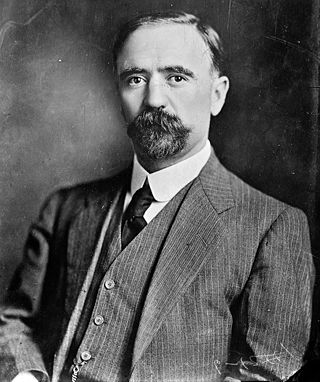
Francisco Ignacio Madero González was a Mexican businessman, revolutionary, writer and statesman, who served as the 37th president of Mexico from 1911 until he was deposed in a coup d'état in February 1913 and assassinated. He came to prominence as an advocate for democracy and as an opponent of President and de facto dictator Porfirio Díaz. After Díaz claimed to have won the fraudulent election of 1910 despite promising a return to democracy, Madero started the Mexican Revolution to oust Díaz. Madero supposedly initiated the Mexican Revolution with guidance from spirits The Mexican revolution would continue until 1920, well after Madero and Díaz's deaths, with hundreds of thousands dead.

Francisco "Pancho" Villa was a general in the Mexican Revolution. He was a key figure in the revolutionary movement that forced out President Porfirio Díaz and brought Francisco I. Madero to power in 1911. When Madero was ousted by a coup led by General Victoriano Huerta in February 1913, he joined the anti-Huerta forces in the Constitutionalist Army led by Venustiano Carranza. After the defeat and exile of Huerta in July 1914, Villa broke with Carranza. Villa dominated the meeting of revolutionary generals that excluded Carranza and helped create a coalition government. Emiliano Zapata and Villa became formal allies in this period. Like Zapata, Villa was strongly in favor of land reform, but did not implement it when he had power. At the height of his power and popularity in late 1914 and early 1915, the U.S. considered recognizing Villa as Mexico's legitimate authority.
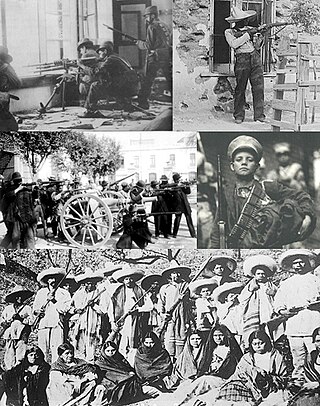
The Mexican Revolution was an extended sequence of armed regional conflicts in Mexico from 20 November 1910 to 1 December 1920. It has been called "the defining event of modern Mexican history". It resulted in the destruction of the Federal Army and its replacement by a revolutionary army, and the transformation of Mexican culture and government. The northern Constitutionalist faction prevailed on the battlefield and drafted the present-day Constitution of Mexico, which aimed to create a strong central government. Revolutionary generals held power from 1920 to 1940. The revolutionary conflict was primarily a civil war, but foreign powers, having important economic and strategic interests in Mexico, figured in the outcome of Mexico's power struggles; the U.S. involvement was particularly high. The conflict led to the deaths of around one million people, mostly noncombatants.

José Victoriano Huerta Márquez was a general in the Mexican Federal Army and 39th President of Mexico, who came to power by coup against the democratically elected government of Francisco I. Madero with the aid of other Mexican generals and the U.S. Ambassador to Mexico. His violent seizure of power set off a new wave of armed conflict in the Mexican Revolution.
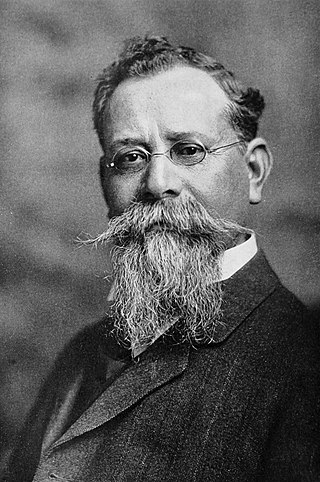
José Venustiano Carranza de la Garza was a Mexican land owner and liberal politician who served as President of Mexico from 1917 until his assassination in 1920, during the Mexican Revolution. He was previously Mexico's de facto head of state as Primer Jefe of the Constitutionalist faction from 1914 to 1917, and previously served as a senator and governor for Coahuila. He played the leading role in drafting the Constitution of 1917 and maintained Mexican neutrality in World War I.

Gustavo Adolfo Madero González, born in Parras de la Fuente, Coahuila, Mexico, was a participant in the Mexican Revolution against Porfirio Díaz along with other members of his wealthy family. He was also known as "Ojo Parado" since he had one glass eye.

Francisco León de la Barra y Quijano was a Mexican political figure and diplomat who served as the 36th President of Mexico from May 25 to November 6, 1911 during the Mexican Revolution, following the resignations of President Porfirio Díaz and Vice President Ramón Corral. He previously served as Secretary of Foreign Affairs for one month during the Díaz administration and again from 1913 to 1914 under President Victoriano Huerta. He was known to conservatives as "The White President" or the "Pure President."

Henry Lane Wilson was an American attorney, journalist, and diplomat who served successively as United States Minister to Chile (1897–1904), Minister to Belgium (1905–09), and Ambassador to Mexico (1909–13). He is best known to history for his involvement in the February 1913 coup d'etat which deposed and assassinated President of Mexico Francisco I. Madero, for which he remains controversial and "perhaps the most vilified United States official of [the 20th] century" in Mexico.
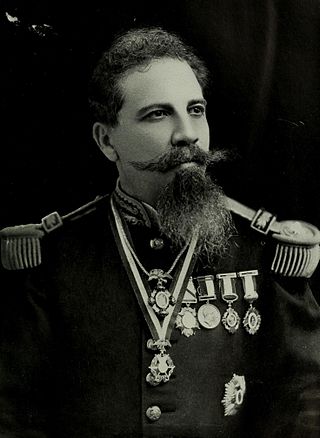
Bernardo Doroteo Reyes Ogazón was a Mexican general and politician, with aspirations to be President of Mexico. He died in a coup d'état against President Francisco I. Madero. Born in a prominent liberal family in the western state of Jalisco, he served in the army, rising to the rank of general. Like his political patron, General and then President Porfirio Díaz, Reyes was a military man who became an able administrator. Reyes was one of the state governors that Díaz appointed, serving as governor of the northern state of Nuevo León. He implemented Porfirian policy, particularly eliminating political rivals, but also building his own power base. He helped in the modernization of that state, enabling local industrialization, improving public education and health, and supporting improvements in the lives of workers. While governor of Nuevo León, Reyes approved a workers compensation law. Followers of Reyes were known as Reyistas.

Abraham González de Hermosillo y Casavantes was the provisional and constitutional governor of the Mexican state of Chihuahua during the early period of the Mexican Revolution. He was the political mentor of the revolutionary Pancho Villa, whom he had met and befriended before the revolution.

The Liberation Army of the South was a guerrilla force led for most of its existence by Emiliano Zapata that took part in the Mexican Revolution from 1911 to 1920. During that time, the Zapatistas fought against the national governments of Porfirio Díaz, Francisco Madero, Victoriano Huerta, and Venustiano Carranza. Their goal was rural land reform, specifically reclaiming communal lands stolen by hacendados in the period before the revolution. Although rarely active outside their base in Morelos, they allied with Pancho Villa to support the Conventionists against the Carrancistas. After Villa's defeat, the Zapatistas remained in open rebellion. It was only after Zapata's 1919 assassination and the overthrow of the Carranza government that Zapata's successor, Gildardo Magaña, negotiated peace with President Álvaro Obregón.

Félix Díaz Prieto was a Mexican politician and general born in Oaxaca, Oaxaca. He was a leading figure in the rebellion against President Francisco I. Madero during the Mexican Revolution. He was the nephew of president Porfirio Díaz.

The Mexican Federal Army, also known as the Federales in popular culture, was the military of Mexico from 1876 to 1914 during the Porfiriato, the long rule of President Porfirio Díaz, and during the presidencies of Francisco I. Madero and Victoriano Huerta. Under President Díaz, a military hero against the French Intervention in Mexico, the Federal Army was composed of senior officers who had served in long ago conflicts. At the time of the outbreak of the Mexican Revolution most were old men and incapable of leading men on the battlefield. When the rebellions broke out against Díaz following fraudulent elections of 1910, the Federal Army was incapable of responding. Although revolutionary fighters helped bring Francisco I. Madero to power, Madero retained the Federal Army rather than the revolutionaries. Madero used the Federal Army to suppress rebellions against his government by Pascual Orozco and Emiliano Zapata. Madero placed General Victoriano Huerta as interim commander of the military during the Ten Tragic Days of February 1913 to defend his government. Huerta changed sides and ousted Madero's government. Rebellions broke out against Huerta's regime. When revolutionary armies succeeded in ousting Huerta in July 1914, the Federal Army ceased to exist as an entity, with the signing of the Teoloyucan Treaties.

The United States involvement in the Mexican Revolution was varied and seemingly contradictory, first supporting and then repudiating Mexican regimes during the period 1910–1920. For both economic and political reasons, the U.S. government generally supported those who occupied the seats of power, but could withhold official recognition. The U.S. supported the regime of Porfirio Díaz after initially withholding recognition since he came to power by coup. In 1909, Díaz and U.S. President Taft met in Ciudad Juárez, across the border from El Paso, Texas. Prior to Woodrow Wilson's inauguration on March 4, 1913, the U.S. Government focused on just warning the Mexican military that decisive action from the U.S. military would take place if lives and property of U.S. nationals living in the country were endangered. President William Howard Taft sent more troops to the US-Mexico border but did not allow them to intervene directly in the conflict, a move which Congress opposed. Twice during the Revolution, the U.S. sent troops into Mexico, to occupy Veracruz in 1914 and to northern Mexico in 1916 in a failed attempt to capture Pancho Villa. U.S. foreign policy toward Latin America was to assume the region was the sphere of influence of the U.S., articulated in the Monroe Doctrine. However the U.S. role in the Mexican Revolution has been exaggerated. It did not directly intervene in the Mexican Revolution in a sustained manner.

The Ten Tragic Days during the Mexican Revolution is the name given to the multi-day coup d'état in Mexico City by opponents of Francisco I. Madero, the democratically elected president of Mexico, between 9-19 February 1913. It instigated a second phase of the Mexican Revolution, after dictator Porfirio Díaz had been ousted and replaced in elections by Francisco I. Madero. The coup was carried out by general Victoriano Huerta and supporters of the old regime, with support from the United States.
Manuel Peláez Gorrochotegui (1885–1959) Mexican military officer, noteworthy for his participation in the Mexican Revolution of 1910 to 1920.

Paul von Hintze was a German naval officer, diplomat, and politician who served as Foreign Minister of Germany in the last stages of World War I, from July to October 1918.

The Ypiranga Incident occurred on April 21, 1914, at the port of Veracruz in Mexico during the Mexican Revolution. The SS Ypiranga was a German steamer that was commissioned to transport arms and munitions to the Mexican federal government under Victoriano Huerta. The United States had placed Mexico under an arms embargo to stifle the flow of weaponry to the war-torn state, then in the throes of civil war, forcing Huerta's government to look to Europe and Japan for armaments.
Felix A. Sommerfeld was a German secret service agent in Mexico and the United States between 1908 and 1919. He was chief of the Mexican secret service under President Francisco I. Madero, worked as a diplomat and arms buyer for Venustiano Carranza and Francisco "Pancho" Villa, and ran the Mexican portion of Germany's war strategy in North America between 1914 and 1917.
In the history of Mexico, the Pact of Torreón was a plan drawn up during the Mexican Revolution in early July 1914 by generals of the Constitutionalist Army in the important northern city of Torreón, Coahuila. The pact was framed as a modification of Venustiano Carranza’s 1913 Plan of Guadalupe, which was a narrow political plan. The pact called for a constitutional convention to revise the 1857 Mexican Constitution. It excluded commanders in the Constitutionalist Army from running for the presidency of the republic in the future. It called for the end of the Federal Army, at the time commanded by former general, now president of Mexico, Victoriano Huerta. The Pact of Torreón added to Plan of Guadalupe language that was more radical than Carranza’s, prompting Carranza to issue "Additions to the Plan of Guadalupe".
References
- ↑ Zolov, Eric. "Henry Lane Wilson". Encyclopedia of Mexico , 1607-08.
- ↑ Katz, Friedrich. The Secret War in Mexico: Europe, the United States, and the Mexican Revolution. Chicago: University of Chicago Press 1981.
- ↑ Grieb, Kenneth J. "The Pact of the Embassy". Encyclopedia of Latin American History and Culture , v. 4, 261.
- ↑ Holden, Robert H. "Introduction to 'Pact of the Embassy'", Latin America and the United States: A Documentary History. New York: Oxford University Press 2011, 101
- ↑ Katz, The Secret War in Mexico, 108.
- ↑ Henderson, Peter V.N. "Félix Díaz". Encyclopedia of Mexico , 405.