
The Via del Corso is a main street in the historical centre of Rome. It is straight in an area otherwise characterized by narrow meandering alleys and small piazzas. Considered a wide street in ancient times, the Corso is approximately 10 metres wide, and it only has room for two lanes of traffic and two narrow sidewalks. The northern portion of the street is a pedestrian area. The length of the street is roughly 1.5 kilometres.

Turin is a city and an important business and cultural centre in Northern Italy. It is the capital city of Piedmont and of the Metropolitan City of Turin, and was the first Italian capital from 1861 to 1865. The city is mainly on the western bank of the Po River, below its Susa Valley, and is surrounded by the western Alpine arch and Superga hill. The population of the city proper is 843,514, while the population of the urban area is estimated by Eurostat to be 1.7 million inhabitants. The Turin metropolitan area is estimated by the OECD to have a population of 2.2 million.

Villas and palaces in Milan are used to indicate public and private buildings in Milan of particular artistic and architectural value. Milan has always been an important centre with regard to the construction of historical villas and palaces, ranging from the Romanesque to the neo-Gothic, from Baroque to Rococo.
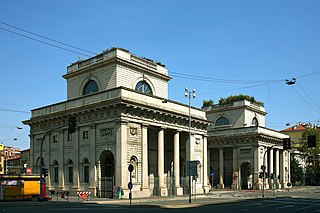
Porta Venezia is one of the historical gates of the city of Milan, Italy. In its present form, the gate dates back to the 19th century; nevertheless, its origins can be traced back to the medieval and even the Roman walls of the city.

Porta Romana is a former city gate of Milan, Italy. In its present form, the gate dates back to the 16th century Spanish walls of Milan. Its origins can be traced further back to the Roman walls of the city, which had a corresponding "Roman Gate" roughly in the same area. Porta Romana was the first and the main imperial entrance of the entire city of Milan, as it was the starting point of the road leading to Ancient Rome. According to a survey conducted by Scenari Immobiliari in 2020, this area is in first place in the ranking of the neighborhoods that offer the best liveability in Milan.
The city of Milan, Italy, has had three different systems of defending walls. The oldest, the Roman walls, were developed in two stages: the first in the Republican era and the second in the Imperial era. The second wall system was realized in the Middle Ages, after the destruction of the city by Frederick I Barbarossa. Finally, the latest wall system was built by the Spanish rulers in the 16th century. While very little remains of these walls, their structure is clearly reflected in the urbanistic layout of the city. In particular, modern Milan has two roughly circular rings of streets, namely the "Cerchia dei Navigli" and the "Cerchia dei Bastioni", which essentially correspond to the Medieval and Spanish walls, respectively. Note that a third ring of roads just beyond the Inner Ring Road, called the External Ring Road, does not follow any old city walls, but rather was part of the 1884 Beruto Plan for the city of Milan, created and named after a municipal engineer and public servant to the local city government.

Palazzo Castiglioni is an Art Nouveau palace of Milan, northern Italy. It was designed by Giuseppe Sommaruga in the Liberty style and built between 1901 and 1903. The rusticated blocks of the basement imitate a natural rocky shape, while the rest of the decorations are inspired by 18th century stuccos. The building is now used as the seat of the Unione Commercianti di Milano.
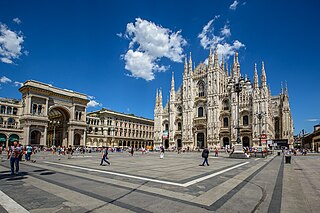
The Zone 1 of Milan, since 2016 officially Municipality 1 of Milan, is one of the 9 administrative divisions of Milan, Italy.
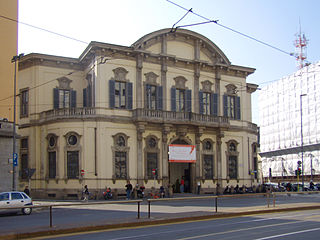
Palazzo Sormani is a historic building of Milan, Italy, and the seat of the central public library of Milan. It is located at number 6 in Corso di Porta Vittoria, in the Zone 1 administrative division of the city.

Neoclassical architecture in Milan encompasses the main artistic movement from about 1750 to 1850 in this northern Italian city. From the final years of the reign of Maria Theresa of Austria, through the Napoleonic Kingdom of Italy and the European Restoration, Milan was in the forefront of a strong cultural and economic renaissance in which Neoclassicism was the dominant style, creating in Milan some of the most influential works in this style in Italy and across Europe. Notable developments include construction of the Teatro alla Scala, the restyled Royal Palace, and the Brera institutions including the Academy of Fine Arts, the Braidense Library and the Brera Astronomical Observatory. Neoclassicism also led to the development of monumental city gates, new squares and boulevards, as well as public gardens and private mansions. Latterly, two churches, San Tomaso in Terramara and San Carlo al Corso, were completed in Neoclassical style before the period came to an end in the late 1830s.
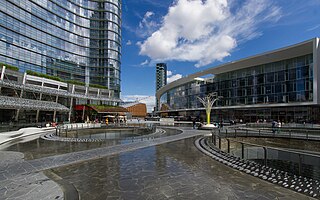
The Zone 9 of Milan, since 2016 officially Municipality 9 of Milan, is one of the 9 administrative divisions of Milan, Italy.

The following outline is provided as an overview of and topical guide to Milan:

Palazzo Arese was a 16th century baroque palace and seat of a branch of the House of Arese in Milan, Italy. It was located adjacent to Casa Fontana Silvestri near the Porta Orientale. The palazzo was demolished in 1943 following damage sustained during the bombing of Milan in World War II.
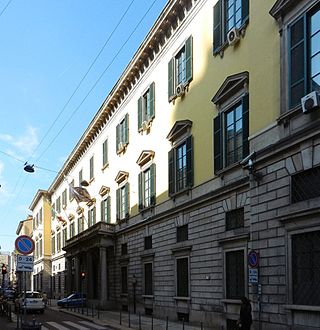
The Prefecture, Milan, also known as Palazzo Diotti, is a historic neoclassical building which has been the location of the office of the Prefect of Milan since 1859. The building is situated at 31, Corso Monforte in the city.

The Palazzo del Touring Club Italiano, also known as Palazzo Bertarelli, is a historic building situated in Milan, Italy.
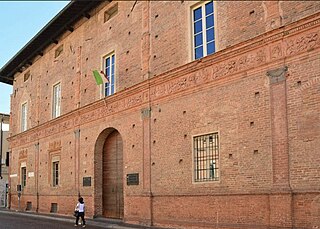
Palace Carminali Bottigella is a noble palace built by the ancient Beccaria family from Pavia. The original structure from the Sforza era was built between 1490 and 1499. The façade, which retains the original terracotta decorations, is one of the major examples of Renaissance civil building in Pavia.

The Palazzo di Prospero Visconti' is a 16th-century palace in Milan. Historically belonging to the sestiere di Porta Ticinese, it is located in via Lanzone 2, in the ancient contrada del Torchio no. 2,919.
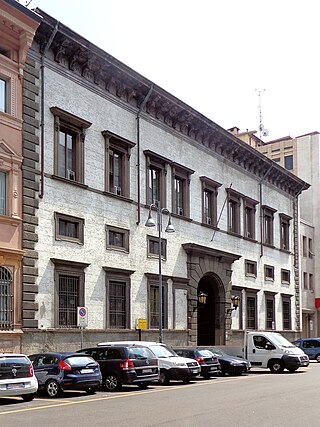
Palazzo Spinola is a 16th-century palazzo in Milan, heavily remodelled during the 19th century. Historically belonging to the sestiere di Porta Nuova, it is located at 10 Via San Paolo. Since 1808 it has been the seat of the Garden Society.

Palazzo Acerbi is a 17th-century palace in Milan in the Baroque style. Historically belonging to the sestiere di Porta Romana, the palace is located at corso di Porta Romana no. 3.


