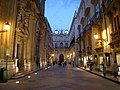
Palazzo Senatorio (also known as the Palazzo Cavarretta) is a historic baroque civic building in the centre of Trapani, Sicily. Standing on Via Torrearsa, it occupies the site of the former Loggia dei Pisani. Although the earliest structure dates to the 15th century, the building was extensively remodelled in the second half of the 17th century and served as the city’s senate and magistracy during the early modern period.[1]
According to Trapani historian Giuseppe Maria di Ferro, in 1825 the palace — then known as the Casa del Comune or Palazzo della Città — was the seat of the city senate and the place where representatives of the people assembled to deliberate on public affairs. He described it as dominating the principal street of Trapani and serving as the core of civic government.[2]
Di Ferro further records that a major renewal of the palace took place around 1696 under the patronage of Fra Giacomo Cavarretta, Bailiff of Santo Stefano, who enlarged the interior spaces, rebuilt the monumental staircase, and promoted the decorative programme of the façade. His portrait was preserved in the palace as a civic tribute.[2]
At the beginning of the 15th century a tower in the form of a bell tower was erected above Porta Oscura adjoining the palace, supporting the city’s public clock. Di Ferro describes this as an astronomical clock indicating the lunar phases by means of a disc representing the illuminated portion of the moon during its cycles. The tower was positioned so that the sound of time could be heard throughout the city, confirming its function as Trapani’s principal civic timekeeper.[2]
Two caissons for a new clock and calendar were added to the top of the façade in 1828, giving the building its distinctive twin timepieces. The clock was constructed by the Marsala clockmaker Giuseppe Lorito and replaced the earlier astronomical clock on the adjoining Porta Oscura, which subsequently fell into disuse.[3]
Architecture
The present three-tier Baroque façade was constructed between 1671 and 1672, financed by Don Giacomo Cavarretta, a local aristocrat. The lower two architectural orders were designed by Pietro Castro, while the upper order was completed by Andrea Palma, who created three niches housing statues of the Madonna of Trapani, Saint John the Baptist and Saint Albert, sculpted by Giuseppe Nolfo in 1701.[4]
The façade is organised in three superimposed orders and represents one of the most prominent examples of Baroque civic architecture in Trapani. Its sculptural programme reflects both the religious identity of the city and the political authority of its municipal institutions, combining Marian devotion with the veneration of local patron saints.[4]
Gallery
View of the façade of Palazzo Senatorio
Palazzo Senatorio at night on Corso Vittorio Emanuele
Statues on the upper part of the façade
References
↑Polizzi, Giuseppe (1879). I monumenti d'antichità e d'arte della provincia di Trapani[The monuments of antiquity and art in the province of Trapani] (in Italian). Trapani: Tipografia Modica-Romano.
123Di Ferro, Giuseppe Maria (1825). Guida per gli stranieri in Trapani: con un saggio storico[A Guide for Foreigners to Trapani: With a Historical Essay] (in Italian). Trapani: Pietro Mannone e Solina. pp.278–279.
↑Addomine, Marisa (2024-09-25). "Orologio di Torre Oscura a Trapani"[The Porta Oscura Tower Clock in Trapani]. Giornale degli Orologi (in Italian). Retrieved 2026-01-12.
This page is based on this Wikipedia article Text is available under the CC BY-SA 4.0 license; additional terms may apply. Images, videos and audio are available under their respective licenses.