Pavilion of Tervuren

Last updated
The Pavilion of Tervuren seen from the canal in the Warande 38. Pavillon de S.A.R. le Prince Hereditaire, a Tervuren.jpg
The Pavilion of Tervuren seen from the canal in the Warande

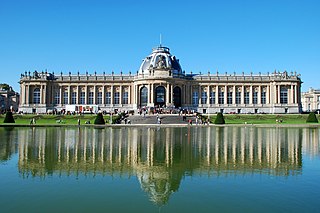
The Pavilion of Tervuren (Dutch : Paviljoen van Tervuren; French : Pavillon de Tervueren) was a summer palace for the prince of Orange, the future King William II of the Netherlands, constructed between 1817 and 1823. It was located in Tervuren, Belgium, just outside Brussels. After the Belgian Revolution in 1830, it was transferred to the Belgian royal family. The former empress of Mexico, Charlotte of Belgium, lived in the palace from 1867 until it burned down in 1879. Nowadays, the Palace of Colonies stands in its place, and is part of the Royal Museum for Central Africa (RMCA).

Contents

History

William II

King William II of the Netherlands and his family, with the Pavilion of Tervuren behind Jan Baptist van der Hulst - Koning Willem II en familie.jpg
King William II of the Netherlands and his family, with the Pavilion of Tervuren behind

In the autumn of 1815, William, Prince of Orange, was given control over Tervuren, Belgium. [1] [2] As Tervuren Castle was demolished in 1782, a new summer palace was built for his participation at the Battle of Waterloo. [1] [2] It was located in the northwestern edge of Tervuren Park, also known as the Warande. [1] [2] The park was expanded to ensure sufficient privacy for the royal family. [1] [2] Construction started in 1817 and took five years to complete. [1] [2]

The pavilion was lavishly furnished and decorated, including reliefs by the French sculptor François Rude, who was then living in exile in Brussels. [1] [2] The building was surrounded by terraces and gardens. [1] [2] To the east extended an Italianate garden decorated with neoclassical statues, including Claudius Civilis by the sculptor Jean-Louis Van Geel. [1] [2]

Leopold II

After the Belgian Revolution in 1830, the pavilion, together with the entire Tervuren Park, became the property of the Belgian State. [1] [2] However, most of the furniture was returned to the Dutch royal family. The pavilion and the surrounding park were given to King Leopold I, who then gave it to his heir, King Leopold II. Under Leopold II, who had a special fondness for Tervuren and at one point even considered living there permanently, the Warande was further expanded through targeted purchases. [1] [2]

Charlotte of Belgium

After her return to Belgium in the summer of 1867, Charlotte of Belgium, former Empress consort of Mexico and sister of Leopold II, moved into the pavilion for a few months. [1] [2] However, the building seemed to be insufficiently furnished and ill-adapted to the cold season. [1] [2] On 8 October 1867, Charlotte moved in with her brother and sister-in-law in the Palace of Laeken. She did not return to the pavilion until May 1869. On the night of 2 March 1879, a fire broke out in the pavilion. [1] Empress Charlotte was woken up by her ladies-in-waiting and escaped the burning building, which was destroyed in the fire. She then moved to Bouchout Castle, where she stayed until her death in 1927. [1]

Aftermath

The Palace of Colonies stands on the location of the pavilion. Palais des Colonies (Tervuren) 03.JPG
The Palace of Colonies stands on the location of the pavilion.

The pavilion was not rebuilt and Tervuren Park remained empty until 1897. At the request of Leopold II, the 1897 Brussels International Exposition took place simultaneously in Brussels and Tervuren. [1] [2] There, the Congo Free State's prosperity was brought to the public's attention. [1] [2] To make the colonial exhibition attractive and accessible, Tervuren was connected to the capital with a wide, 11 km (6.8 mi) tree-lined avenue, flanked by a tram line, which was constructed for the occasion. [1] [2] At the end of this avenue, on the site of the burnt-down pavilion, the Palace of Colonies was built, designed by the architect Ernest Acker. [1] [2] The pavilion was intended as an exhibition space and was framed by classical French gardens with ponds, staircases and statues designed by the French landscape architect Elie Lainé. [1] [2] Lainé became well known in the 1870s as the designer of the garden at Waddesdon Manor in Buckinghamshire, England, commissioned by Ferdinand de Rothschild. [1] [2] He was exponent to the growing interest in Le Nôtre-styled gardens, which would see a revival mainly due to Henri and Achille Duchêne. [1] [2]

Royal Museum for Central Africa

Royal Museum for Central Africa Royal Museum for Central Africa in Tervuren.01.jpg
Royal Museum for Central Africa

Due to its success, the Palace of Colonies has been a museum since 1898. [1] [2] However, the available space soon proved insufficient, so Leopold II decided on 3 December 1902 to expand it so Chinese and Japanese exhibitions could be shown. [1] [2] The project was completed thanks to subsidies from the Congo Free State. [1] [2] The French architect Charles Girault, whose Petit Palais was liked by Leopold II at the Paris Exposition of 1900, was commissioned to develop a concept that encompassed the entire Lokkaartsveld along the Leuvensesteenweg, including of the Palace of Colonies site. [1] [2] In addition to a museum, the project would have also built an international conference center and a school. [1] [2] Following the death of Leopold II, however, only the Congo Museum, the current Royal Museum for Central Africa, would be realized. [1] [2]

Related Research Articles

<span class="mw-page-title-main">Leopold II of Belgium</span> King of the Belgians from 1865 to 1909

Leopold II was the second King of the Belgians from 1865 to 1909, and the founder and sole owner of the Congo Free State from 1885 to 1908.
<span class="mw-page-title-main">Tervuren</span> Municipality in Flemish Community, Belgium

Tervuren is a municipality in the province of Flemish Brabant, in the Flemish region of Belgium. The municipality comprises the villages of Duisburg, Tervuren proper, Vossem and Moorsel. On 1 January 2006, Tervuren had a total population of 20,636. The total area is 32.92 km2 (12.71 sq mi), which gives a population density of 627/km2 (1,620/sq mi).

<span class="mw-page-title-main">Laeken</span> Neighbourhood in Brussels, Belgium

Laeken or Laken is a residential suburb in the north-western part of the Brussels-Capital Region, Belgium. It belongs to the municipality of the City of Brussels and is mostly identified by the Belgian postal code: 1020. Prior to 1921, it was a separate municipality.

<span class="mw-page-title-main">Charlotte of Belgium</span> Empress of Mexico from 1864 to 1867

Charlotte of Belgium, known by the Spanish version of her name, Carlota, was by birth a princess of Belgium and member of the House of Wettin in the branch of Saxe-Coburg and Gotha. As the wife of Archduke Maximilian of Austria, Viceroy of Lombardy–Venetia and later Emperor of Mexico, she became Archduchess of Austria and Empress of Mexico. She was daughter, granddaughter, sister, sister in-law, cousin and wife of reigning or deposed sovereigns throughout Europe and Mexico.

<span class="mw-page-title-main">Brussels Park</span> Park in Brussels, Belgium

Brussels Park is the largest urban public park in central Brussels, Belgium. Formerly known and still sometimes colloquially referred to as the Royal Park, it was the city's first public park, being originally laid out between 1776 and 1783 in a neoclassical style by the French architect Gilles-Barnabé Guimard and the Austrian landscape architect Joachim Zinner, as part of an urban project including the Place Royale/Koningsplein. The area of the rectangular park is 13.1 ha.

<span class="mw-page-title-main">Royal Museum for Central Africa</span> Museum of ethnography and natural history in Tervuren, Belgium

The Royal Museum for Central Africa (RMCA), communicating under the name AfricaMuseum since 2018, is an ethnography and natural history museum situated in Tervuren in Flemish Brabant, Belgium, just outside Brussels. It was originally built to showcase King Leopold II's Congo Free State in the International Exposition of 1897.

<span class="mw-page-title-main">Royal Palace of Brussels</span> Palace in Brussels, Belgium

The Royal Palace of Brussels is the official palace of the King and Queen of the Belgians in the centre of the nation's capital, Brussels. However, it is not used as a royal residence, as the king and his family live in the Royal Palace of Laeken in northern Brussels. The website of the Belgian Monarchy describes the function of the Royal Palace as follows:

The Royal Palace is where His Majesty the King exercises his prerogatives as Head of State, grants audiences and deals with affairs of state. Apart from the offices of the King and the Queen, the Royal Palace houses the services of the Grand Marshal of the Court, the King's Head of Cabinet, the Head of the King's Military Household and the Intendant of the King's Civil List. The Royal Palace also includes the State Rooms where large receptions are held, as well as the apartments provided for foreign Heads of State during official visits.

The Royal Trust Society Of Belgium was a donation to the state proposed in a letter by King Leopold II of Belgium on 9 April 1900. In addition some properties were added to the donation in a letter of 15 November 1900. The Belgian government accepted the donation by law on 31 December 1903. When the King handed the Congo Free State over to the Belgian government on 28 November 1907, additional properties were added to the Royal Trust.
<span class="mw-page-title-main">Palace of Laeken</span> Belgian royal residence in Brussels

The Palace of Laeken or Castle of Laeken is the official residence of the King of the Belgians and the Belgian royal family. It lies in the Brussels-Capital Region, 5 km (3 mi) north of the city centre, in Laeken, and sits in a large private park called the Royal Domain of Laeken.

<span class="mw-page-title-main">Royal Museum of the Armed Forces and Military History</span> Military museum in Brussels, Belgium

The Royal Museum of the Armed Forces and Military History, also known as the Royal Military Museum, is a military museum that occupies the two northernmost halls of the historic complex in the Parc du Cinquantenaire/Jubelpark in Brussels, Belgium. This site is served by the metro stations Schuman and Merode on lines 1 and 5.

<span class="mw-page-title-main">Brussels International Exposition (1897)</span> Worlds fair in Brussels, Belgium

The Brussels International Exposition of 1897 was a world's fair held in Brussels, Belgium, from 10 May 1897 through 8 November 1897. There were 27 participating countries, and an estimated attendance of 7.8 million people.

<span class="mw-page-title-main">Brussels International Exposition (1910)</span> Worlds fair in Brussels, Belgium

The Brussels International Exposition of 1910 was a world's fair held in Brussels, Belgium, from 23 April to 1 November 1910. This was just thirteen years after Brussels' previous world's fair. It received 13 million visitors, covered 88 hectares and lost 100,000 Belgian francs.

<span class="mw-page-title-main">Alfred-Philibert Aldrophe</span> French architect

Alfred-Philibert Aldrophe was a French architect.

<span class="mw-page-title-main">International Colonial and Export Exhibition</span>

The International Colonial and Export Exhibition was a colonial exhibition held in Amsterdam from May 1 to October 1, 1883. The event drew at least a million visitors and was the first international colonial exhibition, with 28 different nations presenting their colonial trade and wealth.

<span class="mw-page-title-main">Neoclassical architecture in Belgium</span> Historical Belgian style of architecture

Neoclassical architecture appeared in Belgium during the period of Austrian occupation in the mid-18th century and enjoyed considerable longevity in the country, surviving through periods of French and Dutch occupation, and the birth of Independent Belgium, surviving well into the 20th century.

<span class="mw-page-title-main">Museums of the Far East</span> Museum in Brussels, Belgium

The Museums of the Far East is a complex of three museums in Laeken, City of Brussels, Belgium, dedicated to Oriental art and culture, specifically that of China and Japan. Consisting of the Chinese Pavilion, the Japanese Tower and the Museum of Japanese Art, it forms part of the Royal Museums of Art and History (RMAH).

Elie Lainé (1829–1911) was a French landscape architect, chiefly remembered for the restoration of the gardens at Vaux-le-Vicomte, the layout of the grounds at Waddesdon Manor and the creation of numerous parks and gardens for King Leopold II of Belgium.
<span class="mw-page-title-main">Société Belge d'Études Coloniales</span>

The Société d'Études Coloniales was a society that promoted the creation and maintenance of Belgian overseas colonies which was established in 1894. For some years it was headquartered in the Hôtel Ravenstein in Brussels. By 1902 it had a library.

<span class="mw-page-title-main">Tervuren Castle</span> Former royal residence in Tervuren, Belgium

Tervuren Castle was a moated castle constructed by the dukes of Brabant, which later became a royal residence and hunting lodge for the governors of the Habsburg Netherlands. It was located in Tervuren, Belgium, just outside Brussels. It was demolished in 1782.

<span class="mw-page-title-main">Africa Palace</span> Palace in Tervuren, Belgium

The Africa Palace or Palace of Africa is a neoclassical palace in Tervuren in Flemish Brabant, Belgium, just outside Brussels. It was originally built in 1897 by order of King Leopold II to house the colonial section of the 1897 International Exposition. Nowadays, it is part of the Royal Museum for Central Africa (RMCA), and houses offices, storage rooms, classrooms and a reception hall. It was formerly called the Palace of the Colonies until 2018.

References

  1. 1 2 3 4 5 6 7 8 9 10 11 12 13 14 15 16 17 18 19 20 21 22 23 24 25 26 27 Wijnants, Maurits (1997). Van hertogen en Kongolezen. Tervuren en de Koloniale tentoonstelling 1897 (in Dutch). Tervuren: Koninklijk museum voor Midden-Afrika. p. 184. ISBN   90-75894090.
  2. 1 2 3 4 5 6 7 8 9 10 11 12 13 14 15 16 17 18 19 20 21 22 23 24 25 "The Warande in Tervuren". www.onroerenderfgoed.be (in Dutch). Retrieved 6 May 2023.

Further reading