
Gomoku, also called Five in a Row, is an abstract strategy board game. It is traditionally played with Go pieces on a Go board. It is played using a 15×15 board while in the past a 19×19 board was standard. Because pieces are typically not moved or removed from the board, gomoku may also be played as a paper-and-pencil game. The game is known in several countries under different names.

Derived from the Greek word for '5', and "domino", a pentomino is a polyomino of order 5, that is, a polygon in the plane made of 5 equal-sized squares connected edge-to-edge. When rotations and reflections are not considered to be distinct shapes, there are 12 different free pentominoes. When reflections are considered distinct, there are 18 one-sided pentominoes. When rotations are also considered distinct, there are 63 fixed pentominoes.
Recreational mathematics is mathematics carried out for recreation (entertainment) rather than as a strictly research and application-based professional activity or as a part of a student's formal education. Although it is not necessarily limited to being an endeavor for amateurs, many topics in this field require no knowledge of advanced mathematics. Recreational mathematics involves mathematical puzzles and games, often appealing to children and untrained adults, inspiring their further study of the subject.

Tic-tac-toe, noughts and crosses, or Xs and Os is a paper-and-pencil game for two players who take turns marking the spaces in a three-by-three grid with X or O. The player who succeeds in placing three of their marks in a horizontal, vertical, or diagonal row is the winner. It is a solved game, with a forced draw assuming best play from both players.

Hex is a two player abstract strategy board game in which players attempt to connect opposite sides of a hexagonal board. Hex was invented by mathematician and poet Piet Hein in 1942 and independently by John Nash in 1948.

Peg solitaire is a board game for one player involving movement of pegs on a board with holes. Some sets use marbles in a board with indentations. The game is known simply as Solitaire in the United Kingdom where the card games are called Patience. It is also called Brainvita.

Nine men's morris is a strategy board game for two players dating at least to the Roman Empire. The game is also known as nine-man morris, mill, mills, the mill game, merels, merrills, merelles, marelles, morelles, and ninepenny marl in English. The game has also been called cowboy checkers and is sometimes printed on the back of checkerboards. Nine men's morris is a solved game, that is, a game whose optimal strategy has been calculated. It has been shown that with perfect play from both players, the game results in a draw.

The Tower of Hanoi is a mathematical game or puzzle consisting of three rods and a number of disks of various diameters, which can slide onto any rod. The puzzle begins with the disks stacked on one rod in order of decreasing size, the smallest at the top, thus approximating a conical shape. The objective of the puzzle is to move the entire stack to the last rod, obeying the following rules:
- Only one disk may be moved at a time.
- Each move consists of taking the upper disk from one of the stacks and placing it on top of another stack or on an empty rod.
- No disk may be placed on top of a disk that is smaller than it.
A puzzle is a game, problem, or toy that tests a person's ingenuity or knowledge. In a puzzle, the solver is expected to put pieces together in a logical way, in order to arrive at the correct or fun solution of the puzzle. There are different genres of puzzles, such as crossword puzzles, word-search puzzles, number puzzles, relational puzzles, and logic puzzles.
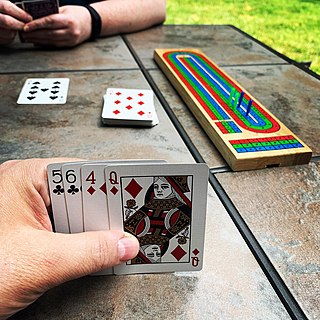
Cribbage, or crib, is a card game, traditionally for two players, that involves playing and grouping cards in combinations which gain points. It can be adapted for three or four players.

Mastermind or Master Mind is a code-breaking game for two players. The modern game with pegs was invented in 1970 by Mordecai Meirowitz, an Israeli postmaster and telecommunications expert. It resembles an earlier pencil and paper game called Bulls and Cows that may date back a century.

TwixT is a two-player strategy board game, an early entrant in the 1960s 3M bookshelf game series. It became one of the most popular and enduring games in the series. It is a connection game where players alternate turns placing pegs and links on a pegboard in an attempt to link their opposite sides. The rules are simple but the strategy complex, so young children can play it, but it also appeals to adults. The game has been discontinued except in Germany and Japan.
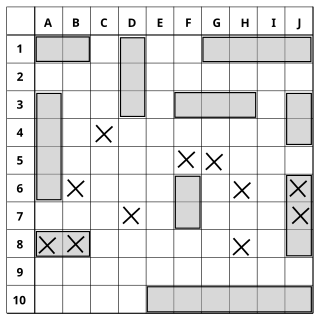
Battleship is a strategy type guessing game for two players. It is played on ruled grids on which each player's fleet of ships are marked. The locations of the fleets are concealed from the other player. Players alternate turns calling "shots" at the other player's ships, and the objective of the game is to destroy the opposing player's fleet.
The Shannon switching game is a connection game for two players, invented by American mathematician and electrical engineer Claude Shannon, the "father of information theory" some time before 1951. Two players take turns coloring the edges of an arbitrary graph. One player has the goal of connecting two distinguished vertices by a path of edges of their color. The other player aims to prevent this by using their color instead. The game is commonly played on a rectangular grid; this special case of the game was independently invented by American mathematician David Gale in the late 1950s and is known as Gale or Bridg-It.

Mathematical puzzles make up an integral part of recreational mathematics. They have specific rules, but they do not usually involve competition between two or more players. Instead, to solve such a puzzle, the solver must find a solution that satisfies the given conditions. Mathematical puzzles require mathematics to solve them. Logic puzzles are a common type of mathematical puzzle.

3D tic-tac-toe, also known by the trade name Qubic, is an abstract strategy board game, generally for two players. It is similar in concept to traditional tic-tac-toe but is played in a cubical array of cells, usually 4x4x4. Players take turns placing their markers in blank cells in the array. The first player to achieve four of their own markers in a row wins. The winning row can be horizontal, vertical, or diagonal on a single board as in regular tic-tac-toe, or vertically in a column, or a diagonal line through four boards.
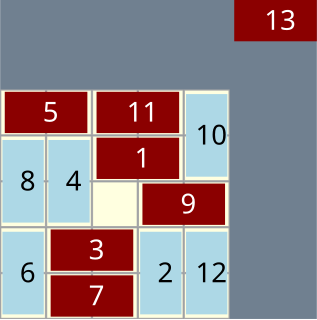
Domineering is a mathematical game that can be played on any collection of squares on a sheet of graph paper. For example, it can be played on a 6×6 square, a rectangle, an entirely irregular polyomino, or a combination of any number of such components. Two players have a collection of dominoes which they place on the grid in turn, covering up squares. One player places tiles vertically, while the other places them horizontally. As in most games in combinatorial game theory, the first player who cannot move loses.

Minichess is a family of chess variants played with regular chess pieces and standard rules, but on a smaller board. The motivation for these variants is to make the game simpler and shorter than the standard chess. The first chess-like game implemented on a computer was a 6×6 chess variant Los Alamos chess. The low memory capacity of the early days computer required reduced board size and smaller number of pieces to make the game implementable on a computer.
A connection game is a type of abstract strategy game in which players attempt to complete a specific type of connection with their pieces. This could involve forming a path between two or more goals, completing a closed loop, or connecting all of one's pieces so they are adjacent to each other. Connection games typically have simple rules, but complex strategies. They have minimal components and may be played as board games, computer games, or even paper and pencil games.
Solving chess means finding an optimal strategy for the game of chess, that is, one by which one of the players can always force a victory, or either can force a draw. It also means more generally solving chess-like games, such as Capablanca chess and infinite chess. According to Zermelo's theorem, a determinable optimal strategy must exist for chess and chess-like games.

