Related Research Articles

The Peranakan Chinese are an ethnic group defined by their genealogical descent from the first waves of Southern Chinese settlers to maritime Southeast Asia, known as Nanyang, namely the British Colonial ruled ports in the Malay Peninsula and the Indonesian Archipelago, as well as Singapore. Peranakan culture, especially in the dominant Peranakan centres of Malacca, Singapore, Penang, Phuket and Tangerang, is characterized by its unique hybridization of ancient Chinese culture with the local cultures of the Nusantara region, the result of a centuries-long history of transculturation and interracial marriage.
The Chitty, also known as the Chetty or Chetti Melaka, are an ethnic group whose members are of primarily Tamil descent, found mainly and initially in Melaka, Malaysia, where they settled around the 16th century, and in Singapore where they migrated to in the 18th and 19th centuries from Melaka. Also known colloquially as "Indian Peranakans", the culture of the Chitty has drawn significant influence from the Nusantara region and to a small extent the Chinese, whilst also retaining their Hindu faith and heritage. In the 21st century, their population stands at 2,000. The Chitty/Chetti community are different from Chettiar, bankers brought from Tamil Nadu to British Malaya. They are practising Hindus.
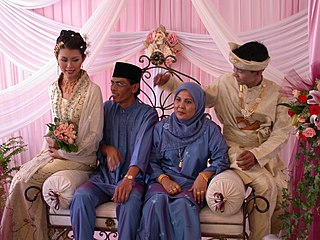
Malay Singaporeans are Singaporeans of Malay ancestry, including those from the Malay Archipelago. They constitute approximately 13.5% of the country's residents, making them the second largest ethnic group in Singapore. Under the Constitution of Singapore, they are recognised by the government as the indigenous people of the country, with Malay as the national language of Singapore.

Islam constitutes the third largest religion in Singapore, with Muslims accounting for approximately 15.6% of the population, as indicated by the 2020 census. Predominantly, Singaporean Muslims are Sunni Muslims adhering to either the Shafi‘i or Hanafi schools of thought. The majority of the Muslim population, about 80%, are ethnic Malays, while 13% are of Indian descent. The remaining fraction comprises local Chinese, Eurasian, and Arab communities, in addition to foreign migrants. Buddhism and Christianity are the two larger religious affiliations in the country.

The Hajjah Fatimah Mosque is a mosque located along Beach Road in the Kampong Glam district within the Kallang Planning Area in Singapore. The mosque was designed in a mix of Islamic and European architectural styles, and completed in 1846. The mosque is named after an aristocratic Malay lady, Hajjah Fatimah, who commissioned its construction.

Indian Singaporeans are Singaporeans of Indian or of general South Asian ancestry. They constitute approximately 9.0% of the country's residents, making them the third largest ancestry and ethnic group in Singapore.
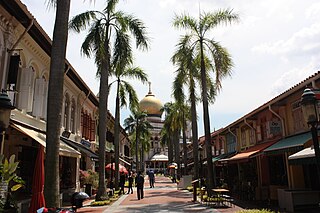
Kampong Glam is a neighbourhood and ethnic enclave in Singapore. It is located north of the Singapore River, in the planning area of Rochor, known as the Malay-Muslim quarter.
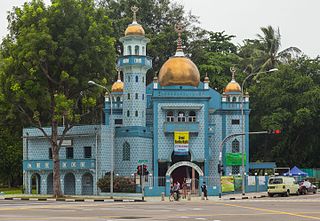
Masjid Malabar or Malabar Muslim Jama-Ath Mosque, also known as Golden Dome Mosque; is Singapore's only Malabar Muslim mosque. The mosque is located at the junction of Victoria Street and Jalan Sultan in the Kampong Glam district, in the Rochor Planning Area within the Central Area. The mosque is built on the Sultan Mosque style with traditional blue and white lapis lazuli tile facade. The mosque was nicknamed as little cousin of the Sultan Mosque, because of similar golden domes.
Dance in Singapore has been an integral part of its culture despite having a relatively short history of creative, artistic and professional dance. The range of dance reflects the cultural diversity of Singapore, from traditional dance forms to contemporary genres.

Joo Chiat Road is a road in Joo Chiat District and a residential conservation area located in the east coast of Singapore.

Daren Shiau, BBM, PBM, is a Singaporean novelist, poet, conservationist, and lawyer in private practice qualified in Singapore, England and Wales. He is an author of five books.
The Jawi Peranakan is an ethnic group found primarily within the Malaysian state of Penang and in Singapore, both regions were part of the historical Straits Settlements where their culture and history is centred around. The term "Jawi Peranakan" refers to locally born, Malay-speaking Muslims of mixed Indian and Malay ancestry. Over time, this has grown to include people with Arab ancestry as well. They were an elite group within the British Malayan community in mid-19th century Malaya. In addition to their substantial wealth and social standing, they are remembered for setting up the first Malay newspaper in Malaysia, Singapore, Indonesia and China, the Jawi Peranakan and their influences on Malay culture.
The Abdul Aleem Siddique Mosque is a mosque in Singapore that was built as a recognition of Muhammad Abdul Aleem Siddiqi’s propagation of Islam.
Syed Abu Bakar bin Taha Alsagoff was a well-known Islamic educator in Singapore.

Singaporeans are the citizens and nationals of the sovereign island city-state of Singapore. Singapore is home to a people of a variety of ethno-racial-religious origins, with the city-state itself being a multi-racial, multi-cultural, multi-religious, multi-denominational, multi-lingual, and multi-ethnic country. Singaporeans of Chinese, Malay, Indian and Eurasian descent have made up the overwhelming majority of the population since the 19th century. The Singaporean diaspora is also far-reaching worldwide.
The National University of Singapore Muslim Society (NUSMS), which used to be called the University of Singapore Muslim Society (USMS) or Persatuan Mahasiswa Islam Universiti Singapura (PMIUS), was established in 1963 to provide a platform for students and staff to engage in activities that serve the Muslim community on campus. It is a student-run organisation registered with the Registry of Societies and is currently managed by the 54th Executive Committee (ExCo).
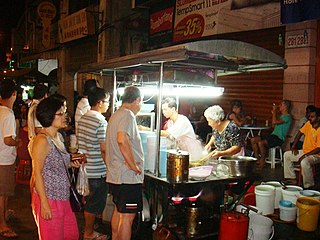
Penangite Chinese are ethnic Chinese Malaysians of full or partial Chinese ancestry who either hail from or live within the State of Penang. As of 2020, 45% of Penang's population belonged to the Chinese ethnic group, making ethnic Chinese the largest ethnic community within the state.
The Singapore Islamic Hub is a religious campus that houses Masjid Muhajirin, Madrasah Irsyad Zuhri Al-Islamiah and the headquarters of Majlis Ugama Islam Singapura (Muis). These institutions combined create a cohesive and symbiotic whole, embodies the Islamic principles of Iman, Ilmu and Amal respectively.

Singapore Business Federation is the apex business chamber in Singapore. SBF aims to improve the organisation of the business community in Singapore and represent it both locally and abroad.
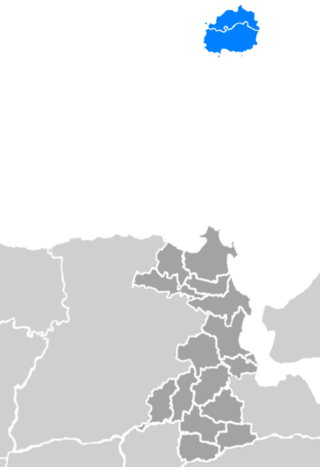
Bawean dialect also known as Bawean language is a dialect of Madurese language spoken predominantly by Bawean people in Bawean island. This dialect have 4 major sub-dialects each spoken predominantly in village of Daun and Suwari in the villages of Sangkapura, and the village of Kepuhteluk in the district of Tambak. As well as additional sub-dialects of Bawean Creole.
References
- 1 2 "The Baweanese (Boyanese)". www.nlb.gov.sg. Retrieved 2024-09-30.
- ↑ Vredenbregt, Jacob (1990). Bawean dan Islam. Indonesian Netherlands Cooperation in Islamic Studies. ISBN 9789798116087.
- ↑ "Kerjasama dengan badan lain". Berita Harian. 8 October 2011. p. 16.
- ↑ "Laaobe - Changing Times: Baweanese Heritage and Culture in Singapore". www.roots.gov.sg. Retrieved 2024-09-30.
- 1 2 "Pondok Peranakan Gelam Club". www.nlb.gov.sg. Retrieved 2024-09-30.
- ↑ Zakaria, Zuzanita (25 February 1999). "Keeping an ethnic heritage alive". The Straits Times.
- ↑ Masyarakat Bawean Singapura: La-A-Obĕ (in English and Malay). Persatuan Bawean Singapura. 2015. ISBN 9789810937980.
- ↑ Rosdi, Sundusia (2018). Ponthuk Bawean di Singapura. Persatuan Bawean Singapura. ISBN 9789811162046.
- ↑ Mustafi, Amanah (2021). Aocak Phĕbiĕn Berbahasa Bawean (in Malay). Persatuan Bawean Singapura. ISBN 9789811484438.