Related Research Articles

John Stuart, 3rd Earl of Bute,, styled Lord Mount Stuart between 1713 and 1723, was a British nobleman who served as the 7th Prime Minister of Great Britain from 1762 to 1763 under George III. He was arguably the last important royal favourite in British politics. He was the first prime minister from Scotland following the Acts of Union in 1707. He was also elected as the first president of the Society of Antiquaries of Scotland when it was founded in 1780.

The Scottish Enlightenment was the period in 18th- and early-19th-century Scotland characterised by an outpouring of intellectual and scientific accomplishments. By the eighteenth century, Scotland had a network of parish schools in the Scottish Lowlands and five universities. The Enlightenment culture was based on close readings of new books, and intense discussions which took place daily at such intellectual gathering places in Edinburgh as The Select Society and, later, The Poker Club, as well as within Scotland's ancient universities.

Chiswick House is a Neo-Palladian style villa in the Chiswick district of London, England. A "glorious" example of Neo-Palladian architecture in west London, the house was designed and built by Richard Boyle, 3rd Earl of Burlington (1694–1753), and completed in 1729. The house and garden occupy 26.33 hectares. The garden was created mainly by the architect and landscape designer William Kent, and it is one of the earliest examples of the English landscape garden.
This article contains information about the literary events and publications of 1799.
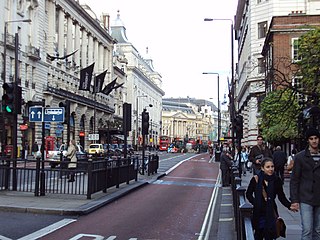
Piccadilly is a road in the City of Westminster, London, to the south of Mayfair, between Hyde Park Corner in the west and Piccadilly Circus in the east. It is part of the A4 road that connects central London to Hammersmith, Earl's Court, Heathrow Airport and the M4 motorway westward. St James's is to the south of the eastern section, while the western section is built up only on the northern side. Piccadilly is just under 1 mile (1.6 km) in length, and it is one of the widest and straightest streets in central London.
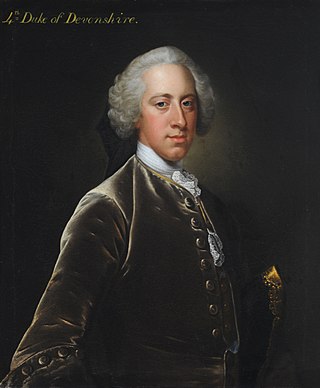
William Cavendish, 4th Duke of Devonshire,, styled Lord Cavendish before 1729, and Marquess of Hartington between 1729 and 1755, was a British Whig statesman and nobleman who was briefly nominal 5th Prime Minister of Great Britain. He was the first son of William Cavendish, 3rd Duke of Devonshire and his wife, Catherine Hoskins. He is also a great-great-great-great-great-grandfather of King Charles III through the king's maternal great-grandmother.

The Georgian era was a period in British history from 1714 to c. 1830–1837, named after the Hanoverian kings George I, George II, George III and George IV. The definition of the Georgian era is often extended to include the relatively short reign of William IV, which ended with his death in 1837. The subperiod that is the Regency era is defined by the regency of George IV as Prince of Wales during the illness of his father George III. The transition to the Victorian era was characterized in religion, social values, and the arts by a shift in tone away from rationalism and toward romanticism and mysticism.

Sir Herbert Butterfield was an English historian and philosopher of history, who was Regius Professor of Modern History and Vice-Chancellor of the University of Cambridge. He is remembered chiefly for a short volume early in his career entitled The Whig Interpretation of History (1931) and for his Origins of Modern Science (1949). Butterfield turned increasingly to historiography and man's developing view of the past. Butterfield was a devout Christian and reflected at length on Christian influences in historical perspectives.

William George Hoskins was an English local historian who founded the first university department of English Local History. His great contribution to the study of history was in the field of landscape history. Hoskins demonstrated the profound impact of human activity on the evolution of the English landscape in a pioneering book: The Making of the English Landscape. His work has had lasting influence in the fields of local and landscape history and historical and environmental conservation.
Jeremy Black is a British historian, writer, and former professor of history at the University of Exeter. He is a senior fellow at the Center for the Study of America and the West at the Foreign Policy Research Institute in Philadelphia, US.

Scottish art is the body of visual art made in what is now Scotland, or about Scottish subjects, since prehistoric times. It forms a distinctive tradition within European art, but the political union with England has led its partial subsumation in British art.

Abraham Kenneth Snowman CBE FSA was a British jeweller, painter and the chairman of Wartski. He was made a Fellow of the Society of Antiquaries of London in 1994, and a Commander of the Order of the British Empire in 1997.
Ragnhild Marie Hatton was professor of International History at the London School of Economics. As the author of her obituary declared, she was "for a generation Britain's leading historian of 17th- and 18th century Europe...."
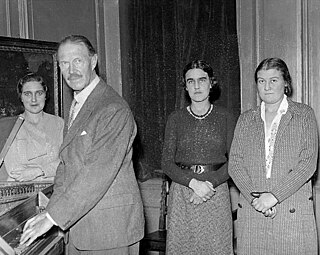
Major George Henry Benton Fletcher was a collector of early keyboard instruments including virginals, clavichords, harpsichords, spinets and early pianos. His collection is currently housed and kept in playing condition by the National Trust in Fenton House, a beautiful late 17th century merchant's house in, Hampstead, north London.
Christopher Hugh Moore is a Canadian author, journalist, and blogger about Canadian history. A freelance writer since 1978, Moore is unusual among professionally trained Canadian historians in that he supports himself by writing for general audiences. He is a longtime columnist for Canada's History magazine and the author of many books. He has twice won the Governor General's Literary Awards.
William Norman Hargreaves-Mawdsley was a British historian, and expert on the history of legal and academic dress.
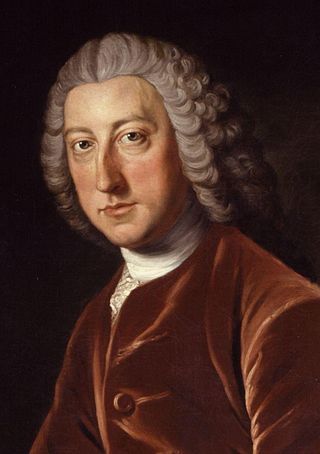
The government of Great Britain was under the joint leadership of William Pitt the Elder and William Cavendish, 4th Duke of Devonshire, between November 1756 and April 1757—when Pitt was dismissed by King George. The King disliked Pitt, but Pitt's influence in the Commons had led to his crucial appointment as Southern Secretary in a ministry nominally headed by Devonshire.

In British usage, the term townhouse originally referred to the town or city residence, in practice normally in Westminster, near the seat of the monarch, of a member of the nobility or gentry, as opposed to their country seat, generally known as a country house or, colloquially, for the larger ones, stately home. The grandest of the London townhouses were stand-alone buildings, but many were terraced buildings.
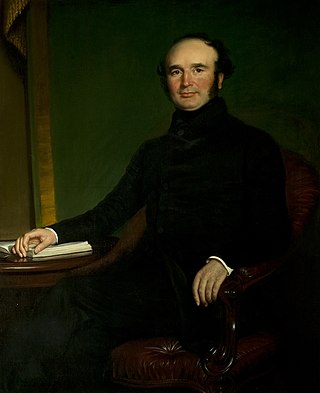
John Biggs was a British hosier and Liberal and Radical politician.
Karl Wolfgang Schweizer is a historian specialising in eighteenth century European history.
References
- ↑ "Brown, Peter Douglas", Library of Congress, accessed 10 January 2021.
- ↑ The Writers Directory, 1980–82 (London: Macmillan, 1979), p. 158.
- ↑ The International Authors and Writers Who's who. International Biographical Centre. 1977. p. 133. ISBN 9780900332456 . Retrieved 20 May 2022.
- 1 2 "Notes on Contributors", Karl Schweizer (ed.), Lord Bute: Essays in Re-interpretation (Leicester: Leicester University Press, 1988).
- ↑ "Court Circular", The Times (26 March 1982), p. 10.