
Peter Philippi (30 March 1866, Trier - 17 August 1945, Rothenburg ob der Tauber) was a German portrait and genre painter. Some sources, mostly art dealerships, give his year of death as 1958.
Peter Philippi (30 March 1866, Trier - 17 August 1945, Rothenburg ob der Tauber) was a German portrait and genre painter. Some sources, mostly art dealerships, give his year of death as 1958.
His father, also named Peter Philippi, was a book seller and binder. His mother, Katharina née Theisen, was a winemaker's daughter from the Mosel region. In 1869, his father acquired a large, popular bookstore, which enabled Peter to attend the Royal Gymnasium. Upon graduating, in 1883, he left home to enroll at the Kunstakademie Düsseldorf. There is no record of any artistic training up to that time.

He studied there from 1884 to 1898, with a one-year interruption for military service. [1] His primary instructors included Hugo Crola, Adolf Schill and Johann Peter Theodor Janssen. Later, he was accepted into the master class of the history painter, Eduard von Gebhardt, who was inclined to religious subject matter, but this had no influence on him. With graduation approaching, he joined the progressive artists' association, Malkasten. He remained in Düsseldorf, but maintained close contact with Trier. In 1905, he married a former fellow-student, Constanze Schmitz, originally from Berlin. They had one daughter.
Seeking an "unspoiled environment", he and Constanze moved to Rothenburg ob der Tauber in 1906. [1] The first portfolio of his artwork was published shortly after. [2] In 1910, he was named an extraordinary member of the Kunstakademie.
In 1923, together with Adolph Hosse and several younger, local artists, he helped establish the Rothenburger Künstlerbund, for which the city provided a permanent exhibition space. That same year, having divorced Constanze, he married Elisabeth Pies, from Trier. In 1930, he helped create a similar artists' association there. After the Nazi takeover in 1933, he was admitted to the Reich Chamber of Culture. [3]
He remained conservative in his approach, calling the Biedermeier period "our last real stylistic epoch". [1] His preferred subjects were elderly, small town people, in old-fashioned clothes. Many of his paintings, or portions of them, were reproduced as popular postcards. He participated in the Große Deutsche Kunstausstellung of 1937, which inspired him to publish The Little Town and Its People, a collection of his works that also featured his poetry and anecdotes about his models. He was represented in a total of 48 exhibits between then and 1943.
On his seventy-fifth birthday, in 1941, he was presented with the Goethe-Medaille für Kunst und Wissenschaft, and deemed to be "politically reliable". [4] Two years later, he was honored with his own exhibition. In 1944, he was added to the "Gottbegnadeten list" of painters who were crucial to Nazi culture. [5]


Rothenburg ob der Tauber is a town in the district of Ansbach of Mittelfranken, the Franconia region of Bavaria, Germany. It is well known for its well-preserved medieval old town, a destination for tourists from around the world. It is part of the popular Romantic Road through southern Germany. Today it is one of only four towns in Germany that still have completely intact city walls, the other three being Nördlingen, Dinkelsbühl and Berching, all in Bavaria.

Werner Peiner was a German painter. He was first influenced by realism, and later by New Objectivity, but he would become known as one of the most talented official painters of the Third Reich.

Ludwig Siebert was a German lawyer and Nazi Party politician who served as the Minister President of Bavaria in Nazi Germany from 1933 to 1942.
Joseph Fassbender (Faßbender) was a German painter and draughtsman.
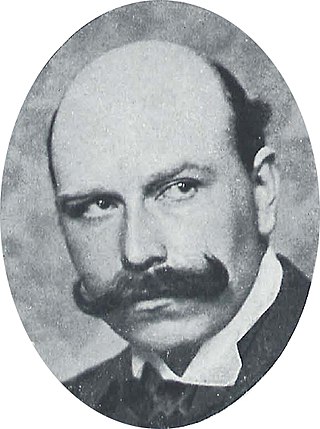
Arthur Kampf was a German painter. He was associated with the Düsseldorf school of painting.

Wolf Stegemann is a German journalist, author, and poet.

Franz Xaver Friedrich Quant, known as Fritz was a German painter, graphic artist and designer.

Karl Friedrich Rudolf Sohn was a German portrait painter in the Academic style.
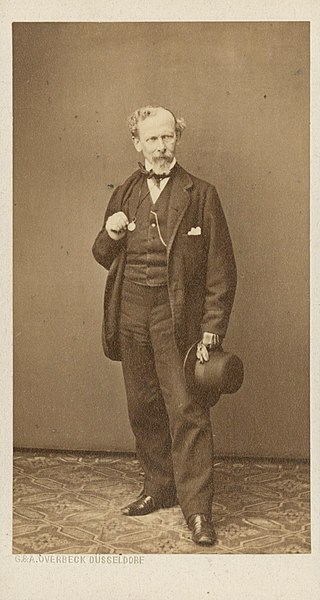
Wilhelm Rudolf Jordan was a German genre painter, illustrator, etcher and art teacher.

Heinrich Hermanns was a German lithographer and landscape painter. He was also known for architectural paintings and vedute and was associated with the Düsseldorfer Malerschule.
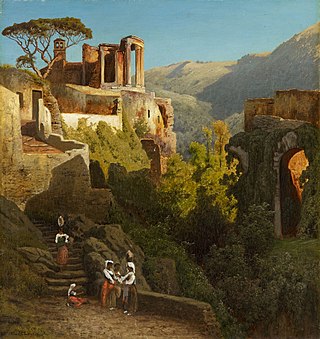
Carl Jungheim was a German landscape painter, associated with the Düsseldorfer Malerschule.

Heinrich Ludwig Philippi was a German history painter; associated with the Düsseldorfer Malerschule. He was primarily known as a watercolorist.
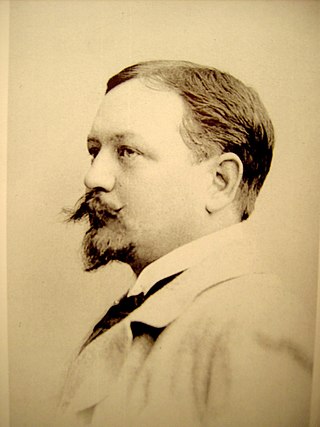
Friedrich Gustav August Julius Philipp Rudolf von Wille, known as Fritz, was a German landscape painter and art professor; associated with the Düsseldorf School.
Emil Jungblut, also Emil Jungbluth written, was a German sculptor.
Johann Josef Scotti was a Prussian civil servant, publisher and writer.
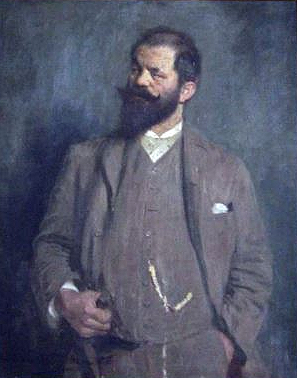
Wilhelm Schneider-Didam was a German portrait painter of the Düsseldorf school of painting.

Adolf Schill, often also Adolph Schill, was a German architect, interior designer, artisan, illustrator and painter of the historism. As a university lecturer he worked at the Kunstakademie Düsseldorf between 1880 and 1911, thus helping to shape the later phase of the Düsseldorf school of painting. Students of sculpture also studied with him.

The Galerie Paffrath is an art gallery in Düsseldorf, Germany, specialising in paintings of the 19th century.

Max Stern was a German painter and graphic artist of Jewish ancestry, associated with the Düsseldorfer Malerschule. He was originally an Impressionist, but later became an advocate of the New Objectivity.

Wilhelm Schreuer was a German painter; associated with the Düsseldorfer Malerschule.

| International | |
|---|---|
| National | |
| Artists | |
| People | |
