
Archery is the sport, practice, or skill of using a bow to shoot arrows. The word comes from the Latin arcus, meaning bow. Historically, archery has been used for hunting and combat. In modern times, it is mainly a competitive sport and recreational activity. A person who practices archery is typically called an archer, bowman, or toxophilite.

Zhang Juanjuan is an archer from the People's Republic of China.
He Ying is an archer from the People's Republic of China who has competed at three Summer Olympics.
Park Sung-hyun is an archer from South Korea who competed in two Olympic Games, winning three gold medals. Park made her international archery debut in 2001, winning the women's recurve title at that year's World Archery Championships. Her Olympic debut came at the 2004 Summer Olympics, where she won gold medals in both the women's individual and women's team events. She won two further medals at the 2008 Summer Olympics, achieving her third Olympic gold in the women's team event before earning the silver medal as the runner-up in the women's individual event.
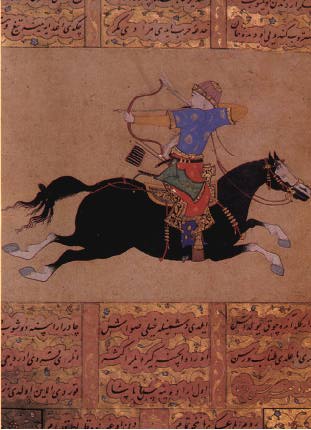
Turkish archery is a tradition of archery which became highly developed in the Ottoman Empire, although its origins date back to the Eurasian Steppe in the second millennium BC.

Howard Hill was an expert bowman who for over two decades, from the early 1930s into the 1950s, was often introduced or billed as "The World's Greatest Archer". He established the record for winning the most bow-and-arrow field tournaments in succession, a total of 196 competitions. In addition, Hill served as a supporting actor, trick-shot performer, and technical adviser on archery for Hollywood shorts and feature films. He also produced and directed documentaries and instructional films on bowhunting, and in the 1950s published two books on the subject, Hunting the Hard Way and Wild Adventure.

Archery, or the use of bow and arrows, was probably developed in Africa by the later Middle Stone Age. It is documented as part of warfare and hunting from the classical period until the end of the 19th century, when bow and arrows was made functionally obsolete by the invention and spread of repeating firearms.

Target archery is the most popular form of archery, in which members shoot at stationary circular targets at varying distances. All types of bow – longbow, barebow, recurve and compound – can be used. In Great Britain, imperial rounds, measured in yards, are still used for many tournaments and these have slightly different rules to metric (WA) rounds, which are used internationally. Archers are divided into seniors and juniors, with juniors being those under the age of 21.

Field archery is any archery discipline that involves shooting at outdoor targets of varying and often unmarked distance, typically in woodland and rough terrain.
A bow draw in archery is the method or technique of pulling back the bowstring to store energy for the bow to shoot an arrow. The most common method in modern target archery is the Mediterranean draw, which has long been the usual method in European archery. Other methods include the pinch draw and the Mongolian or "thumb" draw. In traditional archery practice outside Western Europe the variations of the thumb draw are by far the most dominant draw types, with the Mediterranean draw restricted to the Olympic style of target archery.
This is a list of archery terms, including both the equipment and the practice. A brief description for each word or phrase is also included.

Clout archery is a form of archery in which archers shoot arrows at a flag from a relatively long distance and score points depending on how close each arrow lands to the flag.

Mounted archery is a form of archery that involves shooting arrows while on horseback. A horse archer is a person who does mounted archery. Archery has occasionally been used from the backs of other riding animals. In large open areas, mounted archery was a highly successful technique for hunting, for protecting herds, and for war. It was a defining characteristic of the Eurasian nomads during antiquity and the medieval period, as well as the Iranian peoples such as the Alans, Sarmatians, Cimmerians, Scythians, Massagetae, Parthians, and Persians in Antiquity, and by the Hungarians, Mongols, Chinese, and Turkic peoples during the Middle Ages. The expansion of these cultures have had a great influence on other geographical regions including Eastern Europe, West Asia, and East Asia. In East Asia, horse archery came to be particularly honored in the samurai tradition of Japan, where horse archery is called Yabusame.

For millennia, Chinese archery has played a pivotal role in Chinese society. In particular, archery featured prominently in ancient Chinese culture and philosophy: archery was one of the Six Noble Arts of the Zhou dynasty ; archery skill was a virtue for Chinese emperors; Confucius himself was an archery teacher; and Lie Zi was an avid archer. Because the cultures associated with Chinese society spanned a wide geography and time range, the techniques and equipment associated with Chinese archery are diverse. The improvement of firearms and other circumstances of 20th century China led to the demise of archery as a military and ritual practice, and for much of the 20th century only one traditional bow and arrow workshop remained. However, at the beginning of the 21st century, there has been a revival in interest among craftsmen looking to construct bows and arrows, as well as a practice technique in the traditional Chinese style.
Modern competitive archery involves shooting arrows at a target for accuracy and precision from a set distance or distances. This is the most popular form of competitive archery worldwide and is called target archery. A form particularly popular in Europe, North America, and South America is field archery, shot at targets generally set at various distances in a wooded setting. There are also several other lesser-known and historical forms, as well as archery novelty games.

The women's individual archery event at the 2012 Olympic Games was held from 27 July to 2 August 2012 at Lord's Cricket Ground in London in the United Kingdom. The event was one of four which comprised the 2012 Olympic archery programme of sports and was the eleventh time the women's individual competition was contested as an Olympic event. Forty nations qualified for the competition, sending a total of sixty-four archers to compete. The defending Olympic champion from 2008 was Zhang Juanjuan of China, who did not compete following her retirement in 2010.

The girls' individual archery event at the 2014 Summer Youth Olympics was held from 22 to 25 August 2014 at the Fangshan Sports Training Base in Nanjing, China. One of three recurve archery events which comprised the archery programme, it was the second time the girls' individual discipline was contested at Summer Youth Olympics. Thirty-two archers from thirty-two countries entered the competition, which was open to female archers born between 1 January 1997 and 31 December 1999. The defending champion was South Korea's Kwak Ye-ji, who was unable to defend her title due to the age limitations imposed on the event.

The women's individual archery event at the 2016 Summer Olympics was held from 5 to 13 August at the Sambadrome Marquês de Sapucaí in Rio de Janeiro, Brazil. One of four archery events as part of the 2016 Olympic catalogue of sports, it was the fourteenth time a women's individual competition was contested as a discipline at the Olympic Games. Forty different nations qualified for the event, sending a total of sixty-four archers to compete. The defending Olympic champion was Ki Bo-bae of South Korea.
The girls' individual archery event at the 2018 Summer Youth Olympics was held from 12 to 16 October 2018 at the Parque Sarmiento in Buenos Aires, Argentina. One of three recurve archery events which comprised the archery programme, it was the third time the girls' individual discipline had been contested at Summer Youth Olympics. Thirty-two archers from thirty-two countries entered the competition, which was open to female archers born between 1 January 2001 and 31 December 2003. The defending champion was China's Li Jiaman, who was unable to defend her title due to the age limitations imposed on the event.
The women's individual recurve competition at the 2019 European Games was held from 21 to 26 June 2019 at the Olympic Sports Complex in Minsk, Belarus. It was the second time the event was held as part of the European Games archery programme. A total of 48 archers from 32 different nations entered the competition, with a maximum of three entries per country. The event offered one qualifying spot for the women's individual event at the 2020 Summer Olympics for any archer reaching the semi-finals from a nation that had not already qualified. The defending champion, Karina Winter of Germany, did not take part following her retirement from the sport.


