Related Research Articles

Louis IX, also known as Saint Louis, was King of France from 1226 until his death in 1270. He is widely recognized as the most distinguished of the Direct Capetians. Following the death of his father, Louis VIII, he was crowned in Reims at the age of 12. His mother, Blanche of Castile, effectively ruled the kingdom as regent until he came of age and continued to serve as his trusted adviser until her death. During his formative years, Blanche successfully confronted rebellious vassals and championed the Capetian cause in the Albigensian Crusade, which had been ongoing for the past two decades.

The 13th century was the century which lasted from January 1, 1201 through December 31, 1300 (MCCC) in accordance with the Julian calendar.

Year 1249 (MCCXLIX) was a common year starting on Friday of the Julian calendar.

Baldwin I was the first Emperor of the Latin Empire of Constantinople; Count of Flanders from 1194 to 1205 and Count of Hainaut from 1195 to 1205. Baldwin was one of the most prominent leaders of the Fourth Crusade, which resulted in the sack of Constantinople in 1204, the conquest of large parts of the Byzantine Empire, and the foundation of the Latin Empire. The following year he was defeated at the Battle of Adrianople by Kaloyan, the emperor of Bulgaria, and spent his last days as a prisoner.

The Seventh Crusade (1248–1254) was the first of the two Crusades led by Louis IX of France. Also known as the Crusade of Louis IX to the Holy Land, it aimed to reclaim the Holy Land by attacking Egypt, the main seat of Muslim power in the Near East. The Crusade was conducted in response to setbacks in the Kingdom of Jerusalem, beginning with the loss of the Holy City in 1244, and was preached by Innocent IV in conjunction with a crusade against emperor Frederick II, Baltic rebellions and Mongol incursions. After initial success, the crusade ended in defeat, with most of the army – including the king – captured by the Muslims.

Joan, often called Joan of Constantinople, ruled as Countess of Flanders and Hainaut from 1205 until her death. She was the elder daughter of Baldwin IX, Count of Flanders and Hainaut, and Marie of Champagne.

The Archdiocese of Reims or Rheims is a Latin Church ecclesiastic territory or archdiocese of the Catholic Church in France. Erected as a diocese around 250 by Sixtus of Reims, the diocese was elevated to an archdiocese around 750. The archbishop received the title "primate of Gallia Belgica" in 1089.

The Diocese of Beauvais, Noyon, and Senlis is a Latin Church ecclesiastical territory or diocese of the Catholic Church in France. The diocese encompasses the department of Oise in the region of Hauts-de-France. The diocese is a suffragan of the metropolitan Archdiocese of Reims. The current bishop is Jacques Benoit-Gonnin, appointed in 2010.
The count of Vermandois was the ruler of the county of Vermandois.

The Diocese of Soissons, Laon, and Saint-Quentin is a Latin Church diocese of the Catholic Church in France. The diocese is suffragan to the Archdiocese of Reims and corresponds, with the exception of two hamlets, to the entire Department of Aisne. The current bishop is Renauld Marie François Dupont de Dinechin, appointed on 30 October 2015. In 2022, in the Diocese of Soissons there is one priest for every 5,594 Catholics.

The Diocese of Châlons is a Latin Church ecclesiastical territory or diocese of the Catholic Church in Châlons-sur-Marne, France. The diocese comprises the department of Marne, excluding the arrondissement of Reims.

The former French Catholic Diocese of Noyon lay in the north-east of France, around Noyon. It was formed when Saint Medardus moved the seat of the bishopric at Vermandois to Noyon, in the sixth century. From 545 to 1146, it was united with the bishopric of Tournai as the Diocese of Noyon–Tournai. Then in the twelfth century it was again independent, and the bishop of Noyon became a pairie-comté of France.

The Archdiocese of Clermont is a Latin archdiocese of the Roman Catholic Church in France. The diocese comprises the department of Puy-de-Dôme, in the Region of Auvergne. The Archbishop's seat is Clermont-Ferrand Cathedral. Throughout its history Clermont was the senior suffragan of the Archdiocese of Bourges. It became a metropolitan see itself, however, in 2002. The current archbishop is François Kalist.

Marie of Brienne was Latin Empress as the wife of Baldwin II of Courtenay. She served as regent during the absence of Baldwin II twice: in 1237–1239, and in 1243–1257.
Robert VII de Béthune was a nobleman from the House of Bethune from Artois. He served as a knight and military leader in Flanders and England before inheriting his family territories in France and the Low Countries. He joined the Seventh Crusade, but died en route to the eastern Mediterranean.
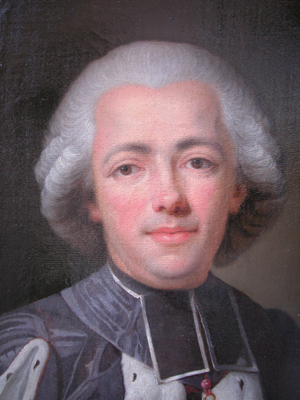
Louis-André Grimaldi d'Antibes was a French nobleman and bishop. He was one of the Princes of Monaco, Bishop of Le Mans, then a Peer of France as Count-Bishop of Noyon from 1777 and bishop emeritus after he resigned from the post of bishop. He spent his later years in London. He was described as "a Voltairean prelate".
Hugh IV of Saint-Pol from the House of Campdavaine, son of Anselm of Saint-Pol, was count of Saint-Pol from 1174 to his death, and lord of Demotika (Didymoteicho) in Thrace in 1204–05. He participated in the Third and Fourth Crusades.

Henry V the Blondell, called the Great, was the Count of Arlon from 1226 to his death, lord of Ligny from 1240 to his death, Count of Luxembourg and Laroche from 1247 to his death, and the Marquis of Namur between 1256 and 1264 as Henry III. He was the son and successor of Waleran III, Duke of Limburg and Ermesinde, Countess of Luxembourg.
References
- 1 2 3 McDougall 2017, p. 229.
- ↑ Field 2019, p. 18.
- ↑ Baldwin 1986, p. 206.
- ↑ McDougall 2017, p. 229-230.
- ↑ Baldwin 1986, p. 306.
- ↑ Harvey 2014, p. 196.
- ↑ Richard 1992, p. 39.
- 1 2 Harvey 2014, p. 195.
- 1 2 3 4 McDougall 2017, p. 230.
- ↑ Gorochov 2007, p. 272.