Pierre Thuillier (Amiens, June 17, 1799 - Paris, November 19, 1858) was a French painter.
Contents

Pierre Thuillier (Amiens, June 17, 1799 - Paris, November 19, 1858) was a French painter.
Pierre Thuillier was a landscape painter, first a pupil of Louis Étienne Watelet then belonging to the School of Barbizon. He carried out his first artistic activity in the region of Amiens and around the Forest of Fontainebleau between 1831 and 1832. As a young apprentice at the atelier of Watelet he met Théodore Caruelle d'Aligny and left with him later to work in Italy. Later he often stayed in Germany, Switzerland, Italy and Algiers, moving along Maghreb, and then returned to paint in France, particularly in Auvergne.
In 1843 he was made a Chevalier of the Legion d'Honneur.
In 1831 he began exhibiting at the "Salon de Paris", where he won awards four times. In particular, he won the 1st Class Medal in 1839 and 1848. In 1854 he won the First Prize at the Geneva Exhibition. [1] He stopped exhibiting at the "Salon" only in 1857.
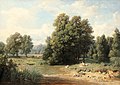


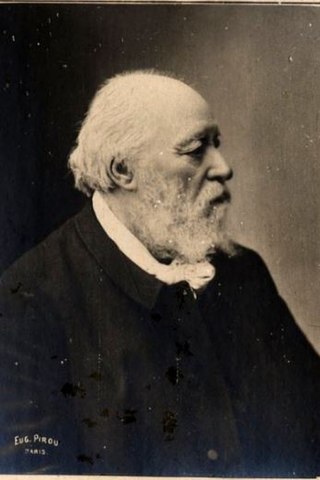
François-Louis Français (1814–1897), usually known as Louis Français, was a French painter, lithographer and illustrator who became one of the most commercially successful landscape painters of the 19th century. A former pupil of Gigoux, he began his career by studying lithography and wood engraving, becoming a prolific illustrator and printmaker. His work as an illustrator is to be found in around forty books and numerous magazines from the late 1830s to the 1860s. Français also produced a large number of pen and ink drawings, enhanced by sepia, notable for their attention to detail and for their technical adroitness and conciseness.

Jean Restout the Younger was a French artist, who worked in painting and drawing. Although little remembered today, Restout was well-respected by his contemporaries for his religious compositions.

Barthélemy Menn was a Swiss painter and draughtsman who introduced the principles of plein-air painting and the paysage intime into Swiss art.

Louis Auvray was a French sculptor and art critic. He was the pupil of David d'Angers and was the brother of Félix Auvray, a painter. He continued the Dictionnaire Général des Artistes de l'école française depuis l'origine des arts du dessin jusqu'à nos jours, started by Émile Bellier de La Chavignerie.
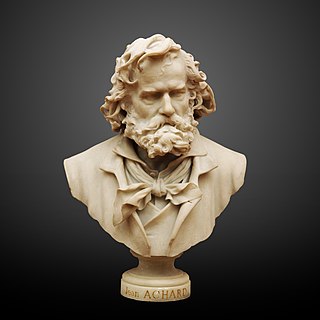
Jean Alexis Achard (1807–1884) was a French painter.

Eugène-Louis Lequesne was a French sculptor. Lequesne was born and died in Paris. In 1841, he entered the École nationale des beaux-arts, in James Pradier's workshop. In 1843, he won the second Prix de Rome, and in 1844 the first prize, with a plaster bas-relief entitled Pyrrhus tuant Priam. He lived at the Académie de France à Rome from 1844 to 1849, alongside Jean-Louis Charles Garnier. In 1855, he was awarded the Great Prize for sculpture at the Exposition Universelle, and received the Légion d'honneur.
Marie Ernestine Lavieille was a French painter.

Jean Messagier was a French painter, sculptor, printmaker and poet. Jean Messagier had his first solo exhibition in Paris at Galerie Arc-en-Ciel in 1947. From 1945 to 1949 the artist worked under the influence of Pablo Picasso, André Masson, Paul Klee and François Desnoyer, his professor at École nationale supérieure des arts décoratifs in Paris. Messagier again was revealed to the public at an exhibition organized by Charles Estienne at the Galerie de Babylone in 1952, entitled "La Nouvelle École de Paris". The following year, Messagier deliberately broke away from his expressionistic form of Post-Cubism; his inspirations now focused on Jean Fautrier and Pierre Tal-Coat to develop a personal vision in which he renders "light...approached abstractly." Jean Messagier is often associated with Lyrical abstraction, Tachisme, Nuagisme, Art informel and paysagisme abstrait, though the artist himself had never accepted any labels, and had always refused the distinction between abstraction and figuration. From 1962 until the year of his death Jean Messagier exhibited in France and abroad, taking part in some major international events as a representative of new trends in French painting.

Antoine-George-Prosper Marilhat, usually known as Prosper Marilhat, was a French Orientalist painter. Many of his most successful works were based on the sketches he drew during the time he spent in Egypt in 1831–1832.
Victor-Ferdinand Bourgeois was a French painter and illustrator.
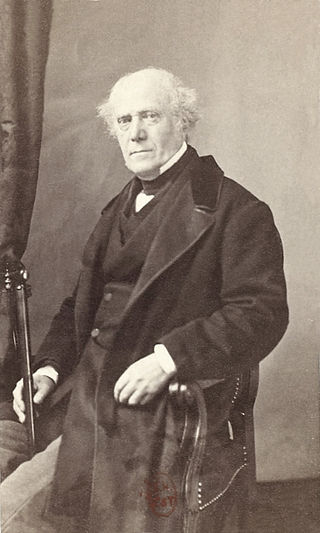
Nicolas-Auguste Hesse was a French painter and artist. He produced historical, mythological, religious and allegorical works along with portraits, wall paintings and designs for stained glass windows.
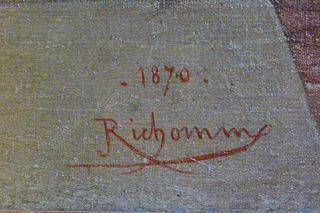
Jules Richomme was a French portrait, landscape, genre and history painter.

Auguste-Xavier Leprince was a French artist and painter who attained celebrity at the age of seventeen. His patrons included the Duchesse de Berry, Charles X, and Alexandre du Sommerard. He was also a teacher; in his twenties he established his own atelier in Paris, with pupils including his two younger brothers, Robert-Léopold and Pierre-Gustave, as well as Eugène Lepoittevin and Nicolas Alexandre Barbier. His meteoric career came to an abrupt end and his "brilliant promise was cut short by his premature death at the age of twenty-seven."

Paul Claude-Michel Carpentier was a French portrait, genre, history painter and author. He studied with Jean-Jacques Lebarbier (1738–1826) and briefly with Jacques-Louis David (1748–1825). Until 1824 he exhibited at the Salons under his family name LeCarpentier, but after 1824 shortened his last name to Carpentier.

Paul-Alfred Parent de Curzon was a French painter, known for his genre scenes and landscapes with figures.

Louis Étienne Watelet was a French landscape painter and art teacher.

Pierre Henry Prosper Baccuet was a French military officer and landscape painter; known primarily for his Orientalist scenes.

Eugène Goyet, was a French artist. Beginning in 1827 his work was regularly selected for exhibition in the annual Paris Salon. He achieved his greatest success as a painter of religious subjects, with his paintings of Christ and various saints installed in churches and public buildings across France. A successful portrait painter, his most prestigious commission was his 1847 portrait of Pope Pius IX. He was the son of self-taught artist Jean-Baptiste Goyet, and husband of the pastel portrait artist Zoé Goyet.
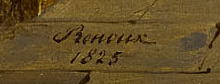
Charles-Caius Renoux was a French painter, lithographer, and illustrator. He first achieved success with paintings of medieval churches, particularly the ruins of cloisters and monasteries destroyed during the French Revolution, works for which he is still best known. Renoux also painted landscapes, large-scale battle scenes, and historical subjects, works which uniquely prepared him for the final phase of his career, the creation of spectacular dioramas, the “moving pictures” of the era. He also taught at the École des Beaux-Arts in Paris; his notable students included Narcisse Berchère and Hector Hanoteau.

Estelle de Barescut was a French painter and lithographer. She exhibited her lithographs at the Salon de Paris in 1834 and 1835, and her paintings from 1842 to 1851.
 Definitions from Wiktionary
 Media from Commons
 News from Wikinews
 Quotations from Wikiquote
 Texts from Wikisource
 Textbooks from Wikibooks
 Resources from Wikiversity
 Wikimedia Commons contiene immagini o altri file su Pierre Thuillier
 | International | |
|---|---|
| National | |
| Artists | |
