
Hugo Alvar Henrik Aalto was a Finnish architect and designer. His work includes architecture, furniture, textiles and glassware, as well as sculptures and paintings. He never regarded himself as an artist, seeing painting and sculpture as "branches of the tree whose trunk is architecture." Aalto's early career ran in parallel with the rapid economic growth and industrialization of Finland during the first half of the 20th century. Many of his clients were industrialists, among them the Ahlström-Gullichsen family, who became his patrons. The span of his career, from the 1920s to the 1970s, is reflected in the styles of his work, ranging from Nordic Classicism of the early work, to a rational International Style Modernism during the 1930s to a more organic modernist style from the 1940s onwards.

Rovaniemi is a city and municipality of Finland. It is the administrative capital and commercial centre of Finland's northernmost province, Lapland, and its southern part Peräpohjola. The city centre is situated about 6 kilometres south of the Arctic Circle and is between the hills of Ounasvaara and Korkalovaara, at the confluence of the river Kemijoki and its tributary, the Ounasjoki. It is the second-largest city of Northern Finland after Oulu, and, together with the capital city Helsinki, it is one of Finland's most significant tourist cities in terms of foreign tourism.

UPM-Kymmene Oyj is a Finnish forest industry company. UPM-Kymmene was formed by the merger of Kymmene Corporation with Repola Oy and its subsidiary United Paper Mills Ltd in 1996. UPM consists of six business areas: UPM Fibres, UPM Energy, UPM Raflatac, UPM Specialty Papers, UPM Communication Papers and UPM Plywood. The Group employs around 17,000 people and it has production plants in 12 countries. UPM shares are listed on the NASDAQ OMX Helsinki stock exchange. UPM is the only paper company which is listed in the global Dow Jones Sustainability Index and the only forest industry company invited to the United Nations Global Compact LEAD sustainability leadership platform.

Lapland is the largest and northernmost region of Finland. The 21 municipalities in the region cooperate in a Regional Council. Lapland borders the region of North Ostrobothnia in the south. It also borders the Gulf of Bothnia, Norrbotten County in Sweden, Troms and Finnmark County in Norway, and Murmansk Oblast and the Republic of Karelia in Russia. Topography varies from vast mires and forests of the South to fells in the North. The Arctic circle crosses Lapland, so polar phenomena such as the midnight sun and polar night can be seen in Lapland.

Lahti is a city and municipality in Finland. It is the capital of the region of Päijänne Tavastia (Päijät-Häme) and its growing region is one of the main economic hubs of Finland. Lahti is situated on a bay at the southern end of lake Vesijärvi about 100 kilometres (60 mi) north-east of the capital city Helsinki, 38 kilometres (24 mi) south-west of the Heinola town and 74 kilometres (46 mi) east of Hämeenlinna, the capital of the region of Tavastia Proper (Kanta-Häme). It is also situated at the intersection of Highway 4 and Highway 12, which are the most significant main roads of Lahti.

Uusikaupunki is a town and municipality of Finland. It is located in the Southwest Finland region, 71 kilometres (44 mi) northwest of Turku and 97 kilometres (60 mi) south of Pori. The municipality has a population of 15,463 and covers an area of 551.65 square kilometres (212.99 sq mi) of which 49.04 km2 (18.93 sq mi) is inland water. The population density is 30.77 inhabitants per square kilometre (79.7/sq mi).
Metsähallitus (Finnish) is a state-owned enterprise in Finland that exceptionally uses a Finnish name in English.

Cross-laminated timber (CLT) is a wood panel product made from gluing together layers of solid-sawn lumber, i.e., lumber cut from a single log. Each layer of boards is usually oriented perpendicular to adjacent layers and glued on the wide faces of each board, usually in a symmetric way so that the outer layers have the same orientation. An odd number of layers is most common, but there are configurations with even numbers as well. Regular timber is an anisotropic material, meaning that the physical properties change depending on the direction at which the force is applied. By gluing layers of wood at right angles, the panel is able to achieve better structural rigidity in both directions. It is similar to plywood but with distinctively thicker laminations.

Sir Philippe Samyn is a Belgian architect and civil engineer whose style is characterized by extensive use of glass, wood and steel to build often monumental structures. He is also known for his discovery of "The volume and displacement indicators for an architectural structure" in August 1997.
The Arctic Centre, University of Lapland is Finland’s national institute for Arctic expertise. It is based at the University of Lapland, the northernmost university in Finland and the EU, and is located in the Arktikum building by the Ounasjoki river in Rovaniemi near the Arctic Circle.
The ABB LEAF Awards is an annual international architectural prize. It recognises innovative architectural design that sets the benchmark for the international architectural community of the next generation.
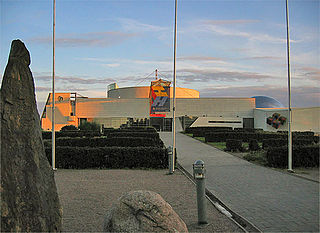
Heikkinen – Komonen Architects is a Finnish architectural firm established by Mikko Heikkinen and Markku Komonen in Helsinki in 1974. Their work is characterised as a fusion between minimalism, high-technology and Abstract expressionism, typified by their design for the Vuotalo Cultural Centre in Helsinki, or the Heureka Science Centre, in Vantaa with the juxtaposition of stark concrete elements against colourful high-tech metal structures and large glazed surfaces. They have also completed a number of small-scale humanitarian projects for Guinea, west Africa, based on local building traditions.

Rainer Mahlamäki is a Finnish architect, president of the Finnish Association of Architects (SAFA) from 2007 to 2011, Professor of Contemporary Architecture at the University of Oulu, and joint partner with Ilmari Lahdelma of the Helsinki-based architecture firm Lahdelma & Mahlamäki Architects, one of the most prolific such firms in Finland. A significant part of their work started as entries in architectural competitions, in which they have received 35 first prizes.

Page\Park Architects was established in 1981 by David Page and Brian Park and has developed as one of Scotland's best known practices undertaking work over a range of sectors.
Märta Blomstedt (1899–1982) was an architect and one of the driving forces of the Finnish functionalism movement. Partnering with her husband, Pauli E. Blomstedt, her first works were noted for their functional, rather than decorative appearance and settings in park-like environments. After her husband's death, initially she formed a firm with Matti Lampén to complete projects her husband and she had begun. Later, she and Lampén formed a firm designing their own creations. She designed all aspects of her buildings including the furnishings, demonstrated in one of Blomstedt & Lampén's most noted designs of the Hotel Aulanko. During the war, Blomstedt & Lampén mostly worked on renovation and restoration projects of existing buildings, but at the war's end, they returned to their own designs. In addition to buildings, they were responsible for the city plans for Kuusjärvi and the Oravikoski Mining Community and created both public and private buildings in each city as well. When Lampén died, Blomstedt formed a partnership with Olli Penttilä and continued to work into the 1970s.
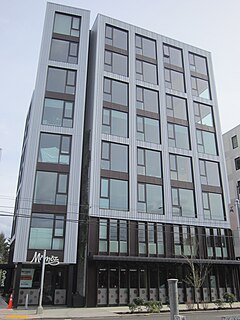
Carbon12 is a wooden building in Portland, Oregon's Eliot neighborhood, in the United States. The eight-story structure built with Oregon-made cross-laminated timber (CLT) became the tallest wood building in the United States upon its completion.

Löyly is a public sauna, restaurant and bar in Hernesaari, Helsinki, Finland. Its address is Hernesaarenranta 4. Löyly opened in 2016.
Peter Busby is an architect and Managing Director at Perkins & Will Architects, with a background in philosophy and a history of advancing sustainable design. Throughout his career, he has advocated for sustainable building strategies and integrated green building infrastructure that serves to educate the users of his spaces.
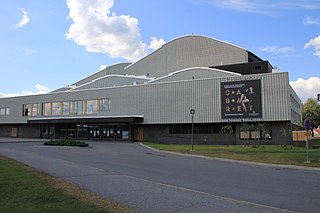
Lappia Hall is a performing arts venue and conference centre in Rovaniemi, the capital city of the Finnish Lapland region, situated close to the Arctic Circle. It is notable for having been designed by the renowned Finnish architect Alvar Aalto in the modernist style.

Rovaniemi library is the main municipal public library of the city of Rovaniemi, Finland. The library building is notable for having been designed by the renowned Finnish architect Alvar Aalto.


