
The Bougainville campaign was a series of land and naval battles of the Pacific campaign of World War II between Allied forces and the Empire of Japan, named after the island of Bougainville. It was part of Operation Cartwheel, the Allied grand strategy in the South Pacific.

The Solomon Islands campaign was a major campaign of the Pacific War of World War II. The campaign began with Japanese landings and capture of several areas in the British Solomon Islands and Bougainville, in the Territory of New Guinea, during the first six months of 1942. The Japanese occupied these locations and began the construction of several naval and air bases with the goals of protecting the flank of the Japanese offensive in New Guinea, establishing a security barrier for the major Japanese base at Rabaul on New Britain, and providing bases for interdicting supply lines between the Allied powers of the United States and Australia and New Zealand.

2nd Battalion, 3rd Marines (2/3) was an infantry battalion in the United States Marine Corps based out of Marine Corps Base Hawaii consisting of approximately 1,000 Marines and sailors. The battalion fell under the command of the 3rd Marine Regiment and the 3rd Marine Division. The battalion was deactivated in January 2022 as part of the Marine Corps' ongoing Force Design efforts.

The Landings at Cape Torokina, also known as Operation Cherryblossom, took place at the beginning of the Bougainville campaign in World War II. The amphibious landings were carried out by elements of the United States Marine Corps in November 1943 on Bougainville Island in the South Pacific, as part of Allied efforts to advance towards the main Japanese base around Rabaul under Operation Cartwheel. Coming in the wake of Allied successes at Guadalcanal and in the central Solomons, the landings were intended to secure a beachhead with the purpose of establishing several bases from which to project air and naval power closer towards Rabaul, in an effort to neutralize the large Japanese force that had been established there.

The Battle of Piva Forks, also known as the Battle of Numa–Numa Trail, was an engagement that took place during the Bougainville campaign in World War II. Occurring between 18 and 25 November 1943 on Bougainville Island in the South Pacific, the battle involved troops from the United States Marine Corps and the United States Army fighting against Imperial Japanese Army forces and took place amidst the context of the expansion of a beachhead that US forces had established around Torokina on the western side of the island.

The Battle of the Koromokina Lagoon was fought between the United States Marine Corps and Imperial Japanese Army forces on Bougainville Island. It took place on 7–8 November 1943 during the Bougainville campaign of the Pacific War.

The Battle of Munda Point was a battle from 22 July – 5 August 1943 between primarily United States Army and Imperial Japanese Army forces during the New Georgia campaign in the Solomon Islands in the Pacific War. The battle took place following a landing by U.S. troops on the western coast of New Georgia from Rendova Island, as part of an effort to capture the Japanese airfield that had been constructed at Munda Point. This advance had become bogged down, and while the Allies brought forward reinforcements and supplies, the Japanese had launched a counterattack on 17–18 July. This effort was ultimately unsuccessful, and afterwards U.S. forces launched a corps-level assault to reinvigorate their effort to capture the airfield. Against this drive, Japanese defenders from three infantry regiments offered stubborn resistance but were ultimately forced to withdraw, allowing U.S. forces to capture the airfield on 5 August. The airfield later played an important role in supporting the Allied campaign on Bougainville in late 1943.

The Battle of Bairoko was fought between American and Imperial Japanese Army and Navy forces on 20 July 1943 on the northern coast of New Georgia Island. Taking place during World War II, it formed part of the New Georgia campaign of the Pacific War. In the battle, two battalions of the US Marine Raiders from the 1st Marine Raider Regiment, supported by two US Army infantry battalions, attacked a Japanese garrison guarding the port of Bairoko on the Dragons Peninsula, advancing from Enogai and Triri. After a day long engagement, the Japanese repulsed the American assault and forced the attacking troops to withdraw with their wounded to Enogai. US forces remained in the area carrying out patrolling and intelligence gathering operations until the end of the campaign. Bairoko was eventually captured at the end of August after the airfield at Munda had been captured, and further reinforcements were sent from there towards Bairoko to clear the area from the south.

The 19th Marine Regiment was a composite engineer regiment of the United States Marine Corps subordinate to the 3rd Marine Division. It existed from September 1942 until September 1944. In December 1943 there was a large change of command in the regiment. Marine engineer regiments were eventually disbanded in favor of independent engineering battalions within the parent Marine divisions.

The 31st/51st Battalion was an infantry battalion of the Australian Army, which served during World War II. Raised for service as part of the Militia in 1943 through the amalgamation of two previously existing battalions, the 31st/51st Battalion undertook garrison duties in Dutch New Guinea in 1943–44 before taking part in the Bougainville Campaign in 1944–45. Following the end of the war, the battalion served in the Pacific overseeing the transfer of Japanese prisoners of war and re-establishing law and order until mid-1946 when it returned to Australia and was disbanded.
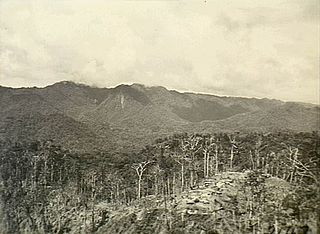
The Battle of Pearl Ridge was an engagement of the Second World War fought between Australian and Japanese forces on Bougainville Island. Part of the wider Bougainville Campaign, the battle took place in the central sector of the island, shortly after the Australians had taken over responsibility from the Americans. Believing that the ridge was held by less than a company of Japanese, on 30 December the Australian 25th Infantry Battalion launched a four-pronged attacked the ridge. The defending force, however, had been greatly reinforced by elements of the 38th Independent Mixed Brigade and was closer to a battalion in strength. After being held up on the right of their advance, the Australians dug in overnight and repulsed a strong Japanese counterattack before resuming the attack on 31 December. By late in the afternoon, the Japanese had been swept off the ridge. The Australians later established an observation post on the ridge, which had commanding views of the whole island, and throughout the remainder of the campaign used it to control artillery fire as they advanced towards Japanese enclaves in the north and south of the island.
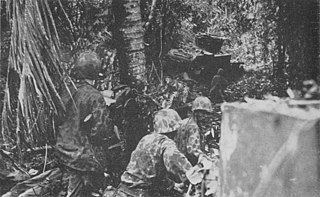
The Battle of the Coconut Grove was a battle between United States Marine Corps and Imperial Japanese Army forces on Bougainville Island during the Pacific War. The battle took place on 13–14 November 1943 during the Bougainville campaign, coming in the wake of a successful landing around Cape Torokina at the start of November, as part of the advance towards Rabaul as part of Operation Cartwheel.

The Numa Numa Trail is a trail on Bougainville in Papua New Guinea that runs from Numa Numa on the east coast over the central mountains of Bougainville to Torokina on the western coast.
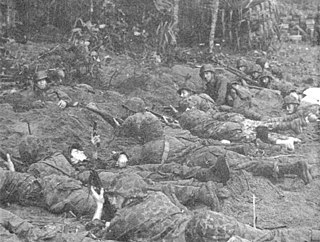
The Raid onKoiari was a battle that occurred between 28 and 29 November 1943 in the Pacific theater of World War II between American and Japanese forces. Part of the Bougainville campaign, the raid involved a landing by a battalion-sized force of United States Marines to harass Imperial Japanese Army troops on Bougainville Island. The raid was a failure for the Americans as they were attacked by a larger-than-expected Japanese force and as a result the Marines were withdrawn from the beachhead without having achieved any of their objectives.
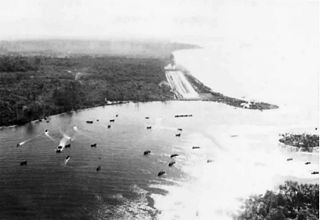
Torokina Airfield, also known as Cape Torokina Airfield, is a former World War II airfield located at Cape Torokina, Bougainville.

The Battle of Hellzapoppin Ridge and Hill 600A consisted of a series of engagements fought in mid-December 1943 on Bougainville between forces of the United States Marine Corps and the Imperial Japanese Army. Although minor in terms of casualties and in comparison to other battles in the Bougainville campaign, the battle was the last significant action undertaken by the 3rd Marine Division on the island before they were replaced by United States Army soldiers from XIV Corps. It resulted in the capture of the two positions by the Marines with the support of artillery and aircraft, and the withdrawal of the Japanese forces as the American perimeter, which had been established around Torokina in November, was expanded towards the Torokina River.

The Bougainville counterattack, also known as the Second Battle of Torokina, was an unsuccessful Japanese offensive against the Allied base at Cape Torokina on Bougainville Island during the Pacific Theater of World War II. The Japanese attack began on 8 March 1944 after months of preparation and was repulsed by United States Army forces in fighting which lasted until 25 March. The attack was hampered by inaccurate intelligence and poor planning and was pushed back by the well-prepared Allied defenders, who greatly outnumbered the Japanese force. The Japanese suffered severe casualties, while Allied losses were light.

The Battle for Piva Trail was a battle between United States Marine Corps and Imperial Japanese Army forces on Bougainville Island. The battle took place on 8–9 November 1943 during the Bougainville campaign of the Pacific War in the days following the US landings at Cape Torokina earlier in the month.
Piva Airfield is a former World War II airfield on Bougainville Island in the Solomon Islands archipelago.
Hector de Zayas was a highly decorated United States Marine Corps lieutenant colonel. He was killed in action during the second battle of Guam in World War II and was posthumously awarded the Navy Cross.

