Related Research Articles
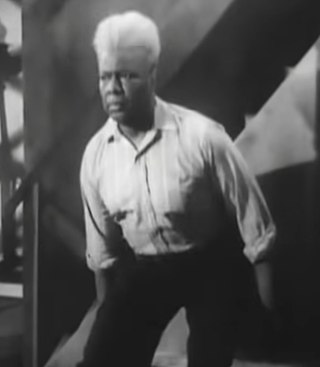
James Franklin Baskett was an American actor who portrayed Uncle Remus, singing the song "Zip-a-Dee-Doo-Dah" in the 1946 Disney feature film Song of the South.

Song of the South is a 1946 American live-action/animated musical drama film directed by Harve Foster and Wilfred Jackson; produced by Walt Disney and released by RKO Radio Pictures. It is based on the Uncle Remus stories as adapted by Joel Chandler Harris, and stars James Baskett as Uncle Remus in his final film role. The film takes place in the U.S. state of Georgia during the Reconstruction era, a period of American history after the end of the American Civil War and the abolition of slavery. The story follows seven-year-old Johnny who is visiting his grandmother's plantation for an extended stay. Johnny befriends Uncle Remus, an elderly worker on the plantation, and takes joy in hearing his tales about the adventures of Br'er Rabbit, Br'er Fox, and Br'er Bear. Johnny learns from the stories how to cope with the challenges he is experiencing while living on the plantation.

Ethel Waters was an American singer and actress. Waters frequently performed jazz, swing, and pop music on the Broadway stage and in concerts. She began her career in the 1920s singing blues. Her notable recordings include "Dinah", "Stormy Weather", "Taking a Chance on Love", "Heat Wave", "Supper Time", "Am I Blue?", "Cabin in the Sky", "I'm Coming Virginia", and her version of "His Eye Is on the Sparrow". Waters was the second African American to be nominated for an Academy Award, the first African American to star on her own television show, and the first African-American woman to be nominated for a Primetime Emmy Award.

The Cotton Club was a New York City nightclub from 1923 to 1940. It was located on 142nd Street and Lenox Avenue (1923–1936), then briefly in the midtown Theater District (1936–1940). The club operated during the United States' era of Prohibition and Jim Crow era racial segregation. Black people initially could not patronize the Cotton Club, but the venue featured many of the most popular black entertainers of the era, including musicians Fletcher Henderson, Duke Ellington, Jimmie Lunceford, Chick Webb, Louis Armstrong, Count Basie, Fats Waller, Willie Bryant; vocalists Adelaide Hall, Ethel Waters, Cab Calloway, Bessie Smith, Lillie Delk Christian, Aida Ward, Avon Long, the Dandridge Sisters, the Will Vodery choir, The Mills Brothers, Nina Mae McKinney, Billie Holiday, Midge Williams, Lena Horne, and dancers such as Katherine Dunham, Bill Robinson, The Nicholas Brothers, Charles 'Honi' Coles, Leonard Reed, Stepin Fetchit, the Berry Brothers, The Four Step Brothers, Jeni Le Gon and Earl Snakehips Tucker.

Ellsworth Raymond "Bumpy" Johnson was an American crime boss in the Harlem neighborhood of New York City.
The numbers game, also known as the numbers racket, the Italian lottery, Mafia lottery or the daily number, is a form of illegal gambling or illegal lottery played mostly in poor and working-class neighborhoods in the United States, wherein a bettor attempts to pick three digits to match those that will be randomly drawn the following day. For many years the "number" has been the last three digits of "the handle", the amount race track bettors placed on race day at a major racetrack, published in racing journals and major newspapers in New York.

Casper Holstein was a prominent New York mobster involved in the Harlem "numbers rackets" during the Harlem Renaissance.
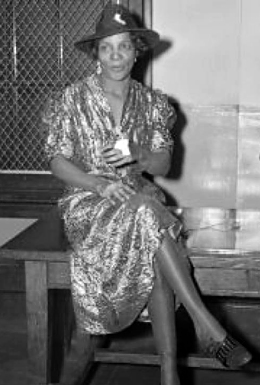
Stephanie St. Clair was a racketeer who ran numerous enterprises in Harlem, New York in the early 20th century. St. Clair resisted the Mafia's interests for several years after Prohibition ended; she became a local legend for her public denunciations of corrupt police and for resisting Mafia control. She ran a successful numbers game in Harlem and was an activist for the black community. Her nicknames included: Queenie, Madame Queen, Madame St. Clair and Queen of the Policy Rackets.
In the late 19th and early 20th centuries, African American organized crime emerged following the first and second large-scale migration of African Americans from the Southern United States to major cities of the Northeast, Midwest, and later the West Coast. In many of these newly established communities and neighborhoods, criminal activities such as illegal gambling, speakeasies and were seen in the post-World War I and Prohibition eras. Although the majority of these businesses in African American neighborhoods were operated by African Americans, it is often unclear the extent to which these operations were run independently of the larger criminal organizations of the time.

Ethel Wales was an American actress who appeared in more than 130 films during her 30-year career.
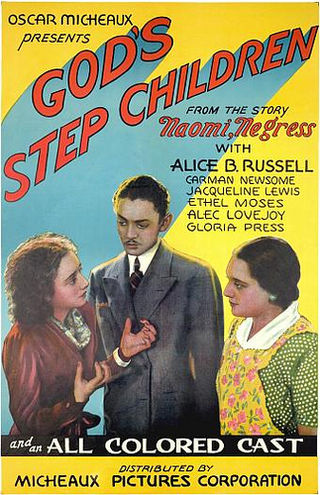
God's Step Children is a 1938 American drama film directed by Oscar Micheaux and starring Jacqueline Lewis. The film is inspired by a combination of elements shared from two previously released Hollywood productions, Imitation of Life and These Three.
Jive talk, also known as Harlem jive or simply Jive, the argot of jazz, jazz jargon, vernacular of the jazz world, slang of jazz, and parlance of hip is an African-American Vernacular English slang or vocabulary that developed in Harlem, where "jive" (jazz) was played and was adopted more widely in African-American society, peaking in the 1940s.
Theodore L. "Teddy" Roe was an African-American organized crime figure who led an illegal gambling empire in South Side, Chicago during the 1940s and early 1950s. Roe earned the nickname "Robin Hood" because of his philanthropy among the neighborhood poor. After refusing to pay "street tax" or hand over his illegal gambling empire to the Chicago Outfit, Roe fatally shot a made man who had been ordered to assassinate him.

Club Harlem was a nightclub at 32 North Kentucky Avenue in Atlantic City, New Jersey. Founded in 1935 by Leroy "Pop" Williams, it was the city's premier club for black jazz performers. Like its Harlem counterpart, the Cotton Club, many of Club Harlem's guests were white, wealthy and eager to experience a night of African-American entertainment.
The Paradise Club or Club Paradise was a nightclub and jazz club at 220 North Illinois Avenue in Atlantic City, New Jersey. It was one of two major black jazz clubs in Atlantic City during its heyday from the 1920s through 1950s, the other being Club Harlem. Entertaining a predominantly white clientele, it was known for its raucous floor shows featuring gyrating black dancers accompanied by high-energy jazz bands led by the likes of Count Basie, Jimmie Lunceford, and Lucky Millinder. In 1954 the Paradise Club merged with Club Harlem under joint ownership.
Ethel Moses was an American stage and film actress, and dancer. She was billed as "the black Jean Harlow". Moses is best known for working in films by Oscar Micheaux.

Harlem Is Heaven is a 1932 American pre-Code crime drama and musical film directed by Irwin Franklyn and featuring a virtually all African-American cast. Bill "Bojangles" Robinson stars in his first leading role on screen, along with Putney Dandridge, John Mason, and some of the top entertainers of the period from Harlem's famous Cotton Club, including James Baskett, Anise Boyer, Henri Wessell, and Alma Smith. Eubie Blake and his orchestra perform most of the background music and instrumentals during the film's onstage song and dance numbers.
Jean Starr was an American actress, dancer, and trumpeter who became a Chicago society figure after marrying Chicago numbers racket tycoon and Jones brothers, McKissack "Mack" McHenry Jones, and becoming Jean Starr Jones.

Irwin Richard Franklyn (1904–1966) was an American film director, film producer, screenwriter, novelist, and publicist. He wrote novelizations of films including Flight: An Epic of the Air for Frank Capra's film. He is also known as Irwin R. Franklin.

Anise Margaret Boyer (1914–2008) was an American dancer and actress known for her work during the Harlem Renaissance. She joined the Cotton Club chorus line when she was a teenager and starred in the 1932 film Harlem is Heaven. She also danced in the duo Anise and Åland, travelling extensively with Cab Calloway's band. She retired from the entertainment industry in 1948.
References
- 1 2 3 4 5 Richards, Larry (2015-09-17). African American Films Through 1959: A Comprehensive, Illustrated Filmography. McFarland. p. 133. ISBN 978-1-4766-1052-8.
- 1 2 Schlabach, Elizabeth Schroeder (September 15, 2012). "Policy, Creativity, and Bronzeville's Dreams". Along the Streets of Bronzeville: Black Chicago's Literary Landscape. Vol. 1. University of Illinois Press. pp. 73–. doi:10.5406/illinois/9780252037825.003.0003. ISBN 9780252095108 – via Google Books.
- 1 2 3 4 Koszarski, Richard (2008). Hollywood on the Hudson: Film and Television in New York from Griffith to Sarnoff. Rutgers University Press. p. 376. ISBN 978-0-8135-4293-5.
- ↑ "The Policy Man (1938)". Frankie Manning Foundation. 3 July 2019.
- ↑ "Roosevelt". The Pittsburgh Press . 1938-07-11. p. 10. Retrieved 2023-03-27.
- ↑ "Negro films". The Palmetto Leader (newspaper). July 30, 1938. OCLC 28640893.
- ↑ "Hallejua Star Receives Long Time Contract (Image 1)". Twin-City Herald (newspaper). July 30, 1938. p. 1. Retrieved 2023-03-27– via Chronicling America, National Endowment for the Humanities.
- 1 2 White, Shane; Garton, Stephen; Robertson, Stephen; White, Graham (May 15, 2010). Playing the Numbers: Gambling in Harlem Between the Wars. Harvard University Press. ISBN 9780674051072 – via Google Books.
- ↑ "Film, Video: Policy Man". Library of Congress.
- ↑ "Policy Man (1938) [Lost Film]". Department of Afro-American Research, Arts, and Culture (DAARAC).
 | This article related to an American film of the 1930s is a stub. You can help Wikipedia by expanding it. |