The Goidelic or Gaelic languages form one of the two groups of Insular Celtic languages, the other being the Brittonic languages.
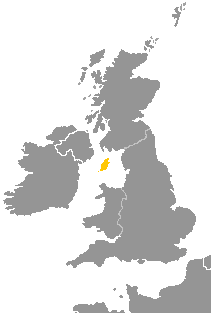
Manx, also known as Manx Gaelic, is a Gaelic language of the insular Celtic branch of the Celtic language family, itself a branch of the Indo-European language family. Manx is the historical language of the Manx people.
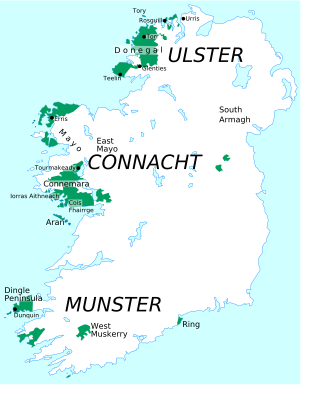
A Gaeltacht is a district of Ireland, either individually or collectively, where the Irish government recognises that the Irish language is the predominant vernacular, or language of the home. The Gaeltacht districts were first officially recognised during the 1920s in the early years of the Irish Free State, following the Gaelic revival, as part of a government policy aimed at restoring the Irish language.
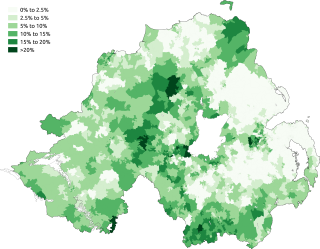
The Irish language is, since 2022, an official language in Northern Ireland. The main dialect spoken there is Ulster Irish. Protection for the Irish language in Northern Ireland stems largely from the European Charter for Regional or Minority Languages.
Although Irish has been used as a literary language for more than 1,500 years, and modern literature in Irish dates – as in most European languages – to the 16th century, modern Irish literature owes much of its popularity to the 19th century Gaelic Revival, a cultural and language revival movement, and to the efforts of more recent poets and writers. In an act of literary decolonization common to many other peoples seeking self-determination, writers in Irish have taken the advice of Patrick Pearse and have combined influences from both their own literary history and the whole of world literature. Writers in Modern Irish have accordingly produced some of the most interesting literature to come out of Ireland, while being both supplemented and influenced by poetry and prose composed in the Irish language outside Ireland.
Language revitalization, also referred to as language revival or reversing language shift, is an attempt to halt or reverse the decline of a language or to revive an extinct one. Those involved can include linguists, cultural or community groups, or governments. Some argue for a distinction between language revival and language revitalization. There has only been one successful instance of a complete language revival, the Hebrew language, creating a new generation of native speakers without any pre-existing native speakers as a model.
RTÉ Raidió na Gaeltachta, abbreviated RnaG, is an Irish language radio station owned and operated by Raidió Teilifís Éireann (RTÉ). The station is available on FM in Ireland and via satellite and on the Internet. It celebrated 40 years on air on 2 April 2012. The station's main-headquarters are in Casla, County Galway with major studios also in Gaoth Dobhair, County Donegal and Ballydavid, County Kerry.
Gaelicisation, or Gaelicization, is the act or process of making something Gaelic, or gaining characteristics of the Gaels, a sub-branch of celticisation. The Gaels are an ethno-linguistic group, traditionally viewed as having spread from Ireland to Scotland and the Isle of Man.

Thomas Brian Stowell, also known as Brian Mac Stoyll, was a Manx radio personality, linguist, physicist, and author. He was formerly Yn Lhaihder to the Parliament of the Isle of Man, Tynwald. He is considered one of the primary people behind the revival of the Manx language.
The history of the Irish language begins with the period from the arrival of speakers of Celtic languages in Ireland to Ireland's earliest known form of Irish, Primitive Irish, which is found in Ogham inscriptions dating from the 3rd or 4th century AD. After the conversion to Christianity in the 5th century, Old Irish begins to appear as glosses and other marginalia in manuscripts written in Latin, beginning in the 6th century. It evolved in the 10th century to Middle Irish. Early Modern Irish represented a transition between Middle and Modern Irish. Its literary form, Classical Gaelic, was used by writers in both Ireland and Scotland until the 18th century, in the course of which slowly but surely writers began writing in the vernacular dialects, Ulster Irish, Connacht Irish, Munster Irish and Scottish Gaelic. As the number of hereditary poets and scribes dwindled under British rule in the early 19th century, Irish became a mostly spoken tongue with little written literature appearing in the language until the Gaelic Revival of the late 19th century. The number of speakers was also declining in this period with monoglot and bilingual speakers of Irish increasingly adopting only English: while Irish never died out, by the time of the Revival it was largely confined to the less Anglicised regions of the island, which were often also the more rural and remote areas. In the 20th and 21st centuries, Irish has continued to survive in Gaeltacht regions and among a minority in other regions. It has once again come to be considered an important part of the island's culture and heritage, with efforts being made to preserve and promote it.
Shaw's Road is a road in west Belfast, Northern Ireland, connecting the Andersonstown Road with the Glen Road.

The North American Gaeltacht is a gathering place for Irish speakers in the community of Tamworth, Ontario, in Canada. The nearest main township is Erinsville, Ontario. Unlike in Ireland, where the term "Gaeltacht" refers to an area where Irish is the traditional language, this part of Ontario has no resident native Irish speakers. The name refers instead to its being a meeting place for Irish speakers from North America and elsewhere.

Irish, also known as Irish Gaelic or simply Gaelic, is a Goidelic language of the Insular Celtic branch of the Celtic language group, which is a part of the Indo-European language family. Irish is indigenous to the island of Ireland and was the population's first language until the 19th century, when English gradually became dominant, particularly in the last decades of the century. Today, Irish is still commonly spoken as a first language in Ireland's Gaeltacht regions, in which 2% of Ireland's population lived in 2022.
A Neo-Gaeltacht is an area where Irish has a strong presence as a spoken language but is not part of the officially defined or traditional Gaeltacht areas. It has been argued that non-Gaeltacht activist groups wishing to establish an Irish language community need to show that it is large, permanent and formally organised and that it has a growing number of people using Irish as their first language. Another objective is a situation in which children use Irish among themselves and with other Irish speakers in a natural way while being able to deal with a largely English-speaking world.
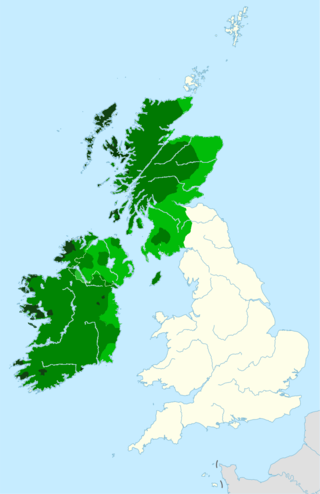
The Gaels are an ethnolinguistic group native to Ireland, Scotland and the Isle of Man. They are associated with the Gaelic languages: a branch of the Celtic languages comprising Irish, Manx and Scottish Gaelic.

Acadamh na hOllscolaíochta Gaeilge is a third level educational and research institution headquartered in Galway, Ireland. It was established as part of the National University of Ireland - Galway in 2004, to further the development Irish-medium education. The academy works in co-operation with faculties, departments and other university offices to develop the range and number of programmes that are provided through the medium of Irish on campus and in the academy's Gaeltacht centres.
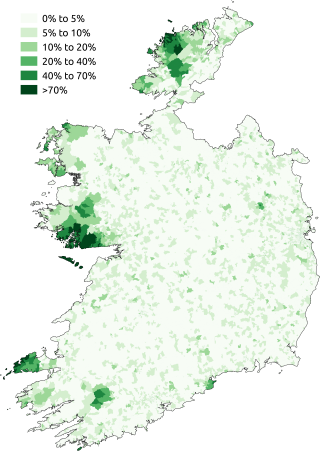
The official status of the Irish language has remained high in the Republic of Ireland from foundation. This reflects the dominance of the language in Irish cultural and social history until the nineteenth century and its role in Irish cultural identity. In 2022, strong recognition was added in Northern Ireland also. In the 2022 Republic of Ireland census 1,873,997 people or 39.8% of the population in the Republic of Ireland said that they had some ability to speak Irish, out of an overall population of 5,149,139. In Northern Ireland 228,600 people (12.4%) have some ability in the Irish language according to the 2021 census for Northern Ireland, out of a population of 1,903,175 people. It has been found, however, that while ideological support for Irish is high, actual routine use is very low, and that there is very little or rare correlation between personal fluency in the language and the perceived value of Irish as an identity-marker. Nevertheless, the language benefits from the support of activists who continue to use it as a social and cultural medium.
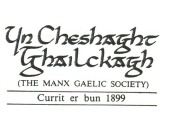
Yn Çheshaght Ghailckagh, also known as the Manx Language Society and formerly known as Manx Gaelic Society, was founded in 1899 in the Isle of Man to promote the Manx language. The group's motto is Gyn çhengey, gyn çheer.

Kevin Scannell is an American professor of mathematics and computer science at Saint Louis University.

Pobble is a Manx language advocacy group and charity that works to promote the Manx language as "a community asset" on the Isle of Man. Pobble has also awarded the Aundyr Brian Stowell since 2019.
