Related Research Articles
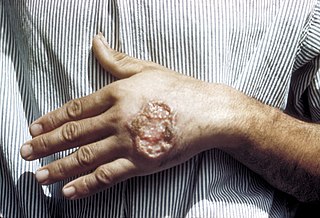
Leishmaniasis is a wide array of clinical manifestations caused by parasites of the Trypanosomatida genus Leishmania. It is generally spread through the bite of phlebotomine sandflies, Phlebotomus and Lutzomyia, and occurs most frequently in the tropics and sub-tropics of Africa, Asia, the Americas, and southern Europe. The disease can present in three main ways: cutaneous, mucocutaneous, or visceral. The cutaneous form presents with skin ulcers, while the mucocutaneous form presents with ulcers of the skin, mouth, and nose. The visceral form starts with skin ulcers and later presents with fever, low red blood cell count, and enlarged spleen and liver.

A nail disease or onychosis is a disease or deformity of the nail. Although the nail is a structure produced by the skin and is a skin appendage, nail diseases have a distinct classification as they have their own signs and symptoms which may relate to other medical conditions. Some nail conditions that show signs of infection or inflammation may require medical assistance.

A hematoma, also spelled haematoma, or blood suffusion is a localized bleeding outside of blood vessels, due to either disease or trauma including injury or surgery and may involve blood continuing to seep from broken capillaries. A hematoma is benign and is initially in liquid form spread among the tissues including in sacs between tissues where it may coagulate and solidify before blood is reabsorbed into blood vessels. An ecchymosis is a hematoma of the skin larger than 10 mm.
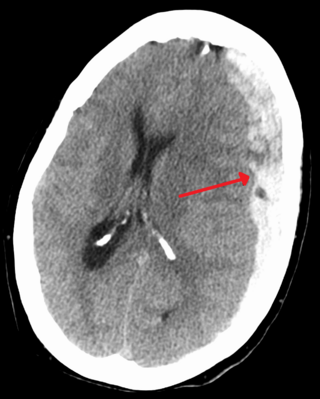
A subdural hematoma (SDH) is a type of bleeding in which a collection of blood—usually but not always associated with a traumatic brain injury—gathers between the inner layer of the dura mater and the arachnoid mater of the meninges surrounding the brain. It usually results from tears in bridging veins that cross the subdural space.

Epidural hematoma is when bleeding occurs between the tough outer membrane covering the brain and the skull. Often there is loss of consciousness following a head injury, a brief regaining of consciousness, and then loss of consciousness again. Other symptoms may include headache, confusion, vomiting, and an inability to move parts of the body. Complications may include seizures.

Purpura is a condition of red or purple discolored spots on the skin that do not blanch on applying pressure. The spots are caused by bleeding underneath the skin secondary to platelet disorders, vascular disorders, coagulation disorders, or other causes. They measure 3–10 mm, whereas petechiae measure less than 3 mm, and ecchymoses greater than 1 cm.
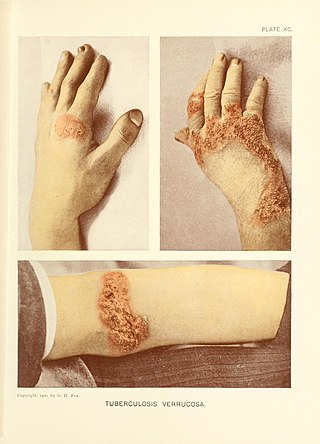
Tuberculosis verrucosa cutis is a rash of small, red papules and nodules in the skin that may appear two to four weeks after inoculation by Mycobacterium tuberculosis in a previously infected and immunocompetent individual.

A subungual hematoma is a collection of blood (hematoma) underneath a toenail or fingernail. It can be extremely painful for an injury of its size, although otherwise it is not a serious medical condition.

Subgaleal hemorrhage, also known as subgaleal hematoma, is bleeding in the potential space between the skull periosteum and the scalp galea aponeurosis.
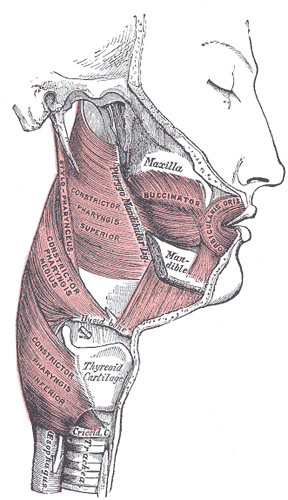
The buccal space is a fascial space of the head and neck. It is a potential space in the cheek, and is paired on each side. The buccal space is superficial to the buccinator muscle and deep to the platysma muscle and the skin. The buccal space is part of the subcutaneous space, which is continuous from head to toe.

Nasal septal hematoma is a condition affecting the nasal septum. It can be associated with trauma.

A blue nevus is a type of coloured mole, typically a single well-defined blue-black bump.
In medicine, Carnett's sign is a finding on clinical examination in which (acute) abdominal pain remains unchanged or increases when the muscles of the abdominal wall are tensed. For this part of the abdominal examination, the patient can be asked to lift the head and shoulders from the examination table to tense the abdominal muscles. An alternative is to ask the patient to raise both legs with straight knees.
Melanonychia is a black or brown pigmentation of a nail, and may be present as a normal finding on many digits in Afro-Caribbeans, as a result of trauma, systemic disease, or medications, or as a postinflammatory event from such localized events as lichen planus or fixed drug eruption.

Paroxysmal hand hematoma is a skin condition characterized by spontaneous focal hemorrhage into the palm or the volar surface of a finger, which results in transitory localized pain, followed by rapid swelling and localized blueish discoloration.
Paraneoplastic acrokeratosis, or Bazex syndrome is a cutaneous condition characterized by psoriasiform changes of hands, feet, ears, and nose, with involvement of the nails and periungual tissues being characteristic and indistinguishable from psoriatic nails. The condition is associated with carcinomas of the upper aerodigestive tract.

A myxoid cyst is a cutaneous condition often characterized by nail plate depression and grooves.
Breast hematoma is a collection of blood within the breast. It arises from internal bleeding (hemorrhage) and may arise due to trauma or due to a non-traumatic cause.
Spesolimab, sold under the brand name Spevigo, is a monoclonal antibody medication used for the treatment of generalized pustular psoriasis (GPP). It is an interleukin-36 receptor (IL1RL2/IL1RAP) antibody.
References
- ↑ Rapini, Ronald P.; Bolognia, Jean L.; Jorizzo, Joseph L. (2007). Dermatology: 2-Volume Set. St. Louis: Mosby. ISBN 978-1-4160-2999-1.
 | This cutaneous condition article is a stub. You can help Wikipedia by expanding it. |