Related Research Articles

Martha Graham was an American modern dancer and choreographer, whose style, the Graham technique, reshaped American dance and is still taught worldwide.

Lar Lubovitch is an American choreographer. He founded his own dance company, the Lar Lubovitch Dance Company in 1968. Based in New York City, the company has performed in all 50 American states as well as in more than 30 countries. As of 2005, he had choreographed more than 100 dances for the company. In addition to the company, Lubovitch has also done creative work in ballet, ice-skating venues, and musical theater, notably Into the Woods. He has played a key role in raising funds to fight AIDS.
Terese Capucilli is an American modern dancer, interpreter of the roles originally performed by Martha Graham. She is one of the last generation of dancers to be coached and directed by Graham herself. A principal dancer with the Martha Graham Dance Company for twenty-six years, she became associate artistic director in 1997 and from 2002 to 2005 served as artistic director, with Christine Dakin, seeing the organization and its dancers through the rebirth of the company. A driving force of Graham's work for nearly three decades, she is now Artistic Director Laureate.
Helgi Tomasson is an Icelandic choreographer, and a former professional ballet dancer. He served as artistic director and principal choreographer for San Francisco Ballet.

Episodes is a ballet choreographed by Martha Graham and George Balanchine, to compositions by Anton Webern. The ballet was a co-production between the Martha Graham Dance Company and Balanchine's New York City Ballet (NYCB). Though it was conceived to be a collaboration between Graham and Balanchine, leading choreographers in modern dance and neoclassical ballet respectively, they ultimately worked separately on the ballet's two halves. Episodes I was choreographed by Graham, for dancers from her company and four NYCB members, and depicts Mary, Queen of Scots remembering the events in her life before her execution. Episodes II, by Balanchine, is completely plotless, and made for members of the NYCB and Graham dancer Paul Taylor, who originated a solo. The ballet uses all seven orchestral compositions by Webern.
Sallie Wilson was a ballerina who appeared with New York City Ballet where she danced opposite Martha Graham in the premiere of Graham and George Balanchine's collaboration at NYCB, Episodes in May, 1959, and subsequently with American Ballet Theatre, where she was associated with several ballets created by Antony Tudor. In 1966, she achieved a triumph as Hagar in ABT's revival of Tudor's ballet Pillar of Fire, set to the music of Arnold Schoenberg's Transfigured Night. The ballet is loosely based on the poem that inspired the Schoenberg piece rather than the Biblical story of Hagar.
Modern dance is a broad genre of western concert or theatrical dance which includes dance styles such as ballet, folk, ethnic, religious, and social dancing; and primarily arose out of Europe and the United States in the late 19th and early 20th centuries. It was considered to have been developed as a rejection of, or rebellion against, classical ballet, and also a way to express social concerns like socioeconomic and cultural factors.
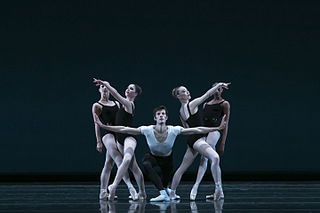
The Four Temperaments or Theme and Four Variations is an orchestral work and ballet by Paul Hindemith. Although it was originally conceived as a ballet for Léonide Massine, the score was ultimately completed as a commission for George Balanchine, who subsequently choreographed it as a neoclassical ballet based on the theory of the four temperaments.
The Martha Graham Dance Company, founded by Martha Graham in 1926, is both the oldest dance company in the United States and the oldest integrated dance company. The company is critically acclaimed in the artistic world and has been recognized as "one of the great dance companies of the world" by the New York Times and as "one of the seven wonders of the artistic universe" by the Washington Post.
Salem Shore is a solo modern dance work choreographed by Martha Graham to original music by Paul Nordoff. The piece premiered on December 26, 1943 at the 46th Street Theater in New York City. The ballet featured costumes by Edythe Gilfond and a set by Arch Lauterer. Program notes accompanying the first performance described the dance as "a ballad of a woman's longing for her beloved's return from the sea."
Maple Leaf Rag is a storyless Martha Graham ballet set to ragtime compositions by Scott Joplin. The work premiered on October 2, 1990 at New York City Center with costumes by Calvin Klein and lighting by David Finley. Chris Landriau arranged the music and played piano at the debut. The dance is a jubilant self-parody and an homage, of sorts, to Graham's mentor and musical director, Louis Horst, who would play the rag for her whenever she fell into a creative slump. Graham was 96 when she created Maple Leaf Rag; it is her last completed dance. In 1991, she began another work, The Eyes of the Goddess, but it was unfinished at the time of her death.
Insincerities, also known as Four Insincerities, is a solo modern dance work created by Martha Graham. The piece consists of four sections: Petulance, Remorse, Politeness and Vivacity performed to music by Serge Prokofiev. It premiered on January 20, 1929, at the Booth Theatre in New York City. Louis Horst accompanied Graham on piano.
Frontier is a solo dance choreographed by Martha Graham to music by Louis Horst. The set was designed by Isamu Noguchi; Graham created the costume. The work began as an ensemble piece, Perspectives: Frontier and Marching Song also known as Frontiers and Frontier. The ballet's Marching Song portion was set to music by Lehman Engle. The work premiered on April 28, 1935, at the Guild Theatre in New York City. By the end of 1935, Graham was performing Frontier exclusively as a solo. The piece was the first of her works to explore American identity through an archetypal character.
Novelette is a solo modern dance work choreographed by Martha Graham to an existing piece of music, Op. 99, No. 9 from Robert Schumann's Bunte Blätter, also known as Colored Leaves. The ninth movement from the piano solo, also titled Novelette, is a three-minute long piece in B-minor. The ballet premiered on April 18, 1926 at New York's 48 Street Theater in the first independent concert presented by Graham.
Immediate Tragedy, sometimes subtitled Dance of Dedication, was a modern dance solo choreographed by Martha Graham to the music of Henry Cowell. It premiered on July 30, 1937, at the Bennington School of the Dance in Bennington, Vermont. The piece was created in response to the Spanish Civil War and rising fascism as Francisco Franco gained control of the country.
Deep Song, a solo modern dance by Martha Graham, premiered on December 19, 1937, at the Guild Theatre in New York City. Performed to music by Henry Cowell, the piece was the second work created by Graham in response to the Spanish Civil War. The first, Immediate Tragedy, was introduced in 1937.
Horizons was a modern dance work choreographed by Martha Graham to music by Louis Horst with a set designed by Alexander Calder. It premiered on February 23, 1936, at the Guild Theatre in New York City. Horizons was divided into four parts, two ensemble dances and two solos: Migration: New Trails (ensemble), Dominion: Sanctified Power (solo), Building Motif: Homesteading (solo) and Dance of Rejoycing (ensemble). The ballet was performed by Martha Graham and Group, the predecessor of the Martha Graham Dance Company.
Fragilité was a modern dance solo choreographed by Martha Graham to music by Alexander Scriabin. The piece was originally part of Five Poems, a ballet divided into five solo sections: Fragilité, Lugubre, Poeme ailé, Danse Languide and Désir. Each of the sections appears in various programs as individual solos. Five Poems premiered on October 16, 1927, at the Little Theatre in New York City.
Revolt, initially called Danse, was a modern dance solo choreographed by Martha Graham to music by Arthur Honegger. It premiered with the original title on October 16, 1927, at the Little Theatre in New York City. By February 1928 it appeared in programs as Revolt.
Lila York is an American dancer and choreographer from New York City. She studied English literature at Skidmore College before studying ballet and modern dance at the Martha Graham Center of Contemporary Dance with Paul Sanasardo. York joined the Paul Taylor Dance Company in 1973, where she danced for more than a decade. After leaving the company, she left the "very heart of American modern dance" to become one of "ballet's most sought-after choreographers," working with many of the world's foremost ballet companies.
References
- ↑ "Praeludium (Ballet choreographed by Martha Graham)". Performing Arts Encyclopedia, Library of Congress. Retrieved 29 January 2016.
- ↑ Fisher, Marjory M. (March 31, 1936). "Martha Graham Dances Before 3000 Auditors". San Francisco News. Retrieved 29 January 2016.
- ↑ Freedman, Russell (1998). Martha Graham: A Dancer's Life . New York, Ny: Clarion Books. p. 75. ISBN 0-395-74655-8.
 | This ballet-related article is a stub. You can help Wikipedia by expanding it. |