Related Research Articles
In the mathematical field of algebraic topology, the fundamental group of a topological space is the group of the equivalence classes under homotopy of the loops contained in the space. It records information about the basic shape, or holes, of the topological space. The fundamental group is the first and simplest homotopy group. The fundamental group is a homotopy invariant—topological spaces that are homotopy equivalent have isomorphic fundamental groups.

Algebraic topology is a branch of mathematics that uses tools from abstract algebra to study topological spaces. The basic goal is to find algebraic invariants that classify topological spaces up to homeomorphism, though usually most classify up to homotopy equivalence.
In mathematics, the simplex category is the category of non-empty finite ordinals and order preserving maps. It is used to define simplicial and cosimplicial objects.
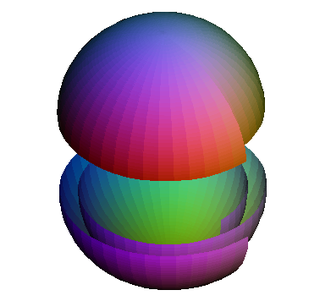
In the mathematical field of algebraic topology, the homotopy groups of spheres describe how spheres of various dimensions can wrap around each other. They are examples of topological invariants, which reflect, in algebraic terms, the structure of spheres viewed as topological spaces, forgetting about their precise geometry. Unlike homology groups, which are also topological invariants, the homotopy groups are surprisingly complex and difficult to compute.
In mathematics, particularly in homotopy theory, a model category is a category with distinguished classes of morphisms ('arrows') called 'weak equivalences', 'fibrations' and 'cofibrations'. These abstract from a conventional homotopy category of topological spaces or of chain complexes, via the acyclic model theorem. The concept was introduced by Daniel G. Quillen (1967).

In mathematics, particularly in algebraic topology, the n-skeleton of a topological space X presented as a simplicial complex refers to the subspace Xn that is the union of the simplices of X of dimensions m ≤ n. In other words, given an inductive definition of a complex, the n-skeleton is obtained by stopping at the n-th step.
The étale or algebraic fundamental group is an analogue in algebraic geometry, for schemes, of the usual fundamental group of topological spaces.
Segal's Burnside ring conjecture, or, more briefly, the Segal conjecture, is a theorem in homotopy theory, a branch of mathematics. The theorem relates the Burnside ring of a finite group G to the stable cohomotopy of the classifying space BG. The conjecture was made in the mid 1970s by Graeme Segal and proved in 1984 by Gunnar Carlsson. As of 2016, this statement is still commonly referred to as the Segal conjecture, even though it now has the status of a theorem.
In mathematics, higher category theory is the part of category theory at a higher order, which means that some equalities are replaced by explicit arrows in order to be able to explicitly study the structure behind those equalities. Higher category theory is often applied in algebraic topology, where one studies algebraic invariants of spaces, such as their fundamental weak ∞-groupoid.

In topology, the Vietoris–Rips complex, also called the Vietoris complex or Rips complex, is an abstract simplicial complex that can be defined from any metric space M and distance δ by forming a simplex for every finite set of points that has diameter at most δ. That is, it is a family of finite subsets of M, in which we think of a subset of k points as forming a (k − 1)-dimensional simplex ; if a finite set S has the property that the distance between every pair of points in S is at most δ, then we include S as a simplex in the complex.
In algebraic geometry and algebraic topology, branches of mathematics, A1homotopy theory is a way to apply the techniques of algebraic topology, specifically homotopy, to algebraic varieties and, more generally, to schemes. The theory is due to Fabien Morel and Vladimir Voevodsky. The underlying idea is that it should be possible to develop a purely algebraic approach to homotopy theory by replacing the unit interval [0, 1], which is not an algebraic variety, with the affine line A1, which is. The theory requires a substantial amount of technique to set up, but has spectacular applications such as Voevodsky's construction of the derived category of mixed motives and the proof of the Milnor and Bloch-Kato conjectures.
Shape theory is a branch of topology, which provides a more global view of the topological spaces than homotopy theory. The two coincide on compacta dominated homotopically by finite polyhedra. Shape theory associates with the Čech homology theory while homotopy theory associates with the singular homology theory.
In mathematics, a topos is a category that behaves like the category of sheaves of sets on a topological space. Topoi behave much like the category of sets and possess a notion of localization; they are a direct generalization of point-set topology. The Grothendieck topoi find applications in algebraic geometry; the more general elementary topoi are used in logic.
In mathematics, more specifically category theory, a quasi-category is a generalization of the notion of a category. The study of such generalizations is known as higher category theory.
In mathematical logic and computer science, homotopy type theory refers to various lines of development of intuitionistic type theory, based on the interpretation of types as objects to which the intuition of (abstract) homotopy theory applies.
In mathematics, more precisely, in the theory of simplicial sets, a simplicial group is a simplicial object in the category of groups. Similarly, a simplicial abelian group is a simplicial object in the category of abelian groups. A simplicial group is a Kan complex The Dold–Kan correspondence says that a simplicial abelian group may be identified with a chain complex.
In mathematics, a classifying topos for some sort of structure is a topos T such that there is a natural equivalence between geometric morphisms from a cocomplete topos E to T and the category of models for the structure in E.
Univalent foundations are an approach to the foundations of mathematics in which mathematical structures are built out of objects called types. Types in univalent foundations do not correspond exactly to anything in set-theoretic foundations, but they may be thought of as spaces, with equal types corresponding to homotopy equivalent spaces and with equal elements of a type corresponding to points of a space connected by a path. Univalent foundations are inspired both by the old Platonic ideas of Hermann Grassmann and Georg Cantor and by "categorical" mathematics in the style of Alexander Grothendieck. Univalent foundations depart from the use of classical predicate logic as the underlying formal deduction system, replacing it, at the moment, with a version of Martin-Löf type theory. The development of univalent foundations is closely related to the development of homotopy type theory.
This is a glossary of properties and concepts in algebraic topology in mathematics.
In mathematics, and in particular homotopy theory, a hypercovering is a simplicial object that generalises the Čech nerve of a cover. For the Čech nerve of an open cover , one can show that if the space is compact and if every intersection of open sets in the cover is contractible, then one can contract these sets and get a simplicial set that is weakly equivalent to in a natural way. For the étale topology and other sites, these conditions fail. The idea of a hypercover is to instead of only working with -fold intersections of the sets of the given open cover , to allow the pairwise intersections of the sets in to be covered by an open cover , and to let the triple intersections of this cover to be covered by yet another open cover , and so on, iteratively. Hypercoverings have a central role in étale homotopy and other areas where homotopy theory is applied to algebraic geometry, such as motivic homotopy theory.
References
- Edwards, David A.; Hastings, Harold M. (1980), "Čech theory: its past, present, and future", The Rocky Mountain Journal of Mathematics, 10 (3): 429–468, doi: 10.1216/RMJ-1980-10-3-429 , MR 0590209 .
- Edwards, David A.; Hastings, Harold M. (1976), Čech and Steenrod homotopy theories with applications to geometric topology, Lecture Notes in Mathematics, Vol. 542, Springer-Verlag, Berlin-New York, MR 0428322 .
 | This topology-related article is a stub. You can help Wikipedia by expanding it. |