
The Chandra X-ray Observatory (CXO), previously known as the Advanced X-ray Astrophysics Facility (AXAF), is a Flagship-class space telescope launched aboard the Space ShuttleColumbia during STS-93 by NASA on July 23, 1999. Chandra is sensitive to X-ray sources 100 times fainter than any previous X-ray telescope, enabled by the high angular resolution of its mirrors. Since the Earth's atmosphere absorbs the vast majority of X-rays, they are not detectable from Earth-based telescopes; therefore space-based telescopes are required to make these observations. Chandra is an Earth satellite in a 64-hour orbit, and its mission is ongoing as of 2024.

The Trifid Nebula is an H II region in the north-west of Sagittarius in a star-forming region in the Milky Way's Scutum–Centaurus Arm. It was discovered by Charles Messier on June 5, 1764. Its name means 'three-lobe'. The object is an unusual combination of an open cluster of stars, an emission nebula, a reflection nebula, and a dark nebula. Viewed through a small telescope, the Trifid Nebula is a bright and peculiar object, and is thus a perennial favorite of amateur astronomers.

The Eagle Nebula is a young open cluster of stars in the constellation Serpens, discovered by Jean-Philippe de Cheseaux in 1745–46. Both the "Eagle" and the "Star Queen" refer to visual impressions of the dark silhouette near the center of the nebula, an area made famous as the "Pillars of Creation" imaged by the Hubble Space Telescope. The nebula contains several active star-forming gas and dust regions, including the aforementioned Pillars of Creation. The Eagle Nebula lies in the Sagittarius Arm of the Milky Way.

Stephan's Quintet is a visual grouping of five galaxies of which four form the first compact galaxy group ever discovered. The group, visible in the constellation Pegasus, was discovered by Édouard Stephan in 1877 at the Marseille Observatory. The group is the most studied of all the compact galaxy groups. The brightest member of the visual grouping is NGC 7320, which has extensive H II regions, identified as red blobs, where active star formation is occurring.

Centaurus A is a galaxy in the constellation of Centaurus. It was discovered in 1826 by Scottish astronomer James Dunlop from his home in Parramatta, in New South Wales, Australia. There is considerable debate in the literature regarding the galaxy's fundamental properties such as its Hubble type and distance. It is the closest radio galaxy to Earth, as well as the closest BL Lac object, so its active galactic nucleus has been extensively studied by professional astronomers. The galaxy is also the fifth-brightest in the sky, making it an ideal amateur astronomy target. It is only visible from the southern hemisphere and low northern latitudes.
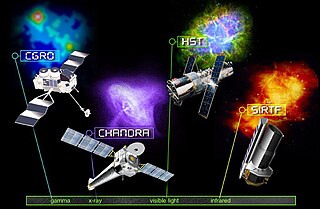
NASA's series of Great Observatories satellites are four large, powerful space-based astronomical telescopes launched between 1990 and 2003. They were built with different technology to examine specific wavelength/energy regions of the electromagnetic spectrum: gamma rays, X-rays, visible and ultraviolet light, and infrared light.

Messier 108 is a barred spiral galaxy about 46 million light-years away from Earth in the northern constellation Ursa Major. It was discovered by Pierre Méchain in 1781 or 1782. From the Earth, this galaxy is seen almost edge-on.

NGC 1365, also known as the Fornax Propeller Galaxy or the Great Barred Spiral Galaxy, is a double-barred spiral galaxy about 56 million light-years away in the constellation Fornax. It was discovered on 2 September 1826 by Scottish astronomer James Dunlop.
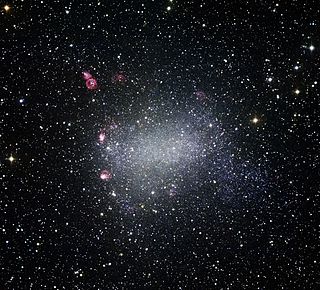
NGC 6822 is a barred irregular galaxy approximately 1.6 million light-years away in the constellation Sagittarius. Part of the Local Group of galaxies, it was discovered by E. E. Barnard in 1884, with a six-inch refractor telescope. It is the closest non-satellite galaxy to the Milky Way, but lies just outside its virial radius. It is similar in structure and composition to the Small Magellanic Cloud. It is about 7,000 light-years in diameter.

NGC 1097 is a barred spiral galaxy about 45 million light years away in the constellation Fornax. It was discovered by William Herschel on 9 October 1790. It is a severely interacting galaxy with obvious tidal debris and distortions caused by interaction with the companion galaxy NGC 1097A.
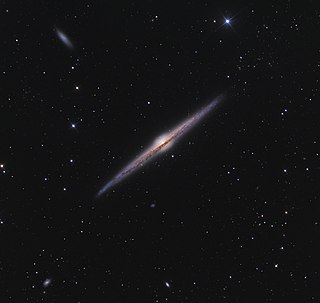
NGC 4565 is an edge-on spiral galaxy about 30 to 50 million light-years away in the constellation Coma Berenices. It lies close to the North Galactic Pole and has a visual magnitude of approximately 10. It is known as the Needle Galaxy for its narrow profile. First recorded in 1785 by William Herschel, it is a prominent example of an edge-on spiral galaxy.

NGC 6357 is a diffuse nebula near NGC 6334 in the constellation Scorpius. The nebula contains many proto-stars shielded by dark discs of gas, and young stars wrapped in expanding "cocoons" or expanding gases surrounding these small stars. It is also known as the Lobster Nebula. This nebula was given the name War and Peace Nebula by the Midcourse Space Experiment scientists because of its appearance, which, in infrared images the bright, western part resembles a dove, while the eastern part looks like a skull. A petition by anime fans to rename it as the Madokami nebula, due to resemblance with a character, was unsuccessful.
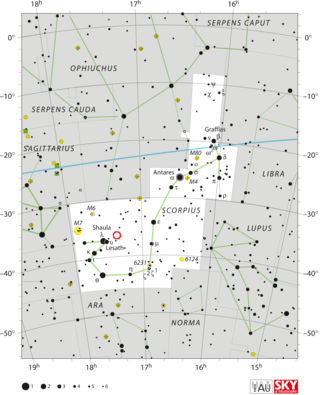
NGC 6334, colloquially known as the Cat's Paw Nebula, or Gum 64, is an emission nebula and star-forming region located in the constellation Scorpius. NGC 6334 was discovered by astronomer John Herschel in 1837, who observed it from the Cape of Good Hope in South Africa. The nebula is located in the Carina–Sagittarius Arm of the Milky Way, at a distance of approximately 5.5 kilolight-years from the Sun.

NGC 1333 is a reflection nebula located in the northern constellation Perseus, positioned next to the southern constellation border with Taurus and Aries. It was first discovered by German astronomer Eduard Schönfeld in 1855. The nebula is visible as a hazy patch in a small telescope, while a larger aperture will show a pair of dark nebulae designated Barnard 1 and Barnard 2. It is associated with a dark cloud L1450. Estimates of the distance to this nebula range from 980–1,140 ly (300–350 pc).
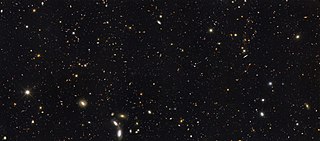
The Great Observatories Origins Deep Survey, or GOODS, is an astronomical survey combining deep observations from three of NASA's Great Observatories: the Hubble Space Telescope, the Spitzer Space Telescope, and the Chandra X-ray Observatory, along with data from other space-based telescopes, such as XMM Newton, and some of the world's most powerful ground-based telescopes.

RCW 49, also known as NGC 3247, is a H II region nebula located 13,700 light years away. Other designations for the RCW 49 region include NGC 3247 and G29 and it is commonly known as the Whirling Dervish Nebula. It is a dusty stellar nursery that contains more than 2,200 stars and is about 300-400 light years across. RCW 49 is recognized as among the brightest and most massive HII regions.
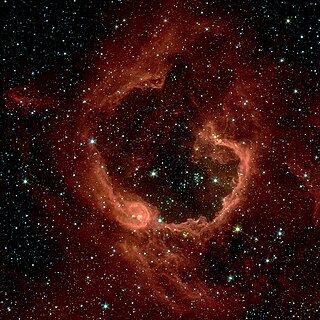
RCW 79 is an emission nebula in the constellation Centaurus.

NGC 6300 is a barred Seyfert spiral galaxy located in the constellation Ara. It is classified as SB(rs)b in the galaxy morphological classification scheme and was discovered by the Scottish astronomer James Dunlop on 30 June 1826. NGC 6300 is located at about 51 million light years away from Earth. It is suspected that a massive black hole may be at its center, pulling all the nearby objects into it. In turn, it emits large amounts of X-rays.

SN 2004et is a bright type IIP supernova that occurred in the spiral galaxy NGC 6946, about 22 million light years away from Earth. The star that made the supernova was falsely identified to be a yellow supergiant but was then identified to be a type red supergiant of 13.8 solar masses. It was discovered alongside SN 2017eaw. SN 2004et showed some rebrightening about 1,000 days after the initial supernova probably due to ejecta of circumstellar material or thermal echo. SN 2004et was one of the most luminous type IIP supernovae ever recorded and characterized.

G299.2-2.9 is a supernova remnant in the Milky Way, 16,000 light years from Earth. It is the remains of a Type Ia supernova. The observed radius of the remnant shell translates to approximately 4,500 years of expansion, making it one of the oldest observed Type Ia supernova remnants.


