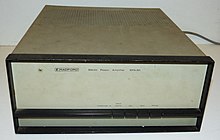
An amplifier, electronic amplifier or (informally) amp is an electronic device that can increase the magnitude of a signal. It is a two-port electronic circuit that uses electric power from a power supply to increase the amplitude of a signal applied to its input terminals, producing a proportionally greater amplitude signal at its output. The amount of amplification provided by an amplifier is measured by its gain: the ratio of output voltage, current, or power to input. An amplifier is defined as a circuit that has a power gain greater than one.
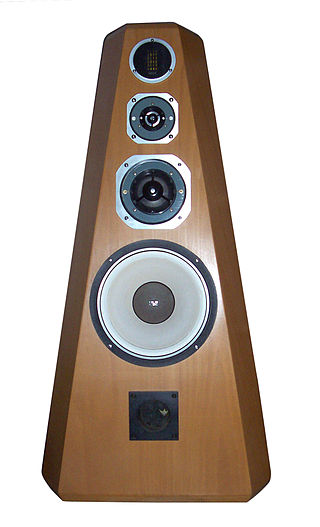
High fidelity is the high-quality reproduction of sound. It is popular with audiophiles and home audio enthusiasts. Ideally, high-fidelity equipment has inaudible noise and distortion, and a flat frequency response within the human hearing range.

An audio power amplifier amplifies low-power electronic audio signals, such as the signal from a radio receiver or an electric guitar pickup, to a level that is high enough for driving loudspeakers or headphones. Audio power amplifiers are found in all manner of sound systems including sound reinforcement, public address, home audio systems and musical instrument amplifiers like guitar amplifiers. It is the final electronic stage in a typical audio playback chain before the signal is sent to the loudspeakers.

An audiophile is a person who is enthusiastic about high-fidelity sound reproduction. The audiophile seeks to achieve high sound quality in the audio reproduction of recorded music, typically in a quiet listening space in a room with good acoustics.
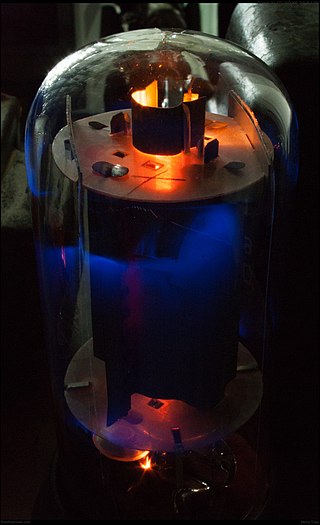
A valve amplifier or tube amplifier is a type of electronic amplifier that uses vacuum tubes to increase the amplitude or power of a signal. Low to medium power valve amplifiers for frequencies below the microwaves were largely replaced by solid state amplifiers in the 1960s and 1970s. Valve amplifiers can be used for applications such as guitar amplifiers, satellite transponders such as DirecTV and GPS, high quality stereo amplifiers, military applications and very high power radio and UHF television transmitters.
The Williamson amplifier is a four-stage, push-pull, Class A triode-output valve audio power amplifier designed by D. T. N. Williamson during World War II. The original circuit, published in 1947 and addressed to the worldwide do it yourself community, set the standard of high fidelity sound reproduction and served as a benchmark or reference amplifier design throughout the 1950s. The original circuit was copied by hundreds of thousands amateurs worldwide. It was an absolute favourite on the DIY scene of the 1950s, and in the beginning of the decade also dominated British and North American markets for factory-assembled amplifiers.
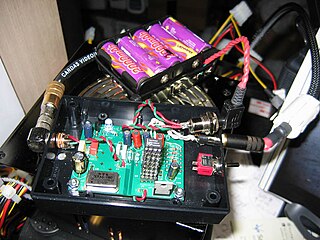
DIY Audio, do it yourself audio. Rather than buying a piece of possibly expensive audio equipment, such as a high-end audio amplifier or speaker, the person practicing DIY Audio will make it themselves. Alternatively, a DIYer may take an existing manufactured item of vintage era and update or modify it. The benefits of doing so include the satisfaction of creating something enjoyable, the possibility that the equipment made or updated is of higher quality than commercially available products and the pleasure of creating a custom-made device for which no exact equivalent is marketed. Other motivations for DIY audio can include getting audio components at a lower cost, the entertainment of using the item, and being able to ensure quality of workmanship.
Dynaco was an American hi-fi audio system manufacturer popular in the 1960s and 1970s for its wide range of affordable, yet high quality audio components. Founded by David Hafler and Ed Laurent in Philadelphia, Pennsylvania in 1955, it's best known product was the ST-70 tube stereo amplifier. They also manufactured other tube and solid state amplifiers, preamplifiers, radio tuners and bookshelf loudspeakers. Dynaco was liquidated in 1980, and the trademark is now owned by Radial Engineering Ltd.

QUAD Electroacoustics is a British manufacturer of hi-fi equipment, based Huntingdon, England. QUAD is part of the IAG Group, with corporate headquarters located in Shenzhen, China.
LEAK is the brand name for high-fidelity audio equipment made by H. J. Leak & Co. Ltd, of London, England. The company was founded in 1934 by Harold Joseph Leak and was sold to the Rank Organisation in January 1969. During the 1950s and 1960s, the company produced high-quality amplifiers, radio tuners, loudspeakers, pickups, tonearms and a turntable. The sale of the business to Rank saw an expanded range of models, and considerable further development of loudspeakers, but Rank was not able to position the brand to counter competition from Japanese electronics manufacturers, so by the late 1970s, electronics and speaker production ceased under the LEAK name.

A single-ended triode (SET) is a vacuum tube electronic amplifier that uses a single triode to produce an output, in contrast to a push-pull amplifier which uses a pair of devices with antiphase inputs to generate an output with the wanted signals added and the distortion components subtracted. Single-ended amplifiers normally operate in Class A; push-pull amplifiers can also operate in Classes AB or B without excessive net distortion, due to cancellation.
Musical Fidelity is a British producer of high-end audio equipment focusing on streaming music players, and its core product range of amplifiers of various types. Other products have included headphones, Digital-Analog Converters (DACs), CD players, Bluetooth Receivers, ‘all-in-one systems’. Founded in the United Kingdom in 1982, they are known for their unusual industrial design, Nuvistor tube use and Class-AB amplifiers.
A valve audio amplifier (UK) or vacuum tube audio amplifier (US) is a valve amplifier used for sound reinforcement, sound recording and reproduction.
Nelson Pass is a designer of audio amplifiers. Pass is vocal that listening tests remain valuable and that electrical measurements alone do not fully characterize the sound of an amplifier. Pass holds at least seven U.S. patents related to audio circuits.
Technical specifications and detailed information on the valve audio amplifier, including its development history.

Tube sound is the characteristic sound associated with a vacuum tube amplifier, a vacuum tube-based audio amplifier. At first, the concept of tube sound did not exist, because practically all electronic amplification of audio signals was done with vacuum tubes and other comparable methods were not known or used. After introduction of solid state amplifiers, tube sound appeared as the logical complement of transistor sound, which had some negative connotations due to crossover distortion in early transistor amplifiers. However, solid state amplifiers have been developed to be flawless and the sound is later regarded neutral compared to tube amplifiers. Thus the tube sound now means 'euphonic distortion.' The audible significance of tube amplification on audio signals is a subject of continuing debate among audio enthusiasts.

Naim Audio is a specialist British manufacturer of high-end audio amplifiers well known for their self described qualities of "pace, rhythm and timing".

The NAD 3020 is a stereo integrated amplifier by NAD Electronics, considered to be one of the most important components in the history of high fidelity audio. Launched in 1978, this highly affordable product delivered a good quality sound, which acquired a reputation as an audiophile amplifier of exceptional value. By 1998, the NAD 3020 had become the most well known and best-selling audio amplifier in history.

The Quad Electrostatic Loudspeaker (ESL) is the world's first production full-range electrostatic loudspeaker, launched in 1957 by Quad Electroacoustics, then known as the Acoustical Manufacturing Co. Ltd. The speaker is shaped somewhat like a home electric radiator curved slightly on the vertical axis. They are widely admired for their clarity and precision, but known to be difficult speakers to run and maintain.
A transmission line loudspeaker is a loudspeaker enclosure design which uses the topology of an acoustic transmission line within the cabinet, compared to the simpler enclosures used by sealed (closed) or ported designs. Instead of reverberating in a fairly simple damped enclosure, sound from the back of the bass speaker is directed into a long damped pathway within the speaker enclosure, which allows far greater control and use of speaker energy and the resulting sound.
FERRARI Pier Paolo - Italy - "RADFORD - Hi-Fi Legend" - SANDIT Editor, Bergamo - Italy - ISBN-10 : 8869283135