
Physical education, often abbreviated to Phys. Ed. or PE, is a subject taught in schools around the world. PE is taught during primary and secondary education and encourages psychomotor, cognitive, and affective learning through physical activity and movement exploration to promote health and physical fitness. When taught correctly and in a positive manner, children and teens can receive a storm of health benefits. These include reduced metabolic disease risk, improved cardiorespiratory fitness, and better mental health. In addition, PE classes can produce positive effects on students' behavior and academic performance. Research has shown that there is a positive correlation between brain development and exercising. Researchers in 2007 found a profound gain in English Arts standardized test scores among students who had 56 hours of physical education in a year, compared to those who had 28 hours of physical education a year.
Media literacy is an expanded conceptualization of literacy that includes the ability to access and analyze media messages as well as create, reflect and take action, using the power of information and communication to make a difference in the world. Media literacy is not restricted to one medium and is understood as a set of competencies that are essential for work, life, and citizenship. Media literacy education is the process used to advance media literacy competencies, and it is intended to promote awareness of media influence and create an active stance towards both consuming and creating media. Media literacy education is part of the curriculum in the United States and some European Union countries, and an interdisciplinary global community of media scholars and educators engages in knowledge and scholarly and professional journals and national membership associations.
The Association of College and Research Libraries defines information literacy as a "set of integrated abilities encompassing the reflective discovery of information, the understanding of how information is produced and valued and the use of information in creating new knowledge and participating ethically in communities of learning". In the United Kingdom, the Chartered Institute of Library and Information Professionals' definition also makes reference to knowing both "when" and "why" information is needed.
Technology education is the study of technology, in which students "learn about the processes and knowledge related to technology". As a field of study, it covers the human's ability to shape and change the physical world to meet needs, by manipulating materials and tools with techniques. It addresses the disconnect between wide usage and the lack of knowledge about technical components of technologies used and how to fix them. This emergent discipline seeks to contribute to the learners' overall scientific and technological literacy, and technacy.

Health education is a profession of educating people about health. Areas within this profession encompass environmental health, physical health, social health, emotional health, intellectual health, and spiritual health, as well as sexual and reproductive health education.
Technological literacy is the ability to use, manage, understand, and assess technology. Technological literacy is related to digital literacy in that when an individual is proficient in using computers and other digital devices to access the Internet, digital literacy gives them the ability to use the Internet to discover, review, evaluate, create, and use information via various digital platforms, such as web browsers, databases, online journals, magazines, newspapers, blogs, and social media sites.

The University of La Laguna is a public research university situated in San Cristóbal de La Laguna, on the island of Tenerife, Spain. It is the oldest university in the Canary Islands. The university has six campuses: Central, Anchieta, Guajara, Campus del Sur, Ofra and Santa Cruz de Tenerife.
A parent education program is a course that can be followed to correct and improve a person's parenting skills. Such courses may be general, covering the most common issues parents may encounter, or specific, for infants, toddlers, children and teenagers. These courses may also be geared towards parents who are considering having a child, or adopting one, or are pregnant.
Education in Tanzania is provided by both the public and private sectors, starting with pre-primary education, followed by primary, secondary ordinary, secondary advanced, and ideally, university level education. Free and accessible education is a human right in Tanzania. The Tanzanian government began to emphasize the importance of education shortly after its independence in 1961. Curriculum is standardized by level, and it is the basis for the national examinations. Achievement levels are important, yet there are various causes of children not receiving the education that they need, including the need to help families with work, poor accessibility, and a variety of learning disabilities. While there is a lack of resources for special needs education, Tanzania has committed to inclusive education and attention on disadvantaged learners, as pointed out in the 2006 Education Sector Review AIDE-MEMORE. The government's National Strategy for Growth and Reduction of Poverty in 2005 heavily emphasized on education and literacy.

Health literacy is the ability to obtain, read, understand, and use healthcare information in order to make appropriate health decisions and follow instructions for treatment. There are multiple definitions of health literacy, in part, because health literacy involves both the context in which health literacy demands are made and the skills that people bring to that situation.

Information and media literacy (IML) enables people to show and make informed judgments as users of information and media, as well as to become skillful creators and producers of information and media messages. IML is a combination of information literacy and media literacy. The transformative nature of IML includes creative works and creating new knowledge; to publish and collaborate responsibly requires ethical, cultural and social understanding.

Education in Somalia refers to the academic system within Somalia. The Ministry of Education is officially responsible for education in Somalia, with about 15% of the nation's budget allocated to scholastic instruction. The breakaway republic of Somaliland maintains its own advanced Ministry of Education.

Education in Mali is considered a fundamental right of Malians. For most of Mali's history, the government split primary education into two cycles which allowed Malian students to take examinations to gain admission to secondary, tertiary, or higher education. Mali has recently seen large increases in school enrollment due to educational reforms.
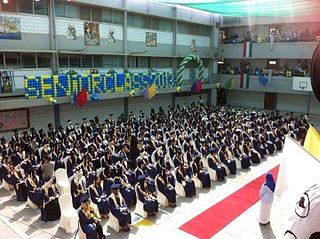
The State of Kuwait, located at the head of the Persian Gulf, supports an educational policy that seeks to provide an opportunity to all children, irrespective of their social class, including children with special needs. Kuwait was ranked 63rd on the Human Development Index report for 2011 by the United Nations Development Programme, placing Kuwait above the regional average.
Literacy in the United States was categorized by the National Center for Education Statistics into different literacy levels, with 92% of American adults having at least "Level 1" literacy in 2014. Nationally, over 20% of adult Americans have a literacy proficiency at or below Level 1. Adults in this range have difficulty using or understanding print materials. Those on the higher end of this category can perform simple tasks based on the information they read, but adults below Level 1 may only understand very basic vocabulary or be functionally illiterate. According to a 2020 report by the U.S. Department of Education, 54% of adults in the United States have English prose literacy below the 6th-grade level.

Education in South Sudan is modelled after the educational system of the Republic of Sudan. Primary education consists of eight years, followed by four years of secondary education, and then four years of university instruction; the 8 + 4 + 4 system, in place since 1990. The primary language at all levels is English, as compared to the Republic of Sudan, where the language of instruction is Arabic. There is a severe shortage of English teachers and English-speaking teachers in the scientific and technical fields.

Miguel Rodríguez Martinez is a Spanish table tennis player who competes in a wheelchair. He has been the Spanish national champion in the men's single championship in 2011, 2012 and 2012, and has been internationally ranked. He has represented Spain at the 2012 Summer Paralympics.

The Instituto Nacional para la Educación de los Adultos, abbreviated INEA, is a decentralized public organization of the Mexican federal public administration, grouped in the sector coordinated by the Ministry of Education Public, with legal personality and its own patrimony, created by presidential decree on August 31, 1981.
TECH is a private international university / educational group that provides online education worldwide. The educational group was founded in 2015, starting its activity in Latin America, where it has its main university: TECH Mexico. It is considered as the world's largest online university by Forbes.

Borja Casillas Toledo, known professionally as Drag Sethlas, is a Spanish drag performer known for competing on season 2 of Drag Race España, as well as winning the Drag Queen Gala of the Carnival of Las Palmas in 2017 and 2020.

