Related Research Articles

The National Autonomous University of Mexico is a public research university in Mexico. It is consistently ranked as one of the best universities in Latin America, where it's also the biggest in terms of enrollment. A portion of UNAM's main campus in Mexico City, known as Ciudad Universitaria, is a UNESCO World Heritage site that was designed by some of Mexico's best-known architects of the 20th century and hosted the 1968 Summer Olympic Games. Murals in the main campus were painted by some of the most recognized artists in Mexican history, such as Diego Rivera and David Alfaro Siqueiros. With acceptance rates usually below 10%, UNAM is also known for its competitive admission process. All Mexican Nobel laureates are either alumni or faculty of UNAM.

San Luis Potosí, commonly called SLP or simply San Luis, is the capital and the most populous city of the Mexican state of San Luis Potosí. It is the municipal seat of the surrounding municipality of San Luis Potosí. The city lies at an elevation of 1,864 metres. It has an estimated population of 824,229 in the city proper and a population of approximately 1,221,526 in its metropolitan area, formed with the neighbour city of Soledad de Graciano Sánchez and other surrounding municipalities, which makes the metropolitan area of Greater San Luis Potosí the eleventh largest in Mexico.
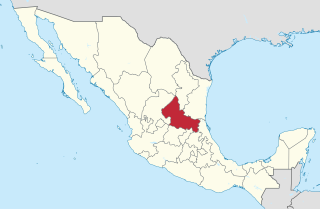
San Luis Potosí, officially the Free and Sovereign State of San Luis Potosí, is one of the 32 states which compose the Federal Entities of Mexico. It is divided in 58 municipalities and its capital city is San Luis Potosí City.
San Luis Potosí is a state in North Central Mexico that is divided into 58 municipalities. According to the 2020 Mexican Census, it is the 19th most populated of Mexico's 31 states, with 2,822,255 inhabitants and the 15th largest by land area spanning 61,138.0 square kilometres (23,605.5 sq mi). The largest municipality by population is the city of San Luis Potosí, with 911,908 residents, while the smallest is Armadillo with 4,013 residents. The largest municipality by land area is Santo Domingo which spans 4,322.60 km2 (1,669.0 sq mi), and the smallest is Huehuetlán with 71.50 km2 (27.61 sq mi). The newest municipalities are El Naranjo, created out of Ciudad del Maíz, and Matlapa, carved from Tamazunchale, both established in 1994.
Federal Highway 85 connects Mexico City with the Mexico–United States border at Nuevo Laredo, Tamaulipas. Highway 85 runs through Monterrey, Nuevo León; Ciudad Victoria, Tamaulipas; Ciudad Valles, San Luis Potosí; and Pachuca, Hidalgo. It ends at the intersection of Highway 95 in the San Pedro area of Mexico City. Highway 85 is the original route of the Pan-American Highway from the border to the capital as well as the Inter-American Highway.
Rioverde is a city and its surrounding municipality located in the south-central part of the state of San Luis Potosí, Mexico. It is the fifth-most populated city in the state, behind San Luis Potosí, Soledad de Graciano Sánchez, Ciudad Valles, and Matehuala. It is the agricultural, economic, turistic and demographic most important core in the Zona Media, one of the four geographical divisions of the state. The city had a 2005 census population of 49,183, while the municipality, of which it serves as municipal seat, had a population of 85,945 and an area extent of 3,109.71 km². The population of its metropolitan area, which includes the largest municipality of Ciudad Fernández, was 126,997.

Ciudad Valles is the second-largest city in the Mexican state of San Luis Potosí. It is located in the eastern part of the state, in the cultural region of Huasteca. The city is also the municipal seat of the surrounding municipality of the same name. The city had a 2014 census population of 176,935.

The Tamaulipas Institute of Higher Education, or IEST for its acronym in Spanish, is a private university in Altamira, Tamaulipas, Mexico founded in 1974. It is one of the most recognized universities along with ITESM Campus Tampico in the southern area of the state of Tamaulipas. It serves all the metropolitan area of Tampico, Ciudad Madero and Altamira, the northern part of the state of Veracruz and the eastern part of the state of San Luis Potosí. Its campus consist of Campus Altamira, and Campus Cd. Valles located in Ciudad Valles, San Luís Potosí.
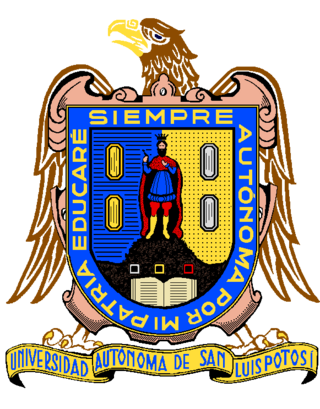
The Autonomous University of San Luis Potosí is a public university in Mexico. It is the largest, oldest, and most comprehensive university in the state of San Luis Potosí, as well as one of the most important ones in Mexico. Among other historic milestones, in 1923, UASLP was the first university in Mexico to have autonomy constitutionally granted.

Arturo Estrada Hernández is a Mexican painter, one of a group of Frida Kahlo’s students called “Los Fridos.” Estrada is mostly known for his mural work, which remains faithful to the figurative style and ideology of Mexican muralism. He has created murals in various parts of Mexico in both public and private places, including a 1988 mural found in the Centro Médico metro station in Mexico City. He has also taught classes at the Escuela Nacional de Pintura, Escultura y Grabado "La Esmeralda", where he was a student, since 1948 and continues to give classes there and other venues. He lives in his birthplace: Panindicuaro, Michoacán.

Fernando Leal was one of the first painters to participate in the Mexican muralism movement starting in the 1920s. After seeing one of his paintings, Secretary of Education José Vasconcelos invited Leal to paint at the Escuela Nacional Preparatoria. The resulting work is Los danzantes de Chalma. Leal also painted a mural dedicated to Simón Bolívar at the Anfiteatro Bolivar, as well as religious murals such as those at the chapel dedicated to the Virgin of Guadalupe at the Basilica Villa in Tepeyac.
Events in the year 1982 in Mexico.
Events from the year 1928 in Mexico
Events in the year 1984 in Mexico.
Events in the year 1962 in Mexico.
Events in the year 1969 in Mexico.
Delia Guerrero Coronado is a Mexican politician from the Institutional Revolutionary Party. She serves as a federal deputy to the LXIII Legislature of the Mexican Congress representing San Luis Potosí and the second electoral region.

Saturnino Cedillo Martínez was a Mexican politician who participated in the Mexican Revolution and the Cristero War. He was governor of San Luis Potosí from 1927 to 1931 through the Partido Nacional Revolucionario (PNR) and served as Secretary of Agriculture on two occasions, one under President Pascual Ortiz Rubio and again under President Lázaro Cárdenas. He maintained de facto control of his home state until shortly before his death. He "was the last of the great military caciques of the Mexican Revolution who maintained his own quasi-private personal army," building a fiefdom in the state of San Luis Potosí. He rose in rebellion against Cárdenas and was killed.
References
- 1 2 Camp, Roderic Ai (6 November 2014). Mexican Political Biographies, 1884–1934. University of Texas Press. ISBN 978-0-292-75603-8.
- ↑ "Rafael Curiel Gallegos, retrato". Mediateca - Instituto Nacional de Antropología e Historia (in Spanish). Retrieved 14 August 2020.
- ↑ Diaz, Julian. "Rafael Curiel Gallegos: El constituyente vallense". www.juliandiaz.mx (in European Spanish). Retrieved 14 August 2020.
- ↑ Gallegos, Secundaria Rafael Curiel. "CONTRIBUIMOS EN LA FORMACIÓN DE JÓVENES EXITOSOS". Secundaria Rafael Curiel Gallegos (in Mexican Spanish). Retrieved 14 August 2020.
  | This biographical article related to the military of Mexico is a stub. You can help Wikipedia by expanding it. |