Related Research Articles

In Māori mythology, Tāwhirimātea is the god of weather, including thunder and lightning, wind, clouds and storms. He is a son of Papatūānuku and Ranginui. Tawhirimatea is the second oldest of 7 children, all of whom are boys. In his anger at his brothers for separating their parents, Tāwhirimātea destroyed the forests of Tāne, drove Tangaroa and his progeny into the sea, pursued Rongo and Haumia-tiketike till they had to take refuge in the bosom of their mother Papa, and only found in Tūmatauenga a worthy opponent and eternal enemy. To fight his brothers, Tāwhirimātea gathered an army of his children, winds and clouds of different kinds - including Apū-hau, Apū-matangi, Ao-nui, Ao-roa, Ao-pōuri, Ao-pōtango, Ao-whētuma, Ao-whekere, Ao-kāhiwahiwa, Ao-kānapanapa, Ao-pākinakina, Ao-pakarea, and Ao-tākawe. Grey translates these as 'fierce squalls, whirlwinds, dense clouds, massy clouds, dark clouds, gloomy thick clouds, fiery clouds, clouds which preceded hurricanes, clouds of fiery black, clouds reflecting glowing red light, clouds wildly drifting from all quarters and wildly bursting, clouds of thunder storms, and clouds hurriedly flying on'.

In Cook Islands mythology, Avatea was a lunar deity and the father of gods and men in Mangaian myth of origin. His eyes were thought to be the Sun and the Moon; he was also known as the god of light.

A storm is any disturbed state of the natural environment or the atmosphere of an astronomical body. It may be marked by significant disruptions to normal conditions such as strong wind, tornadoes, hail, thunder and lightning, heavy precipitation, heavy freezing rain, strong winds, wind transporting some substance through the atmosphere such as in a dust storm, among other forms of severe weather.

The Burns' Day Storm was an extremely violent windstorm that took place on 25–26 January 1990 over North-Western Europe. It is one of the strongest European windstorms on record. This storm has received different names, as there was no official list of such events in Europe at the time. Starting on Burns Day, the birthday of the Scottish poet Robert Burns, it caused widespread damage and hurricane-force winds over a wide area.

Fūjin or Fūten, sometimes also known as Ryobu, is the Japanese god of the wind and one of the eldest Shinto gods. He is portrayed as a terrifying wizardly demon, resembling a red-headed green-skinned humanoid wearing a leopard skin, carrying a large bag of winds on his shoulders. In Japanese art, the deity is often depicted together with Raijin, the god of lightning, thunder and storms.
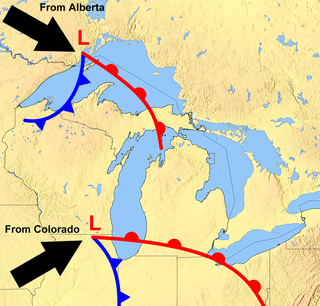
The Great Lakes Storm of 1913 was a blizzard with hurricane-force winds that devastated the Great Lakes Basin in the Midwestern United States and Southwestern Ontario, Canada, from November 7 to 10, 1913. The storm was most powerful on November 9, battering and overturning ships on four of the five Great Lakes, particularly Lake Huron.

The Daughter of the Lioness series by Tamora Pierce is a series of two novels set in the fictional Tortall universe. It is centered on Alianne of Pirate's Swoop, the sixteen-year-old daughter of Tortall's legendary lady knight, Alanna the Lioness, who was the subject of The Song of the Lioness quartet. The novels take place approximately 24 years after the last book in the quartet, Lioness Rampant.
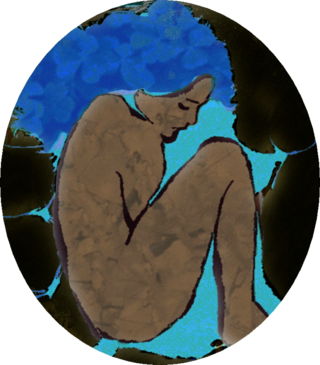
In Cook Islands mythology, Varima-te-takere also called Vari, was the primordial mother of the gods and mortals.
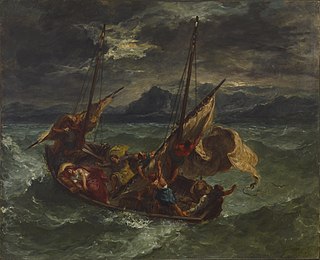
Matthew 8:26 is a verse in the eighth chapter of the Gospel of Matthew in the New Testament.
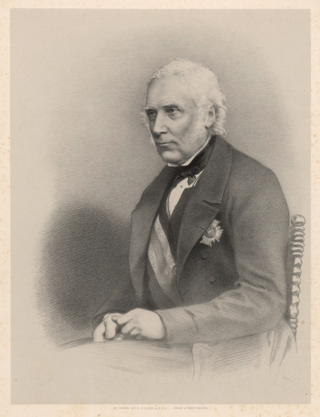
Major General Sir William Reid was a Scottish military engineer, administrator and meteorologist. He was Governor of the Bermudas (1839–1846), of the British Windward Islands (1846–1848), and of Malta (1851–1858). Reid founded the Bermuda National Library in 1839.

Gilles de Rais, Baron de Rais, was a knight and lord from Brittany, Anjou and Poitou, a leader in the French army, and a companion-in-arms of Joan of Arc. He is best known for his reputation and later conviction as a confessed serial killer of children.
The Five Islands Nature Reserve is a protected nature reserve located in the Tasman Sea, off the Illawarra east coast of the state of New South Wales, Australia. The 26-hectare (64-acre) reserve comprises five continental islands that are situated between 0.5 and 3.5 kilometres east of Port Kembla. The Five Islands are Flinders Islet, Bass Islet, Martin Islet, Big Island and Rocky Islet.
In Cook Islands mythology, Tumu-te-ana-oa was the female personification of Echo. She was the fourth child of Vari, the primordial mother goddess. Both her name and the land she occupied had to do with the production of echoes. Her name means "the cause (tumu) of the call or voice (oa) heard from caves (ana)". The term oa is used by people when calling out to evoke an echo. Her land was Te Parae-tea, which Gill translates, "The-hollow-gray-rocks". Mamae gives no more detail, but Gill recounts that Tumu-te-ana-oa frequented the caves of Mangaia, where she was seen by Rangi, one of the first inhabitants. The cave in which she was first seen was Aitu-mamaoa.
In Cook Islands mythology, Tu-metua was the sixth child and most beloved daughter of the mother goddess, Vari. Tu-metua lived in Te-enua-te-ki "The-mute-land". This was a place said to have no spoken language, but communication only by signs—such as nods, raised eyebrows, grimaces, and smiles. Gill states that Vari and Tu-metua lived together in Enua-te-ki, but he was in error in treating Te Aiti as a descriptive word and not as Vari's own distinct land. Mamae's native text, however, shows that the two lands were close together. It also explains the meaning of Tu-metua's name, which differs from Gill's translation as "Stick-to-the-parent".
In Cook Islands mythology, Tango (Support) was the third child of the primordial mother goddess, Varima-te-takere. He was assigned to live at Enua-kura. According to Mamae, Gill's informant, Tango was the progenitor of a skilled fishing family. That the six grandsons of Tango were good workers is shown in the native text. The enclosure (akeke) for fish mentioned in a chant has not been retained in the local culture of the people.

Oleg, or also known by its conventional long name Oleg Tamulilingan or Oleg Tambulilingan) is a form of traditional Balinese dance originated from the Indonesian island of Bali which featured unique dance movements that symbolizes the wild life of bumblebees, thus sometimes it is also colloquially known as 'Balinese bumblebee dance'.
References
- ↑ Te Rangi Hiroa (1934). Mangaian Society: Children of Vari. Bernice P. Bishop Museum, Bulletin 122. p. 12.
- ↑ William Wyatt Gill (1876). Myths and Songs from the South Pacific. London: Henry S. King & Co. p. 5.