
Look up rattle in Wiktionary, the free dictionary.
Rattle may refer to:
Rattle may refer to:


A cappella music is a performance by a singer or a singing group without instrumental accompaniment, or a piece intended to be performed in this fashion. The term a cappella was originally intended to differentiate between Renaissance polyphony and Baroque concertato musical styles. In the 19th century, a renewed interest in Renaissance polyphony, coupled with an ignorance of the fact that vocal parts were often doubled by instrumentalists, led to the term coming to mean unaccompanied vocal music. The term is also used, rarely, as a synonym for alla breve.
Band or BAND may refer to:

A percussion instrument is a musical instrument that is sounded by being struck or scraped by a beater including attached or enclosed beaters or rattles struck, scraped or rubbed by hand or struck against another similar instrument. Excluding zoomusicological instruments and the human voice, the percussion family is believed to include the oldest musical instruments. In spite of being a very common term to designate instruments, and to relate them to their players, the percussionists, percussion is not a systematic classificatory category of instruments, as described by the scientific field of organology. It is shown below that percussion instruments may belong to the organological classes of idiophone, membranophone, aerophone and cordophone.
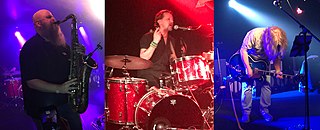
The Choir is an atmospheric Christian alternative rock band currently comprising Derri Daugherty on guitar and vocals, Steve Hindalong on drums, and Dan Michaels on saxophone and lyricon. Long-time bassist Tim Chandler died in 2018, and guitarist Marc Byrd was the fifth member of the band between 2005–2014. As of 2023, the band has released 18 full-length studio albums, three EPs, five live albums, one single-disc compilation, one retrospective box set, and is still actively recording new material.

The kazoo is an American musical instrument that adds a "buzzing" timbral quality to a player's voice when the player vocalizes into it. It is a type of mirliton, one of a class of instruments which modifies its player's voice by way of a vibrating membrane of goldbeater's skin or material with similar characteristics.

Contemporary Christian music (CCM), also known as Christian pop, and occasionally inspirational music, is a genre of modern popular music, and an aspect of Christian media, which is lyrically focused on matters related to the Christian faith and stylistically rooted in Christian music. It was formed by those affected by the 1960s Jesus movement revival who began to express themselves in other styles of popular music, beyond the church music of hymns, gospel and Southern gospel music that was prevalent in the church at the time. Initially referred to as Jesus music, today, the term is typically used to refer to pop, but also includes rock, alternative rock, hip hop, metal, contemporary worship, punk, hardcore punk, Latin, electronic dance music, R&B-influenced gospel, and country styles.
Given the vastness of the African continent, its music is diverse, with regions and nations having many distinct musical traditions. African music includes the genres amapiano, Jùjú, Fuji, Afrobeat, Highlife, Makossa, Kizomba, and others. African music also uses a large variety of instruments across the continent. The music and dance of the African diaspora, formed to varying degrees on African musical traditions, include American music like Dixieland jazz, blues, jazz, and many Caribbean genres, such as calypso and soca. Latin American music genres such as cumbia, salsa music, son cubano, rumba, conga, bomba, samba and zouk were founded on the music of enslaved Africans, and have in turn influenced African popular music.

The toy piano, also known as the kinderklavier, is a small piano-like musical instrument. Most modern toy pianos use round metal rods, as opposed to strings in a regular piano, to produce sound. The U.S. Library of Congress recognizes the toy piano as a unique instrument with the subject designation, Toy Piano Scores: M175 T69. The most famous example of a dedicated composition for the instrument is the "Suite for Toy Piano" (1948) by John Cage.
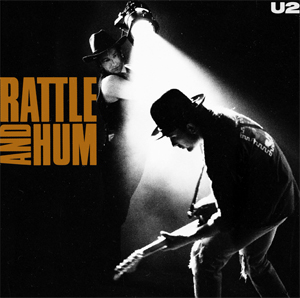
Rattle and Hum is a hybrid live/studio album by Irish rock band U2, and a companion rockumentary film directed by Phil Joanou. The album was produced by Jimmy Iovine and was released on 10 October 1988, while the film was distributed by Paramount Pictures and was released on 27 October 1988. Following the breakthrough success of the band's previous studio album, The Joshua Tree, the Rattle and Hum project captures their continued experiences with American roots music on the Joshua Tree Tour, further incorporating elements of blues rock, folk rock, and gospel music into their sound. A collection of new studio tracks, live performances, and cover songs, the project includes recordings at Sun Studio in Memphis and collaborations with Bob Dylan, B. B. King, and Harlem's New Voices of Freedom gospel choir.
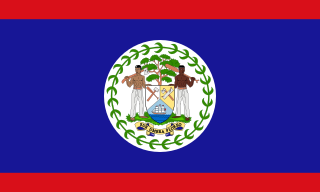
The music of Belize has a mix of Creole, Mestizo, Garìfuna, Mayan and European influences.
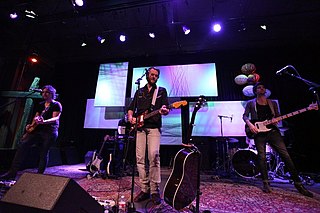
Contemporary worship music (CWM), also known as praise and worship music, is a defined genre of Christian music used in contemporary worship. It has developed over the past 60 years and is stylistically similar to pop music. The songs are frequently referred to as "praise songs" or "worship songs" and are typically led by a "worship band" or "praise team", with either a guitarist or pianist leading. It has become a common genre of music sung in many churches, particularly in charismatic or non-denominational Protestant churches with some Roman Catholic congregations incorporating it into their mass as well.

A sistrum is a musical instrument of the percussion family, used most notably by the ancient Egyptians. It consists of a handle and a U-shaped metal frame, made of brass or bronze and ranging from 30–76 cm (12–30 in) in width. When shaken, the small rings or loops of thin metal on its movable crossbars produce a sound that can vary from a soft clank to a loud jangling. Its name in the ancient Egyptian language was sekhem (sḫm) or sesheshet (sššt) because of the sound it made when it rattled.The ancient Egyptian sistrum had important associations with religious and ritualistic practices concerning various musical and joyful deities.

Indigenous music of North America, which includes American Indian music or Native American music, is the music that is used, created or performed by Indigenous peoples of North America, including Native Americans in the United States and Aboriginal peoples in Canada, Indigenous peoples of Mexico, and other North American countries—especially traditional tribal music, such as Pueblo music and Inuit music. In addition to the traditional music of the Native American groups, there now exist pan-Indianism and intertribal genres as well as distinct Native American subgenres of popular music including: rock, blues, hip hop, classical, film music, and reggae, as well as unique popular styles like chicken scratch and New Mexico music.
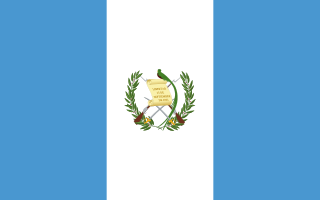
The music of Guatemala is diverse. Music is played all over the country. Towns also have wind and percussion bands that play during the lent and Easter-week processions as well as on other occasions. The marimba is an important instrument in Guatemalan traditional songs. The oldest documented use of marimba in the Americas dates to 1680 during celebrations at Santiago de los Caballeros de Guatemala.
Blackfoot music is the music of the Blackfoot people. Singing predominates and was accompanied only by percussion.

A monkey stick is a traditional English percussion instrument, used in folk music. Some musicians have taken to fixing a small stuffed toy monkey to the tops of their instruments.

"Angel of Harlem" is a song by Irish rock band U2. It is the tenth track on their 1988 album Rattle and Hum, and was released as its second single in December 1988. It topped the charts in Canada and New Zealand, and peaked at number nine on the UK Singles Chart, number eight on the Dutch Top 40, number 14 on the Billboard Hot 100, and number one on the Mainstream Rock Tracks chart. Written as a homage to Billie Holiday, it was released with two different B-sides; one was an original U2 song called "A Room at the Heartbreak Hotel," while the other was a live version of Rattle and Hum's "Love Rescue Me".

Contemporary worship is a form of Christian worship that emerged within Western evangelical Protestantism in the 20th century. It was originally confined to the charismatic movement, but is now found in a wide range of churches, including many which do not subscribe to a charismatic theology. Contemporary worship uses contemporary worship music in an informal setting. Congregational singing typically comprises a greater proportion of the service than in conventional forms of worship. Where contemporary worship is practiced in churches with a liturgical tradition, elements of the liturgy are frequently kept to a minimum. The terms historic worship, traditional worship or liturgical worship are sometimes used to describe conventional worship forms and distinguish them from contemporary worship.
Music of Canadian Cultures is a wide and diverse accumulation of music from many different individual communities all across Canada. With Canada being vast in size, the country throughout its history has had regional music scenes. The music of Canada has reflected the multi-cultural influences that have shaped the country. First Nations people, the French, the British, the United States and many others nationalities have all made unique contributions to the musical heritage of Canada
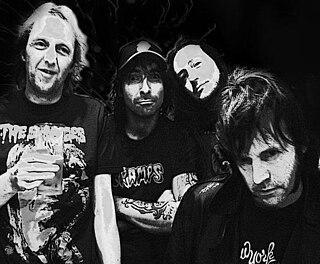
UFX are an English alternative rock band formed in Blackpool, Lancashire, England, in 2000.