The National University of San Marcos is a public research university located in Lima, the capital of Peru. It is considered the most important, recognized and representative educational institution at the national level. At the continental level, it is the first officially established and the oldest continuously operating university in the Americas, which is why it appears in official documents and publications as "University of Peru, Dean University of the Americas". It had its beginnings in the general studies that were offered in the cloisters of the convent of the Rosario of the order of Santo Domingo —current Basilica and Convent of Santo Domingo— around 1548. Its official foundation was conceived by Fray Thomas de San Martín on May 12, 1551; with the decree of Emperor Carlos I of Spain and V of the Holy Roman Empire, in 1571, it acquired the degree of pontifical granted by Pope Pius V with which it ended up being named as the "Royal and Pontifical University of the City of the Kings of Lima". Being recognized by the Spanish Crown as the first university in America officially founded by Real cédula, it is also referred to as the "University of Lima" throughout the Viceroyalty. Throughout its history, the university had a total of four colleges under tutelage: the Colegio Real y Mayor de San Martín and the Colegio Real y Mayor de San Felipe y San Marcos, the Real Colegio de San Carlos —focused on law and letters, derived from the merger of the two previous ones—and the Royal College of San Fernando—focused on medicine and surgery—. In the times of emancipation, it acquired a main role in the formation of several of the leaders managing the independence of Peru. After the proclamation of independence and during the republic, it maintains both colloquially and formally —in various treaties and documents historical—its name as "University of Lima" until 1946, the year in which its current name and denomination as National and Major University were made official.
The term Peruvian literature not only refers to literature produced in the independent Republic of Peru, but also to literature produced in the Viceroyalty of Peru during the country's colonial period, and to oral artistic forms created by diverse ethnic groups that existed in the area during the prehispanic period, such as the Quechua, the Aymara and the Chanka South American native groups.
The Constituent Congress of Peru, 1822 was the first democratically elected institution in Peru. Its members, called deputies, were appointed by popular election called by the liberator José de San Martín, who then exercised power as Protector of Peru. The main task of this meeting was to give the Republic of Peru its first constitution, which was the liberal constitution of 1823. Also, before the retirement of San Martín, presented the Executive to three members, who formed a collegial body called the Supreme Governing Board and whose head was General José de la Mar. subsequently ratified in succession to the former presidents of the Republic of Peru: José de la Riva Agüero and José Bernardo de Tagle.
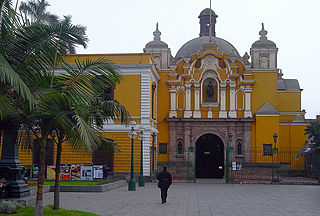
The Panteón de los Próceres is a crypt inside the old Church of the Real Convictorio de San Carlos that holds the remains of the heroes of the Peruvian War of Independence.

The Plaza San Martín is one of the most representative public spaces of the city of Lima, Peru. It is located at the ninth block of Colmena avenue, within the Historic Centre of Lima which was declared a World Heritage Site in 1988 by UNESCO. It is located near the Plaza Mayor of Lima and is connected to it by the Jiron de la Union. Its central monument gives homage to Peru's liberator, José de San Martín.
General elections were held in Cuba on 14 November 1908. José Miguel Gómez won the presidential election running under the Liberal Coalition banner, whilst the coalition emerged as the largest faction in the House of Representatives, winning 49 of the 83 seats. Voter turnout was 71.0%.

Pedro Bustamante y García was a Peruvian Brigadier General of the War of the Pacific. He served as the Minister of War and Navy throughout various presidencies during the 1860s and 1870s. He was also known as the main commander during the Siege of Arequipa where he defeated the Conservative forces of Manuel Ignacio de Vivanco.

The Royal University of San Felipe was a university created by King Philip V in 1738, in territory which was then part of the Kingdom of Spain. It was officially founded in Santiago in 1747 and began teaching activities in 1758. It is the immediate predecessor of the University of Chile (1843).
The Convictorio Carolino was a school which operated in Santiago in colonial Chile. Some of the most important figures in the Chilean War of Independence were educated there.
The Casona de la Universidad Nacional Mayor de San Marcos, also known as Cultural Center of the National University of San Marcos, is a large Colonial building in the city of Lima, Lima Region, Peru, where the main cultural center of the University of San Marcos operates. It currently houses various entities of importance to the university institution as a whole, such as: the Museum of Art, the Museum of Archeology and Anthropology, the University Theater of San Marcos (TUSM), the España de las Artes Library and the directions of Ballet, Folklore, Music, Film and Television, Band and Orchestra, and Tourism. The set of the "Casona de la Universidad de San Marcos" -which includes the famous "University Park" on its outside-, of undeniable historical and cultural importance for the city, it is part of the area and of the list of buildings of the historic center of Lima that were recognized as a World Heritage Site by UNESCO, in 1988.
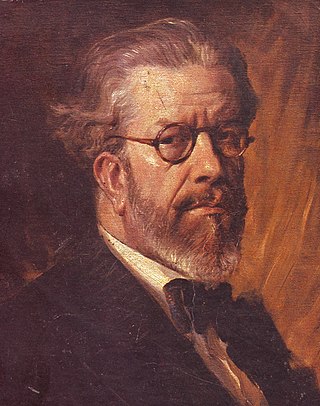
José Gálvez Barrenechea was a Peruvian poet, writer, journalist, university professor, and politician. He was Minister of Justice, Worship and Instruction (1931); Minister of Foreign Relations (1931); First Vice President of the Republic (1945–1948); President of the Senate (1956–1957), and also Grand Master of the Masonic Grand Lodge of Peru (1955–1956), among other academic and political positions, which he carried out with notable success.

Francisco de Paula Valdivieso y Prada was a Peruvian lawyer, magistrate and politician. He was Minister of Government and Foreign Relations from 1822 to 1824, president of the Supreme Court in 1825, and president of the General Constituent Congress in 1827.

The October 9 Revolution was a successful revolt against the Spanish Empire in Guayaquil on October 9, 1820. It was led by the General Antonio José de Sucre and directed by Simón Bolívar. The revolt established a revolutionary junta and created the Free Province of Guayaquil, an independent state. The independence of Guayaquil revived the war of independence of the Real Audiencia de Quito as part of the Spanish American wars of independence. Prominent events in the revolution include the uprising of the Spanish garrison in the city of Guayaquil and the control of the Pacific by the Liberating Expedition of Peru, under the command of José de San Martín.
José Manuel Gálvez Paz was a Peruvian politician. He reached the rank of Lieutenant Colonel of Cavalry of San Miguel de Pallaques and was sub-prefect of the province of Cajamarca.

José Gabriel Gálvez Egúsquiza was a Peruvian lawyer, professor and liberal politician. During the presidential government of Mariano Ignacio Prado he was Secretary—i.e. Minister—of War and Navy (1865). He was killed in action during the Battle of Callao, where he died fighting the Spanish squadron, thus becoming a symbol of the independence of America.

Pedro Gálvez Egúsquiza was a Peruvian lawyer, politician, educator and diplomat. A staunch liberal, he was one of the leaders of the Liberal Revolution of 1854 headed by General Ramón Castilla. He is remembered for having been the drafter of the decree that abolished the tribute of the natives. He was Minister of Justice and Worship in 1855, and Minister of Finance and Commerce in 1862, in the second government of Ramón Castilla; President of the Council of Ministers and Minister of Government (1868–1869) in the government of José Balta; constituent deputy (1855–1857) and senator (1868–1869). Likewise, he exercised various diplomatic representations in the United States, Latin America and Europe.

Manuel María Gálvez Egúsquiza was a Peruvian lawyer, magistrate, university professor and politician.

University Park is a public park located in the historic centre of the city of Lima, Peru. It is rectangular in shape and is located at the intersection of Abancay and Nicolás de Piérola avenues.


