Reatha King

Last updated
Reatha Belle Clark King
Reatha King 2009.jpg
Born (1938-04-11) April 11, 1938 (age 85)
Alma mater
Occupation(s)chemist and businesswoman
Employer General Mills, Inc.

Reatha Clark King (born April 11, 1938) is an American chemist, the former vice president of the General Mills Corporation; and the former president, executive director, and chairman of the board of trustees of the General Mills Foundation, the philanthropic foundation of General Mills, Inc.

Contents

Early life and education

Reatha Belle Clark [1] was born in Pavo, Georgia, United States on April 11, 1938. [2] [3] Her father, Willie B. Clark, was a sharecropper, and her mother, Ola Mae Watts Campbell, had only a third-grade education. [4] [5]

Reatha Clark began elementary school in a one-room school for grades 17, at Mt. Zion Baptist, a colored church, where she was taught by Florence Frazier. [6] Later, she attended school in Coolidge, Georgia, and high school in Moultrie, Georgia. [4] When she graduated from Moultrie High School for Negro Youth in 1954, the same year that Brown v. Board of Education determined segregated schools were illegal, Clark was the valedictorian of her class. [7] [6]

Clark was recruited to attend Clark College in Atlanta, where she initially enrolled as a home economics major. She was encouraged to become a research chemist by the head of the chemistry department there, Alfred Spriggs. [4] King earned a bachelor of science degree in chemistry and mathematics from Clark College. [4]

Spriggs encouraged her to apply for a fellowship from the Woodrow Wilson National Fellowship Foundation, which she received from 1958 to 1960. [2] The fellowship supported her work at the University of Chicago, from which she obtained a master of science degree in chemistry in 1960. She went on to study with advisor Ole J. Kleppa, receiving her Ph.D. degree in thermochemistry from the University of Chicago in 1963. The title of her Ph.D. thesis was "Contributions to the thermochemistry of the Laves phases." [8] While in Chicago she also met and married N. Judge King. [7]

Reatha Clark King later earned a master's in business administration in finance management from Columbia University while on sabbatical. [9]

Scientific and academic career

King was employed for five years (1963–1968) as a research chemist for the National Bureau of Standards in Washington, D.C. Hired by George T. Armstrong, King was the first African American female chemist to work at the agency. [2] [8] She used techniques for both bomb and flame calorimetry. [10] Much of her work there involved measuring the accurate heats of formation of gaseous fluorine compounds, [9] and she received a Meritorious Publication Award for her paper on fluoride flame calorimetry. [8] This research was important to the NASA space program. [9] Her two children were born during this time. [4] Techniques and mechanisms that she developed for flame fluorine calorimetry are still used. [11] [12]

King and her family moved to New York when her husband accepted a position at Nassau Community College, Garden City, New York. King obtained an assistant professorship at York College, City University of New York. There she served as professor of chemistry, 1968–1977, associate dean for Division of Natural Science & Mathematics, 1970-1974, and associate dean for academic affairs, 1974–1977. [4]

She moved to Minneapolis–Saint Paul, Minnesota, to become president of Metropolitan State University, where she worked from 1977 to 1988. [4] She helped to substantially expand the university, [9] and promoted involvement of minorities and women in higher education. [6] Her husband joined the Minnesota Mining and Manufacturing Company (3M) as a research chemist. [4]

Business career

In 1988, King was recruited by General Mills in Minneapolis, Minnesota, to serve in two roles. She became vice president of the General Mills Corporation and president and executive director of the General Mills Foundation. She remained in these positions from 1988 to 2002. In 2002, she was elected as chairman of the board of trustees of General Mills Foundation, and served in this position for a further year, retiring completely from General Mills in 2003. Under her leadership the General Mills Foundation, originally established in 1954, has been active both locally and nationally in philanthropic and community service. [9]

King has served on the boards of a number of other corporations, including ExxonMobil, Wells Fargo & Company; Department 56; Minnesota Mutual Companies; and the H. B. Fuller Company. She has also served with nonprofits, such as the International Trachoma Initiative, Allina Health, the Council on Foundations, the National Association of Corporate Directors, [13] and the Congressional Black Caucus Foundation. [14]

She has served as a trustee with Clark Atlanta University, and is a Life Trustee for the University of Chicago. She is a member of the American Council on Education and the Executive Leadership Council in Washington, D.C. [15] She has a particularly strong interest in education, [16] and has stated: "I realized early in life that education is our best enabling resource, that technical skills are important, and that my stamina for championing educational opportunity for all people is inexhaustible." [17]

Publications

Awards and honors

King has received honorary degrees and many other awards, including: [4]

Related Research Articles

<span class="mw-page-title-main">Exothermic process</span> Thermodynamic process that releases energy to its surroundings

In thermodynamics, an exothermic process is a thermodynamic process or reaction that releases energy from the system to its surroundings, usually in the form of heat, but also in a form of light, electricity, or sound. The term exothermic was first coined by 19th-century French chemist Marcellin Berthelot.

<span class="mw-page-title-main">Thermochemistry</span> Study of the heat energy associated with chemical reactions and/or physical transformations

Thermochemistry is the study of the heat energy which is associated with chemical reactions and/or phase changes such as melting and boiling. A reaction may release or absorb energy, and a phase change may do the same. Thermochemistry focuses on the energy exchange between a system and its surroundings in the form of heat. Thermochemistry is useful in predicting reactant and product quantities throughout the course of a given reaction. In combination with entropy determinations, it is also used to predict whether a reaction is spontaneous or non-spontaneous, favorable or unfavorable.

In chemistry and thermodynamics, the standard enthalpy of formation or standard heat of formation of a compound is the change of enthalpy during the formation of 1 mole of the substance from its constituent elements in their reference state, with all substances in their standard states. The standard pressure value p = 105 Pa(= 100 kPa = 1 bar) is recommended by IUPAC, although prior to 1982 the value 1.00 atm (101.325 kPa) was used. There is no standard temperature. Its symbol is ΔfH. The superscript Plimsoll on this symbol indicates that the process has occurred under standard conditions at the specified temperature (usually 25 °C or 298.15 K).

<span class="mw-page-title-main">Fluorocarbon</span> Class of chemical compounds

Fluorocarbons are chemical compounds with carbon-fluorine bonds. Compounds that contain many C-F bonds often have distinctive properties, e.g., enhanced stability, volatility, and hydrophobicity. Several fluorocarbons and their derivatives are commercial polymers, refrigerants, drugs, and anesthetics.

<span class="mw-page-title-main">Flame</span> Visible, gaseous part of a fire

A flame is the visible, gaseous part of a fire. It is caused by a highly exothermic chemical reaction taking place in a thin zone. When flames are hot enough to have ionized gaseous components of sufficient density they are then considered plasma.

<span class="mw-page-title-main">Hess's law</span> Observation that total enthalpy change of a chemical reaction is independent of the steps taken

Hess's law of constant heat summation, also known simply as Hess' law, is a relationship in physical chemistry named after Germain Hess, a Swiss-born Russian chemist and physician who published it in 1840. The law states that the total enthalpy change during the complete course of a chemical reaction is independent of the sequence of steps taken.

<span class="mw-page-title-main">Exothermic reaction</span> Chemical reaction that releases energy as light or heat

In thermochemistry, an exothermic reaction is a "reaction for which the overall standard enthalpy change ΔH⚬ is negative." Exothermic reactions usually release heat. The term is often confused with exergonic reaction, which IUPAC defines as "... a reaction for which the overall standard Gibbs energy change ΔG⚬ is negative." A strongly exothermic reaction will usually also be exergonic because ΔH⚬ makes a major contribution to ΔG. Most of the spectacular chemical reactions that are demonstrated in classrooms are exothermic and exergonic. The opposite is an endothermic reaction, which usually takes up heat and is driven by an entropy increase in the system.

<span class="mw-page-title-main">Hans Peter Jørgen Julius Thomsen</span>

Hans Peter Jørgen Julius Thomsen was a Danish chemist noted in thermochemistry for the Thomsen–Berthelot principle.

<span class="mw-page-title-main">Oxygen fluoride</span> Any binary compound of oxygen and fluorine

Oxygen fluorides are compounds of elements oxygen and fluorine with the general formula OnF2, where n = 1 to 6. Many different oxygen fluorides are known:

<span class="mw-page-title-main">Cadmium fluoride</span> Chemical compound

Cadmium fluoride (CdF2) is a mostly water-insoluble source of cadmium used in oxygen-sensitive applications, such as the production of metallic alloys. In extremely low concentrations (ppm), this and other fluoride compounds are used in limited medical treatment protocols. Fluoride compounds also have significant uses in synthetic organic chemistry. The standard enthalpy has been found to be -167.39 kcal. mole−1 and the Gibbs energy of formation has been found to be -155.4 kcal. mole−1, and the heat of sublimation was determined to be 76 kcal. mole−1.

<span class="mw-page-title-main">Xenon difluoride</span> Chemical compound

Xenon difluoride is a powerful fluorinating agent with the chemical formula XeF
2
, and one of the most stable xenon compounds. Like most covalent inorganic fluorides it is moisture-sensitive. It decomposes on contact with water vapor, but is otherwise stable in storage. Xenon difluoride is a dense, colourless crystalline solid.

<span class="mw-page-title-main">Krypton difluoride</span> Chemical compound

Krypton difluoride, KrF2 is a chemical compound of krypton and fluorine. It was the first compound of krypton discovered. It is a volatile, colourless solid at room temperature. The structure of the KrF2 molecule is linear, with Kr−F distances of 188.9 pm. It reacts with strong Lewis acids to form salts of the KrF+ and Kr
2
F+
3
cations.

<span class="mw-page-title-main">Plutonium hexafluoride</span> Chemical compound

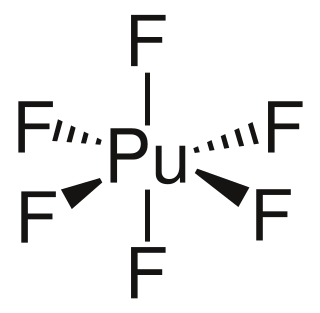
Plutonium hexafluoride is the highest fluoride of plutonium, and is of interest for laser enrichment of plutonium, in particular for the production of pure plutonium-239 from irradiated uranium. This pure plutonium is needed to avoid premature ignition of low-mass nuclear weapon designs by neutrons produced by spontaneous fission of plutonium-240.

<span class="mw-page-title-main">Thiophosphoryl fluoride</span> Chemical compound

Thiophosphoryl fluoride is an inorganic molecular gas with formula PSF3 containing phosphorus, sulfur and fluorine. It spontaneously ignites in air and burns with a cool flame. The discoverers were able to have flames around their hands without discomfort, and called it "probably one of the coldest flames known". The gas was discovered in 1888.

<span class="mw-page-title-main">Fluorine azide</span> Chemical compound

Fluorine azide or triazadienyl fluoride is a yellow green gas composed of nitrogen and fluorine with formula FN3. Its properties resemble those of ClN3, BrN3, and IN3. The bond between the fluorine atom and the nitrogen is very weak, leading to this substance being very unstable and prone to explosion. Calculations show the F–N–N angle to be around 102° with a straight line of 3 nitrogen atoms.

Sandra Charlene Greer is an American physical chemist who has held important academic and administrative positions at both the University of Maryland, College Park and Mills College. Her area of study is the thermodynamics of fluids, especially polymer solutions and phase transitions. She has received awards for her scientific contributions, and for her advocacy for women in science and her work on ethics in science.

Lucia V. Streng was a Russian Empire-born American chemist. She spent much of her career studying the noble gases and their properties, successfully synthesizing krypton difluoride. She and her husband, Alex G. Streng, both held positions at Temple University.

Jean'ne Marie Shreeve is an American chemist known for her studies of fluorine compounds and explosives. She has held her namesake professorship at the University of Idaho since 2004.

<span class="mw-page-title-main">Vladimir Luginin</span>

Vladimir Fedorovich Luginin was a Russian physical chemist. His main work was in thermochemistry, and dealt with the heat of combustion of organic compounds.

<span class="mw-page-title-main">Radon compounds</span>

Radon compounds are compounds formed by the element radon (Rn). Radon is a member of the zero-valence elements that are called noble gases, and is chemically not very reactive. The 3.8-day half-life of radon-222 makes it useful in physical sciences as a natural tracer. Because radon is a gas at standard conditions, unlike its decay-chain parents, it can readily be extracted from them for research.

References

  1. Yount, Lisa (2008). A to Z of women in science and math (PDF) (Rev. ed.). New York: Facts On File, Inc. pp. 156–157. ISBN   978-0816066957 . Retrieved 24 October 2018.
  2. 1 2 3 Brown, Jeannette E. (2012). African American women chemists . New York: Oxford University Press. pp.  115–123. ISBN   9780199742882.
  3. Center for Oral History. "Reatha Clark King". Science History Institute .
  4. 1 2 3 4 5 6 7 8 9 10 11 Brown, Jeannette E. (1 May 2005). Reatha Clark King, Transcript of an Interview Conducted by Jeannette E. Brown at Minneapolis, Minnesota on 1 May 2005 (PDF). Philadelphia, PA: Chemical Heritage Foundation.
  5. 1 2 Jenkins, Edward Sidney (1996). "Reatha Clark King: Chemistry of the Halogen Compounds (1938- )". To fathom more : African American scientists and inventors. Lanham, Md.: University Press of America. pp.  342–368. ISBN   978-0761802150.
  6. 1 2 3 4 "Equality through education and giving, Reatha Clark". African American Registry. Retrieved 13 May 2014.
  7. 1 2 Tuttle, Kelly (2012). "For the Love of the Lab". Chemical Heritage Magazine. 30 (2): 38. Retrieved 6 December 2016.
  8. 1 2 3 4 "Reatha Clark King". The HistoryMakers. 2012-01-16. Retrieved 13 May 2014.
  9. 1 2 3 4 5 6 7 8 9 "Reatha Clark King—2004-05 Louis W. Hill, Jr. Fellow". Grotto Foundation. Archived from the original on December 16, 2014. Retrieved 13 May 2014.
  10. Domalski, Eugene S. (November 1971). "Evaluating Experimental Data on Heats of Combustion". Journal of Chemical Documentation. 11 (4): 234–238. doi:10.1021/c160043a014. Basically, two main experimental techniques are employed to obtain the heats of combustion, bomb calorimetry (combustion process at constant volume), and flame or flow calorimetry (combustion process at constant pressure). Flame calorimetry is more applicable to the combustion of gaseous or highly volatile substances, whereas bomb calorimetry is more suited to studying liquids and solids.
  11. Simões, José A. Martinho; Piedade, Manuel Minas da (July 10, 2008). Molecular Energetics : Condensed-Phase Thermochemical Techniques. Oxford University Press, USA. pp. 120–. ISBN   9780195133196 . Retrieved 18 November 2018. Jessup and Armstrong and their colleagues [109, 115-117] developed the method of fluorine flame calorimetry to a high degree of accuracy and precision.
  12. Mark Ockerbloom, Mary (2019). "Reatha Clark King, Starting Fires with Fluorine". In Lykknes, Annette; Van Tiggelen, Brigitte (eds.). Women in Their Element: Selected Women's Contributions To The Periodic System. Singapore: World Scientific.
  13. Daly, Ken (23 May 2013). "NACD Board Names Dr. Reatha Clark King Chairman". National Association of Corporate Directors. Retrieved 13 May 2014.
  14. "Equality through education and giving, Reatha Clark King". African American Registry. Retrieved 24 October 2018.
  15. "Reatha Clark King Ph.D. Executive Profile". Bloomberg BusinessWeek. Retrieved 16 December 2014.[ dead link ]
  16. King, Reatha Clark (April 1, 1999). "Succeeding Against the Odds in Higher Education: Advancing Society by Overcoming Obstacles Due to Race and Gender". In Harvey, William B. (ed.). Grass roots and glass ceilings : African American administrators in predominantly white colleges and universities. Albany, NY: State University of New York Press. pp. 1–38. ISBN   978-0791441640 . Retrieved 13 November 2018.
  17. "Bios: Reatha Clark King, Woman of Science". Paving the Path Before You. Pathways. Retrieved 13 May 2014.
  18. Nguyen, Christine. "Photos: Minnesotans celebrate MLK Day". MPR News. Retrieved 25 January 2019.
  19. Bolsta, Phil (April 19, 2013). "2013 International Citizen Awards". Twin Cities Business. Retrieved 16 December 2014.
  20. "Reatha Clark King, PhD: International Citizen Award". Twin Cities Business. 19 April 2013. Retrieved 13 May 2014.
  21. "Exceptional black scientists collection". New York Public Library Archives & Manuscripts. Retrieved 16 December 2014.
  22. "Reatha Clark King". NNDB Tracking the entire world. Retrieved 13 May 2014.