
A recreational vehicle, often abbreviated as RV, is a motor vehicle or trailer which includes living quarters designed for accommodation. Types of RVs include motorhomes, campervans, caravans, fifth-wheel trailers, popup campers, and truck campers.

GO Transit is a regional public transit system serving the Greater Golden Horseshoe region of Ontario, Canada. With its hub at Union Station in Toronto, GO Transit's distinctive green and white commuter rail trains and coach-style buses serve a population of more than seven million across an area over 11,000 square kilometres (4,200 sq mi) stretching from Brantford and Kitchener in the west to Newcastle and Peterborough in the east, and from Barrie in the north to Niagara Falls in the south. GO Transit carried 68.5 million passengers in 2017, and its ridership continues to grow. GO Transit operates diesel-powered double-decker trains and coach buses, on routes that connect with all local transit systems in its service area, as well as Via Rail, Canada's national rail system.

Innovia Metro is the current name given to an automated rapid transit system manufactured by Bombardier Transportation. Innovia Metro systems run on conventional metal rails and pull power from a third rail, but are powered by a linear induction motor that provides traction by pulling on a "fourth rail" placed between the running rails. A new version of the technology being marketed by Bombardier is compatible with standard electric rotary propulsion.

Forest River Inc. is an American manufacturer of recreational vehicles, cargo trailers, utility trailers, pontoon boats, and buses.

A campervan, sometimes referred to as a camper, caravanette, or motor caravan, is a self-propelled vehicle that provides both transport and sleeping accommodation. The term mainly describes vans that have been fitted out, often with a coachbuilt body for use as accommodation.

A motorhome is a type of self-propelled recreational vehicle (RV) which offers mobile living accommodation.
The Wayne Corporation was an American manufacturer of buses and other vehicles under the "Wayne" marque. The corporate headquarters were in Richmond, Indiana, in Wayne County, Indiana. During the middle 20th century, Wayne served as a leading producer of school buses in North America.

The GMC Motorhome was manufactured by the GMC Truck & Coach Division of General Motors for model years 1973–1978 in Pontiac, Michigan, USA — as the only complete motorhome built by a major auto/truck manufacturer. Manufactured in 23 and 26 ft lengths, the design was noted for its front-wheel drive and its low profile, fully integrated body.

The Urban Transportation Development Corporation Ltd. (UTDC) was a Crown corporation owned by the Government of Ontario, Canada. It was established in the 1970s as a way to enter what was then expected to be a burgeoning market in advanced light rail mass transit systems. UTDC built a respected team of engineers and project managers. It developed significant expertise in linear propulsion, steerable trucks and driverless system controls which were integrated into a transit system known as the Intermediate Capacity Transit System (ICTS). It was designed to provide service at rider levels between a traditional subway on the upper end and buses and streetcars on the lower, filling a niche aimed at suburbs that were otherwise expensive to service.
Hawker Siddeley Canada was the Canadian unit of the Hawker Siddeley Group of the United Kingdom and manufactured railcars, subway cars, streetcars, aircraft engines and ships from the 1960s to 1980s.
Highway Products, Inc., based in Kent, Ohio, was formed by Joseph Thomas 'Joe' Myers in 1960 to manufacture truck bodies for specialty markets such as mobile post offices. In addition to mail trucks and mobile post offices the company also manufactured small boats for both military and commercial use, missile launchers and engines. The company diversified into small transit buses and motorhomes in the late 1960s and early 1970s and was sold to Alco Standard Corporation in 1970; the Highway Products division of Alco Standard declared bankruptcy in 1975, ending production.
The Wayne Busette is a minibus that was assembled by Wayne Corporation from 1973 to 1990. During its production, many examples of the Busette were produced as school buses. One of the first examples produced with a cutaway van chassis, the Busette mated a purpose-built school bus body with a dual rear-wheel van chassis. In North America, this configuration is now preferred by manufacturers for many other types of minibuses in addition to school buses.

The Canadian Light Rail Vehicle (CLRV) and Articulated Light Rail Vehicle (ALRV) were the types of streetcars used by the Toronto Transit Commission (TTC). Two variants have been produced: the standard single-module CLRV and the longer articulated double-module ALRV.

The Travco motorhome was an aerodynamic Class A Recreational Vehicle built on a Dodge motorhome chassis from 1965 until the late 1980s. The Travco design originally emerged as a 1961 model called the "Dodge Frank Motor Home" and marketed with the assistance of the Chrysler Corporation, which was the maker of its chassis. One hundred thirty one were produced the first year, with an average price tag of $9000. The Travco/Dodge Motor Home design and fiberglass body were refinements by Ray Frank to the original Frank Motor Home, a conventional box-type design based on the Dodge chassis and built in Brown City, Michigan from 1958 to 1962. Ray Frank, founder of Frank Industries, also made up the name "motorhome" and went on to develop Xplorer Motorhomes. Frank has been inducted into the RV/MH Hall of Fame & Museum as the father of the motorhome.
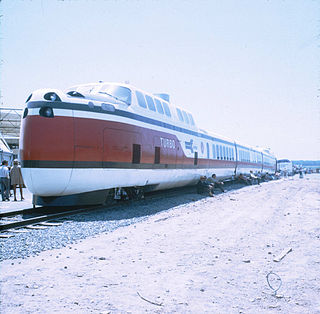
U.S. International Transportation Exposition, better known as Transpo '72, was a trade show held on 300 acres (1.2 km2) of land at Dulles International Airport outside Washington, D.C., for nine days from May 27 to June 4, 1972. The $10 million event, sponsored by the U.S. Department of Transportation, was a showcase for all sorts of transportation-related technologies. Over a million visitors flocked to the show from all over the world. According to the Wall Street Journal, it was "the biggest show the government has put on since World War II."
GO ALRT was a rapid transit system proposed by GO Transit in 1982. The ALRT system would have been implemented along two new lines in the Greater Toronto Area. It would have used a new electric train to provide interurban service, also then referred to as "inter-regional rapid transit", along the existing and new GO corridors. The system was based on an enlarged UTDC ICTS vehicle that was designed to offer a compromise between passenger capacity and the level of infrastructure needed to support it. The project was cancelled due to budget cuts of the Tory government in 1985, although a number of the proposed lines were later implemented using conventional heavy rail systems, including the eastern portion of the Lakeshore East GO train service route from Pickering station, to Whitby station, in Durham region.
Jayco, Inc., a subsidiary of Thor Industries, is an American manufacturer of recreation vehicles. The company manufactures fold-down camping trailers, conventional travel trailers, toy haulers, fifth-wheel travel trailers, and motorhomes. Jayco is based in Middlebury, Indiana, and about three-quarters of its 3,200-person workforce is from the Amish and Mennonite communities of Indiana.
Krauss-Maffei's Transurban was a 12-passenger automated guideway transit (AGT) mass transit system based on a maglev guideway. Development started in 1970 as one of the many AGT and PRT projects that followed in the wake of the HUD reports of 1968. Its selection as the basis of the GO-Urban system in Toronto in 1973 made it well known in the industry; it would have been the basis of the first large-area AGT mass transit network in the world. Technical problems cropped up during the construction of the test track, and the sudden removal of funding by the West German government led to the project's cancellation in late 1974. The Ontario government completed development and installation of a non-maglev version, today known as the Bombardier Advanced Rapid Transit.
GO-Urban was a planned mass transit project for Greater Toronto to be operated by GO Transit. The system envisioned the use of automated guideway transit vehicles set up in hydro corridors and other unused parcels of land to provide rapid transit services without the expense of constructing tunnels. GO-Urban would serve high-density areas in the downtown core, but also be able to accelerate to high speed between distant stations in the outskirts of the city. Similar deployments were planned for Hamilton and Ottawa.


