
In photography, shutter speed or exposure time is the length of time that the film or digital sensor inside the camera is exposed to light when taking a photograph. The amount of light that reaches the film or image sensor is proportional to the exposure time. 1⁄500 of a second will let half as much light in as 1⁄250.

Cinematography is the art of motion picture photography.

Steadicam is a brand of camera stabilizer mounts for motion picture cameras invented by Garrett Brown and introduced in 1975 by Cinema Products Corporation. It was designed to isolate the camera from the camera operator's movement, keeping the camera motion separate and controllable by a skilled operator.

A zoom lens is a system of camera lens elements for which the focal length can be varied, as opposed to a fixed-focal-length (FFL) lens.

A camera operator, or depending on the context cameraman or camerawoman, is a professional operator of a film camera or video camera as part of a film crew. The term "cameraman" does not imply that a male is performing the task.

A professional video camera is a high-end device for creating electronic moving images. Originally developed for use in television studios or with outside broadcast trucks, they are now also used for music videos, direct-to-video movies, corporate and educational videos, wedding videos, among other uses. Since the 2000s, most professional video cameras are digital professional video cameras.
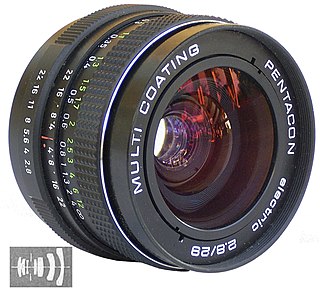
In film and photography, a prime lens is a fixed focal length photographic lens, typically with a maximum aperture from f2.8 to f1.2. The term can also mean the primary lens in a combination lens system. Confusion between these two meanings can occur without clarifying context. Alternate terms, such as primary focal length, fixed focal length, or FFL are sometimes used to avoid ambiguity.

In cinematography, a jib is any boom device used to mount a camera on one end, and a counterweight with camera controls on the other. In principle, it operates like a see-saw, with the balance point located closer to the counterweight, which allows the end of the arm with the camera to move through an extended arc. Typically a jib permits the camera to be moved vertically, horizontally, or a combination of the two. A small jib can be mounted on a tripod, but many larger, purpose-built jibs have their own support stands, often on wheels. Modern jibs are normally modular and can be assembled in various lengths.
Video production is the process of producing video content for video. It is the equivalent of filmmaking, but with video recorded either as analog signals on videotape, digitally in video tape or as computer files stored on optical discs, hard drives, SSDs, magnetic tape or memory cards instead of film stock. There are three stages of video production: pre-production, production, and post-production. Pre-production involves all of the planning aspects of the video production process before filming begins. This includes scriptwriting, scheduling, logistics, and other administrative duties. Production is the phase of video production which captures the video content and involves filming the subject(s) of the video. Post-production is the action of selectively combining those video clips through video editing into a finished product that tells a story or communicates a message in either a live event setting, or after an event has occurred (post-production).

In photography, a tripod is a portable device used to support, stabilize and elevate a camera, a flash unit, or other videographic or observational/measuring equipment. All photographic tripods have three legs and a mounting head to couple with a camera. The mounting head usually includes a thumbscrew that mates to a female-threaded receptacle on the camera, as well as a mechanism to be able to rotate and tilt the camera when it is mounted on the tripod. Tripod legs are usually made to telescope, in order to save space when not in use. Tripods are usually made from aluminum, carbon fiber, steel, wood or plastic.
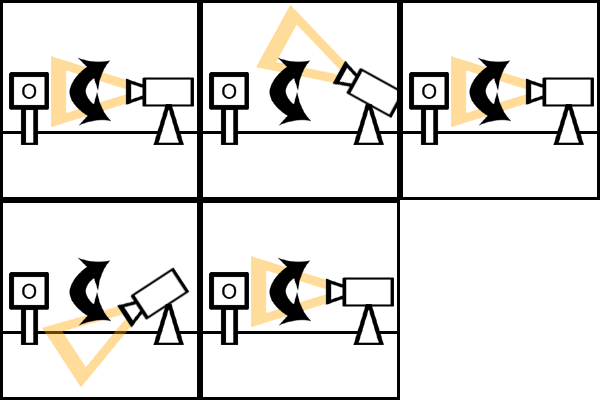
Tilting is a cinematographic technique in which the camera stays in a fixed position but rotates up/down in a vertical plane. Tilting the camera results in a motion similar to someone raising or lowering their head to look up or down. It is distinguished from panning in which the camera is horizontally pivoted left or right. Pan and tilt can be used simultaneously. In some situations the lens itself may be tilted with respect to the fixed camera body in order to generate greater depth of focus.
This article contains a list of cinematic techniques that are divided into categories and briefly described.

Intelligent lighting refers to lighting that has automated or mechanical abilities beyond those of traditional, stationary illumination. Although the most advanced intelligent lights can produce extraordinarily complex effects, the intelligence lies with the human lighting designer, control system programmer(For example, Chamsys and Avolites), or the lighting operator, rather than the fixture itself. For this reason, intelligent lighting (ILS) is also known as automated lighting, moving lights, moving heads, or simply movers.

Image stabilization (IS) is a family of techniques that reduce blurring associated with the motion of a camera or other imaging device during exposure.

In cinematography and photography, panning means swivelling a still or video camera horizontally from a fixed position. This motion is similar to the motion of a person when they turn their head on their neck from left to right. In the resulting image, the view seems to "pass by" the spectator as new material appears on one side of the screen and exits from the other, although perspective lines reveal that the entire image is seen from a fixed point of view.

A pan-tilt-zoom camera is a robotic camera capable of panning horizontally, tilting vertically, and zooming. PTZ cameras are often positioned at guard posts where active employees may manage them using a remote camera controller. Their primary function is to monitor expansive open regions that need views in the range of 180 or 360 degrees. Depending on the camera or software being used, they may also be set up to automatically monitor motion-activated activities or adhere to a defined schedule.
Articles related to the field of motion pictures include:
Elevated photography is the process of taking aerial photos using a telescoping pole or mast, or other aerial or elevated support systems, to emulate aerial photographs, or video, taken from a commercially licensed aircraft.
The Technocrane is a telescopic camera crane and a revolutionary invention that has transformed the film industry and television production worldwide.

A tripod head is the part of a tripod system that attaches the supported device to the tripod legs, and allows the orientation of the device to be manipulated or locked down. Modular or stand-alone tripod heads can be used on a wide range of tripods, allowing the user to choose which type of head best suits their needs. Integrated heads are built directly onto the tripod legs, reducing the cost of the tripod system.
