Background
Newte was born at Tiverton and baptized on 24 February 1613, [1] the third son of Henry Newte the elder, Tiverton's first Town Clerk after its incorporation in 1615. [2] He was educated at Blundell's School and Exeter College, Oxford where he matriculated.

Tiverton is a town and civil parish in the English county of Devon and the main commercial and administrative centre of the Mid Devon district. It has also become a dormitory town for commuters to Exeter and Taunton. The built-up area had a population of 19,544 in 2011 and the parish had 21,335.

Blundell's School is a co-educational day and boarding independent school located in the town of Tiverton in the county of Devon, England. It was founded in 1604 under the will of Peter Blundell, one of the richest men in England at the time, and moved to its present site on the outskirts of the town in May 1882. It was known until the 19th century as Tiverton Grammar School.

Exeter College is one of the constituent colleges of the University of Oxford in England and the fourth oldest college of the University.
He became Rector of the Tidcombe portion of Tiverton on 24 September 1641 and, in addition, of the Clare portion the following month. He was appointed chaplain to Lord Digby the Earl of Bristol in 1641, then, after the Restoration, chaplain to Lord de la Warr. During the Civil War Newte was mostly travelling under Royal licence in continental Europe; he returned in 1646 to discover his parsonage at Clare in ruins and the area subject to the ravages of plague. Nevertheless, he was determined to return to the town and continue in his duties which he endeavored to do by using a place in the fields when the people would not enter the plague-hit town. [3]
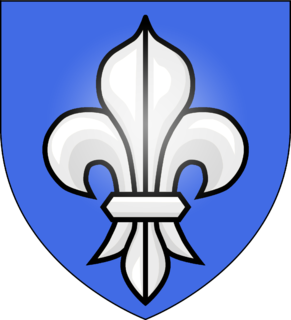
Earl of Bristol is a title that has been created twice in British history. The first creation came in the Peerage of England in 1622 in favour of the politician and diplomat John Digby who served for many years as Ambassador to Spain, and had already been created Baron Digby of Sherborne, in the County of Dorset, in 1618, also in the Peerage of England. Digby was the brother of Sir Robert Digby of Coleshill, Warwickshire, whose son Robert Digby became 1st Baron Digby of Geashill in the Peerage of Ireland in 1620..

The Restoration of the English monarchy took place in the Stuart period. It began in 1660 when the English, Scottish and Irish monarchies were all restored under King Charles II. This followed the Interregnum, also called the Protectorate, that followed the Wars of the Three Kingdoms.

The English Civil War (1642–1651) was a series of armed conflicts and political machinations between Parliamentarians ("Roundheads") and Royalists ("Cavaliers") over, principally, the manner of England's governance. The first (1642–1646) and second (1648–1649) wars pitted the supporters of King Charles I against the supporters of the Long Parliament, while the third (1649–1651) saw fighting between supporters of King Charles II and supporters of the Rump Parliament. The war ended with the Parliamentarian victory at the Battle of Worcester on 3 September 1651.
He married Thomasine Trobridge of Crediton and their first son was baptized 31 May 1654 at Tidcombe. His second son, John Newte, was born at Ottery St Mary in 1656 whilst he was temporarily denied his living at Tidcombe. John was, in due course, to follow his father as rector of Tidcombe. In 1666, Richard Newte was appointed Chaplain to Charles II although he appears not to have served owing to his suffering from gout and the distance of his residence from the royal court. [3]
John Newte (1656–1716) was a high Anglican clergyman best remembered as the defender of the lawfulness of church music.
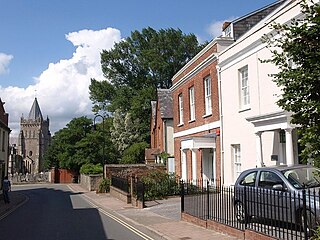
Ottery St Mary, known as "Ottery", is a town and civil parish in the East Devon district of Devon, England, on the River Otter, about 10 miles (16 km) east of Exeter on the B3174. At the 2001 census, the parish, which includes the villages of Metcombe, Fairmile, Alfington, Tipton St John, Wiggaton, and West Hill, had a population of 7,692. The population of the urban area alone at the 2011 census was 4,898. There are two electoral wards in Ottery. The total population of both wards, including the adjacent civil parish of Aylesbeare, at the above census was 9,022. Archaeological excavations in 2014, in advance of a housing development at Island Farm, uncovered a medieval longhouse dating to AD.1250–1350 Ottery is first attested in the Domesday Book of 1086, where it appears as 'Otri' and 'Otrei'. 'Oteri Sancte Marie' is first mentioned in 1242. The town takes its name from the River Otter on which it stands, the river taking its name from the animal. The 'St Mary' element refers to the fact that the town belonged to the church of St Mary in Rouen in 1086.

Charles II was king of England, Scotland and Ireland. He was king of Scotland from 1649 until his deposition in 1651, and king of England, Scotland and Ireland from the restoration of the monarchy in 1660 until his death.