Pentax is a brand name used primarily by Japanese multinational imaging and electronics company Ricoh for cameras, sport optics, and CCTV optics. The brand is also used by Hoya Corporation for medical products & services, TI Asahi for surveying instruments, and Seiko Optical Products for certain optical lenses.

Hoya Corporation is a Japanese company manufacturing optical products such as photomasks, photomask blanks and glass magnetic-memory disks, contact lenses and eyeglass lenses using wavefront technology for the health-care market, medical photonics, lasers, photographic filters, and software. Hoya Corporation is one of the Forbes Global 2000 Leading Companies and Industry Week 1000 Company.
This article discusses the cameras – mainly 35 mm SLRs – manufactured by Pentax Ricoh Imaging Corp. and its predecessors, Pentax Corporation and Asahi Optical Co., Ltd. .

Pentax lenses were first badged as Takumar. The Takumar branded lenses were well respected for their line of Super Takumar, which designated the high performance coating applied to the lens as well as the optical formulas used to make them. The majority of the industry at the time was still satisfied with the variations of the "plumb" coating process and later some of the two and three layer processes as well. Asahi Pentax soon introduced the Takumar Super-Multi-Coated line of lenses which was a 7 layer process as the industry had just caught up with similar forms of 5 layer multi-coated optics. Eventually Asahi Optical and Pentax slowly shifted much of their lens production under the Pentax name and transitioned some of the successful designs that were first introduced under the Takumar name to use Asahi/Pentax badging as well as beginning to use the "smc" abbreviation. Eventually the Asahi partnership disappeared and the Pentax name became solely used. Pentax lenses saw many feature changes to answer the market, such as: incorporating "Auto-Aperture" with the M42, the light weight and compactness with the 'M' series, Aperture Priority overrides with the 'A' series, and Auto-Focus with the 'F' series. Modern Pentax lenses for digital SLR cameras have seen the elimination of the aperture ring completely as found on Pentax DA and D-FA series lenses. They use the Pentax KAF mount. All of these lenses have an autofocus feature, either operated from the camera body or from an internal SDM motor. Pentax compatible lenses are also made by third-party companies.
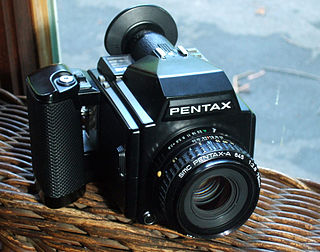
The Pentax 645 is a medium format single-lens reflex system camera manufactured by Pentax. It was introduced in 1984, along with a complementary line of lenses. It captures images nominally 6 cm × 4.5 cm on 120, 220, and 70 mm film, though the actual size of the images is 56 mm × 41.5 mm.

The Pentax K-3 is a 24-megapixel Pentax high-end digital single-lens reflex camera with an APS-C sensor, announced on 7 October 2013. The Pentax K-3 is the successor to both the K-5 II and K-5 IIs models, which have a 16-megapixel sensor. The K-5 II had an optical low pass filter or anti-aliasing (AA) filter that can prevent the appearance of moire patterning on the captured image. This filter reduces the sharpness of the image, so Pentax also produced the K-5 IIs which omitted this filter. In the K-3, Pentax obviated the need for providing two separate models by including a selectable AA filter "simulator". This mechanism vibrates the sensor when switched on, slightly blurring the image in a way that replaces the function of the optical AA filter, providing the same benefit as the filter in the K-5 II and other cameras with an optical AA filter. When the AA simulator is disabled, the sensor records a sharper image, as in the K-5 IIs.
The Pentax Q-S1 is a compact digital mirrorless interchangeable lens camera announced by Ricoh under the Pentax brand on August 4, 2014. It replaces the Pentax Q7, and is part of Pentax' Q system, the most compact digital interchangeable lens camera system as of September 2014, with crop factors ranging from 4.6 to 5.6.

The Ricoh GR is a digital large sensor compact camera announced by Ricoh on April 17, 2013, one of a number of Ricoh GR digital cameras. It was succeeded by the Ricoh GR II in 2015 and the Ricoh GR III in 2018.

As of July 2015, the Pentax HD DA 560mm F5.6 ED AW is the longest prime lens in production under the Pentax brand. It has a telescope-type optical design.
The lens is fully compatible with the K-1 full-frame DSLR and covers the 35mm image circle. On the K-1, lens correction profiles are supported to remove chromatic aberrations and vignetting.
The Ricoh WG-20 is a digital compact camera announced by Ricoh on February 5, 2014. It replaces the Pentax WG-10 and is rated as "waterproof to 33 feet, shockproof from drops of up to five feet, coldproof to 14 degrees Fahrenheit and crushproof, withstanding up to 220 foot-pounds of force" by its manufacturer.

The Pentax K-S1 is a midrange DSLR camera announced by Ricoh on August 27, 2014. It has a 20 megapixel sensor — new to the Pentax line-up — and an anti-aliasing filter simulator as previously seen in the Pentax K-3. Also adopted from the K-3 is compatibility with the Pentax FluCard, which allows wireless tethered shooting and wireless download of images from the camera.
The Ricoh WG-M1 is a rugged digital compact camera announced by Ricoh on September 10, 2014. It features 120fps high speed videography as well as full HD capture at 30p with electronic image stabilisation. It is waterproof to a depth of 10 meters and shockproof to drops from up to 2 meters. It includes WiFi and is can be remote-operated using a smart phone. Ricoh claims that underwater sounds can be captured without muffling. In 2015, the WG-M1 won the TIPA Award in the category Best Actioncam.
The Ricoh WG-30 is a rugged, waterproof digital compact camera announced by Ricoh on October 8, 2014. It is the successor of the Ricoh WG-20. The main advance is the backside-illuminated sensor that also increases resolution from 14 to 16 megapixels compared to the previous model. The rugged metrics have also increased, with now 40 feet rather than 33 feet of underwater depth tolerance advertised. As in the previous model, the WG-30 is shockproof to 1.5m (5ft), crushproof to 100kg (220lb) of force, and coldproof to -10 degrees Celsius.

The Pentax K-3 II is a flagship APS-C DSLR camera announced by Ricoh on April 22, 2015.

The Pentax K-1 is the first production Pentax full-frame digital SLR camera.
As the flagship model of the Pentax K-mount system, it includes several new and improved features, including a five-axis SR II in-body image stabilization system, newly designed flexible tilt articulating screen mounted on four metal struts allowing for rotation about the optical axis in addition to upward and downward tilt, and improved autofocus and metering systems.

The Pentax K-70 is a 24 megapixel compact APS-C digital SLR camera announced by Ricoh on June 8, 2016. In contrast to the previously introduced APS-C flagship K-3 II, it includes a flash, flip-out display and built-in WiFi. In common with that camera, the K-70 is capable of Pixel Shift Resolution images, which provide higher colour resolution and require the camera to be stationary. It is the first Pentax camera to also include on-sensor PDAF elements that support hybrid autofocus, enabling continuous autofocus during video capture.

The Pentax KP is a 24 megapixel compact APS-C digital SLR camera announced by Ricoh on January 25, 2017. It features a PRIME IV image processor with an "image accelerator unit" that supports its operation up to ISO 819,200. It has a 1/6000s conventional and 1/24,000s electronic shutter. In terms of bracketing modes, it adds depth of field and shutter speed bracketing.
The HD Pentax-D FA* 50mm f/1.4 SDM AW lens is a professional normal prime lens for the Pentax K-mount. The lens was officially announced on October 27th 2017, launched on June 28th 2018 and first shipped on July 26th 2018.