Related Research Articles

Jessica Lal was a model in New Delhi who was working as a celebrity barmaid at a crowded socialite party when she was shot dead at around 2:00 am on 30 April 1999. Dozens of witnesses pointed to Siddharth Vashisht, also known as Manu Sharma, the son of Venod Sharma, a wealthy and influential Member of Parliament from Haryana, as the murderer. Manu Sharma was later convicted for the murder and sentenced to life.
Priyadarshini Mattoo was a 25-year-old law student who was found raped and murdered at her house in New Delhi on 23 January 1996. On 17 October 2006, the Delhi High Court found Santosh Kumar Singh guilty on both counts of rape and murder, and on 30 October of the same year sentenced him to death. On 6 October 2010, the Supreme Court of India commuted the death sentence to life imprisonment. Santosh Kumar Singh, the son of an Inspector-General of Police, had earlier been acquitted by a trial court in 1999, and the High Court decision was widely perceived in India as a landmark reversal. This decision was overturned as the facts were not presented correctly in the lower court.

The Kakori Train robbery was a train robbery that took place at Kakori, a village near Lucknow, on 9 August 1925, during the Indian independence movement against the British rule in India. It was organized by the Indian revolutionaries of Hindustan Republican Association (HRA).
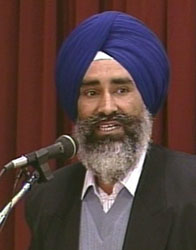
Jaswant Singh Khalra (1952–1995) was a prominent Sikh human rights activist.

Nitish Katara was a 23-year-old Indian business executive in Delhi who was murdered in the early hours of 17 February 2002 by Vikas Yadav. Yadav was the son of influential politician D. P. Yadav. Katara had recently graduated from the Institute of Management Technology in Ghaziabad where he had fallen in love with his classmate Bharti Yadav, sister of Vikas Yadav. The trial court held that Katara's murder was an honour killing because the family did not approve of their relationship. Vikas and Vishal Yadav were later found guilty by the trial Court and both were given life sentences on 30 May 2008.

The murder of Michael Briggs occurred on October 16, 2006, in Manchester, New Hampshire, United States. Briggs, a police officer, was shot while on duty and was transported to the hospital, where he died of his injuries. The suspect, Michael "Stix" Addison, fled New Hampshire, prompting a manhunt by police. Fifteen hours after the shooting, Addison was arrested in Dorchester, Massachusetts. He was charged by Boston Police with being a fugitive from justice. He waived domestic extradition and was transported back to New Hampshire.

Channon Gail Christian, aged 21, and Hugh Christopher Newsom Jr., aged 23, were from Knoxville, Tennessee, United States. They were kidnapped on the evening of January 6, 2007, when Christian's vehicle was carjacked. The couple were taken to a rental house. Both of them were raped, tortured, and murdered. Four males and one female were arrested, charged, and convicted in the case. In 2007, a grand jury indicted Letalvis Darnell Cobbins, Lemaricus Devall Davidson, George Geovonni Thomas, and Vanessa Lynn Coleman on counts of kidnapping, robbery, rape, and murder. Also in 2007, Eric DeWayne Boyd was indicted by a federal grand jury of being an accessory to a carjacking, resulting in serious bodily injury to another person and misprision of a felony. In 2018, Boyd was indicted on state-level charges of kidnapping, robbery, rape, and murder.

Jon Graham Burge was an American police detective and commander in the Chicago Police Department. He was found guilty of lying about "directly participat[ing] in or implicitly approv[ing] the torture" of at least 118 people in police custody in order to force false confessions.
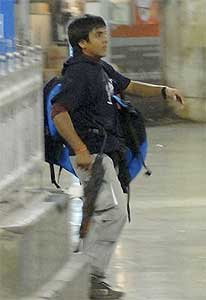
Mohammed Ajmal Amir Kasab was a Pakistani terrorist and a member of the Islamist terrorist organization Lashkar-e-Taiba through which he took part in the 2008 Mumbai terrorist attacks in Maharashtra, India. Kasab, alongside fellow Lashkar-e-Taiba recruit Ismail Khan, killed 72 people during the attacks, most of them at the Chhatrapati Shivaji Terminus. Kasab was the only attacker who was apprehended alive by the police.
The Batla House encounter case was an armed Delhi Police operation to arrest terrorists of the terrorist outfit called 'Indian Mujahideen' (IM), hiding in a flat in the Batla House area of Jamia Nagar, Okhla, on 19 September 2008. The operation resulted in the deaths of two terrorists and one police officer, Inspector Mohan Chand Sharma, with the remaining terrorists arrested. On 15 March 2021, one of the arrested Ariz Khan alias Junaid, was sentenced to death for the murder of Inspector Sharma.
Naina Sahni was the victim of the 1995tandoor murder case. On 2 July 1995, 29-year-old Sahni was killed by her husband Sushil Sharma, an Indian National Congress youth leader. Sushil Sharma was convicted for the murder by the Trial Court, Delhi High Court and Supreme Court. In October 2013, Sharma's death penalty was commuted to life imprisonment by the Supreme Court.
The Hashimpura massacre was the killing of 75 Muslim men by police on or around 22 May 1987 near Meerut in Uttar Pradesh state, India, during the 1987 Meerut communal riots. It was reported that 19 personnel of the Provincial Armed Constabulary rounded up 42 Muslim youths from the Hashimpura mohalla (locality) of the city, took them to the outskirts of the city, shot them in cold blood and dumped their bodies in a nearby irrigation canal. A few days later, the dead bodies were found floating in the canal and a case of murder was registered. Eventually, 19 men were accused of having performed the act. In May 2000, 16 of the 19 accused surrendered and were later released on bail. Whereas, the other three accused died in the intervening period. In 2002, the Supreme Court of India ordered that the case trial should be transferred from the Ghaziabad district court to a Sessions Court at the Tis Hazari court complex in Delhi.
Sukhdev Singh Namdhari is the ex-chairman of Uttarakhand Minority Commission, an alleged mining baron, and a politically influential figure. He stepped into politics as a small-time BJP leader, and in due time, became a well-connected political figure. He was also the State President of Rashtriya Sikh Sangat, a sister organization of the Rashtriya Swayamsevak Sangh.
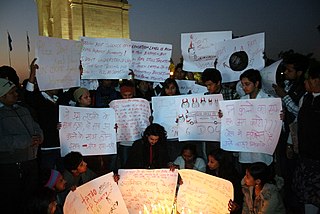
The 2012 Delhi gang rape and murder, commonly known as the Nirbhaya case, involved a rape and fatal assault that occurred on 16 December 2012 in Munirka, a neighbourhood in South Delhi. The incident took place when Jyoti Singh, a 22-year-old physiotherapy intern, was beaten, gang-raped, and tortured in a private bus in which she was travelling with her male friend, Avnindra Pratap Pandey. There were six others in the bus, including the driver, all of whom raped the woman and beat her friend. She was rushed to Safdarjung Hospital in Delhi for treatment and transferred to Singapore eleven days after the assault, where she succumbed to her injuries two days later. The incident generated widespread national and international coverage and was widely condemned, both in India and abroad. Subsequently, public protests against the state and central governments for failing to provide adequate security for women took place in New Delhi, where thousands of protesters clashed with security forces. Similar protests took place in major cities throughout the country. Since Indian law does not allow the press to publish a rape victim's name, the victim was widely known as Nirbhaya, meaning "fearless", and her struggle and death became a symbol of women's resistance to rape around the world.
The Chauri Chaura Incident took place on 4 February 1922 at Chauri Chaura in the Gorakhpur district of United Provinces in British India. The police there fired upon a large group of protesters participating in the non-cooperation movement. In retaliation, the demonstrators attacked and set fire to a police station, killing all of its occupants. The incident led to the deaths of three civilians and 22 policemen. Mahatma Gandhi halted the non-cooperation movement on the national level on 12 February 1922 as a direct result of the incident. Nineteen arrested demonstrators were sentenced to death and 14 to life imprisonment by the British colonial authorities.
Pradyuman Thakur was a seven-year-old student at Ryan International School, in Gurugram, in the state of Haryana, India. He was found with injuries to his neck outside a washroom at the school on 8 September 2017, and he later succumbed to his wounds. A bus conductor who provided assistance with carrying the injured Pradyuman was initially charged with the murder, and allegedly confessed to police, but was later found to be innocent. Four police officers were later charged with framing him for the murder. Following a transfer of the case to the Central Bureau of Investigation, an unnamed sixteen year old student from the same school has since been charged with his murder. The case is still going on, and the trial proceedings have not begun as of December 2021.
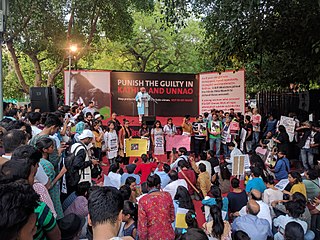
The Kathua rape case involved the abduction, gang rape, and murder of an 8-year-old Muslim girl, Asifa Bano, by seven Hindu males in January 2018 in the Rasana village near Kathua in Jammu and Kashmir, India. A chargesheet for the case was filed, the accused were arrested and the trial began in Kathua on 16 April 2018. The victim belonged to the nomadic Bakarwal community, and the crime was a bid to terrorise the group off Jammu. She disappeared for a week before her body was discovered by the villagers a kilometer away from the village. The incident made national news when charges were filed against eight men in April 2018. The arrests of the accused led to protests by the Panthers Party and other local groups, who sought justice for the victim. The gang rape and murder, as well as the support the accused received especially from local officials of the Bharatiya Janata party, sparked widespread outrage in India and world-wide.

On the night of September 6, 2018, 26-year-old accountant Botham Jean was murdered in Dallas, Texas, by off-duty Dallas Police Department patrol officer Amber Guyger, who entered Jean's apartment and fatally shot him. Guyger, who said that she had entered Jean's apartment believing it was her own and believed Jean to be a burglar, was initially charged with manslaughter. The absence of a murder charge led to protests and accusations of racial bias because Jean—an unarmed black man—was killed in his own home by a white off-duty officer who had apparently disregarded police protocols. On November 30, 2018, Guyger was indicted on a charge of murder. On October 1, 2019, she was found guilty of murder, and was sentenced to ten years' imprisonment the following day. The ruling was upheld on appeal in 2021.
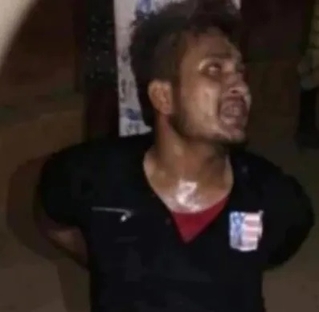
On 17 June 2019, 24-year-old Tabrez Ansari was attacked by a lynch mob in Jharkhand, India. Ansari, a Muslim, was tied to a tree, brutally beaten and forced to chant Hindu religious slogans. He died four days later. The incident came to light after a video of the lynching went viral. The attackers accused him of bike theft. India's Prime Minister commented on this lynching in the Parliament of India.

The 2020 Delhi riots, or North East Delhi riots, were multiple waves of bloodshed, property destruction, and rioting in North East Delhi, beginning on 23 February 2020 and brought about chiefly by Hindu mobs attacking Muslims. Of the 53 people killed, two-thirds were Muslims who were shot, slashed with repeated blows, or set on fire. The dead also included over a dozen Hindus, who were shot or assaulted. More than a week after the violence had ended, hundreds of wounded were languishing in inadequately staffed medical facilities and corpses were being found in open drains. By mid-March many Muslims had remained missing.
References
  | This Indian law–related biographical article is a stub. You can help Wikipedia by expanding it. |