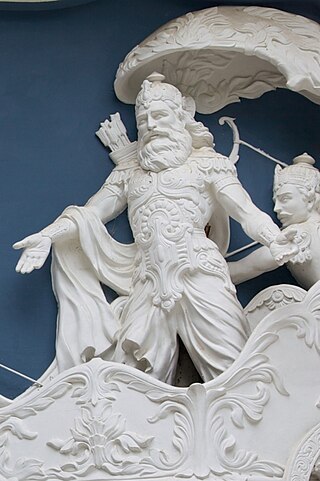
Kshatriya is one of the four varnas of Hindu society and is associated with the warrior aristocracy. The Sanskrit term kṣatriyaḥ is used in the context of later Vedic society wherein members were organised into four classes: brahmin, kshatriya, vaishya, and shudra.

Singh is a title, middle name, or surname that means "lion" in various South Asian and Southeast Asian communities. Traditionally used by the Hindu Kshatriya community, it was later mandated in the late 17th century by Guru Gobind Singh for all male Sikhs as well, in part as a rejection of caste-based prejudice and to emulate Rajput naming conventions. As a surname or a middle name, it is now found throughout the world across communities and religious groups, becoming more of a generic, caste-neutral, decorative name.
Rajput, also called Thakur, is a large multi-component cluster of castes, kin bodies, and local groups, sharing social status and ideology of genealogical descent originating from the Indian subcontinent. The term Rajput covers various patrilineal clans historically associated with warriorhood: several clans claim Rajput status, although not all claims are universally accepted. According to modern scholars, almost all Rajput clans originated from peasant or pastoral communities.

Khatri is a caste originating from the Malwa and Majha areas of Punjab region of South Asia that is predominantly found in India, but also in Pakistan and Afghanistan. The Khatris claim they are warriors who took to trade. In the Indian subcontinent, they were mostly engaged in mercantile professions such as banking and trade. They were the dominant commercial and financial administration class of late-medieval India. Some in Punjab often belonged to hereditary agriculturalist land-holding lineages, while others were engaged in artisanal occupations such as silk production and weaving.
The Bhonsle are a prominent group within the Maratha clan system.

Khas tribe, popularly known as Khashya, according to the 2015 constitution of Nepal are an Indo-Aryan ethno-linguistic group native to the Himalayan region of the Indian subcontinent, in what is now the South Asian country of Nepal, as well as the Indian states of Uttarakhand, Himachal Pradesh, West Bengal, Assam and Sikkim. Historically, Khas were the speakers of an ancient Khas language from the Indo-Aryan language family and the earliest recorded speakers of the Western Pahari languages. The large portion of the Indo-Aryan speakers throughout lower Himalayas were the Khas people. An intrusion of this tribe from the Western and Northwestern Himalayas into Central Himalayas is substantiated by the early linguistic evidences related to the Nepali language. They were also known as Parbatiyas/Parbates and are currently known as Paharis/Pahadis.. They were also referred to as Yartse in Tibet and are also known as Khasan by Bhotia people. The term Khas has now become obsolete, as the Khas people have adopted communal identities because of the negative stereotypes associated with the term Khas. In Nepal the native speaker of Nepali language are known as Khas people.

Shahu of the Bhonsle dynasty of Marathas was a Raja and the first Maharaja (1900–1922) of the Indian princely state of Kolhapur. Rajarshi Shahu was considered a true democrat and social reformer. Shahu Maharaj was an able ruler who was associated with many progressive policies during his rule. From his coronation in 1894 till his demise in 1922, he worked for the cause of the lower caste subjects in his state. Primary education to all regardless of caste and creed was one of his most significant priorities.
Sanskritisation is a term in sociology which refers to the process by which castes or tribes placed lower in the caste hierarchy seek upward mobility by emulating the rituals and practices of the dominant castes or upper castes. It is a process similar to "passing" in sociological terms. This term was made popular by Indian sociologist M. N. Srinivas in the 1950s. Sanskritisation has in particular been observed among mid-ranked members of caste-based social hierarchies.
In Indian culture, the Agnivanshi are people who claim descent from Agni, the Vedic god of fire. The Agnivanshi lineage is one of the lineages among the Rajput clans, the others being the Suryavanshi and the Chandravanshi. According to medieval legends, there are four Agnivanshi clans: Chauhans (Chahamanas), Pratihar (Pratiharas), Parmars (Paramaras) and Solankis (Chaulukyas).

Patidar, formerly known as Kanbi, is an Indian land-owning and peasant caste and community native to Gujarat. The community comprises at multiple subcastes, most prominently the Levas and Kadvas. They form one of the dominant castes in Gujarat. The title of Patidar originally conferred to the land owning aristocratic class of Gujarati Kanbis; however, it was later applied en masse to the entirety of the Kanbi population who lay claim to a land owning identity, partly as a result of land reforms during the British Raj.
Rajput is a large multi-component cluster of castes, kin bodies, and local groups, sharing social status and ideology of genealogical descent originating from the Indian subcontinent. The term Rajput covers various patrilineal clans historically associated with warriorhood: several clans claim Rajput status, although not all claims are universally accepted. According to modern scholars, almost all Rajputs clans originated from peasant or pastoral communities.
Begowal is a town and a Nagar Panchayat in Kapurthala district in the state of Punjab, India. Located 35 kilometers north of Kapurthala City, the town has an average elevation of 225 metres. Begowal is called NRI's area. Many of them are in USA and Canada. The town's population includes of Labana, Jatt, Rajput, Brahmin, Khatri people. Before partition, Begowal belonged to Muslim jagirdar Chaudhary Fazal Mohammad Khan, and later his three sons, Chaudhary Abdul Aziz, Sardar Abdur Rashid Khan, and General Aziz Ahmed.
The Darbhanga Raj, also known as Raj Darbhanga and the Khandwala dynasty, was a Maithil Brahmin dynasty and the rulers of territories, not all contiguous, that were part of the Mithila region, now divided between India and Nepal.
Bihari Mauritians are the descendants of mainly Bhojpuri speaking migrants to Mauritius. A majority of Indo-Mauritians are of Bihari descent, and the majority of Mauritians are Indo-Mauritian. Castewise, most Bihari Mauritians are Vaishyas with significant Bhumihars, Brahmins, Rajputs, Koeris, Chamars, Yadavs, Kurmis, Banias and Kayasthas. All but one Mauritian Prime Ministers have been of Bihari Vaishya descent. The community includes a Hindu majority with a Muslim minority. About 65.7 % of the 1.3 million population of Mauritius is of Indian origin, most of them from Bihar, with Bhojpuri as their ancestral tongue.
The Gautam is an ancient clan found primarily in north region of Indian subcontinent. Gautam Rajputs, who descent from the Ishvaku dynasty.

The Lodhi is a community of agriculturalists, found in India. There are many in Madhya Pradesh, to where they had emigrated from Uttar Pradesh. The Lodhi are categorised as an Other Backward Class, but claim Rajput ties and prefer to be known as "Lodhi-Rajput", although they have no account of their Rajput origin or prevailing Rajput traditions.

Chhipi is a caste of people with ancestral roots tracing back to India. These people are basically Rajputs and used to wear Kshatriya attire. These people were skilled in the art of war, Later people of this caste started doing printing work. They are found in the states of Gujarat, Rajasthan, Madhya Pradesh, Haryana, Delhi, Uttar Pradesh of India.

The Koli is an Indian caste found in Rajasthan, Himachal Pradesh, Gujarat, Maharashtra, Uttar Pradesh, Haryana, Karnataka, Odisha and Jammu and Kashmir states in India. Koli is an agriculturist caste of Gujarat but in coastal areas they also work as fishermen along with agriculture. In the beginning of 20th century, the Koli caste was recognised as a denotified tribe under Criminal Tribes Act by the Indian Government because of their anti-social activities during World War I.
Kanhpuriyaor Kanhvanshi are a dynasty of Kshatriyas (Rajput). They are from the Chandravansh. Maharaja Kanhdev was the originator of Kanhpuria dynasty, by the name of Maharaja Kanhdev and due to residence in Kanhpur. This dynasty is known as Kanhpuria or Kanhvanshi.
Modern historians agree that Rajputs consisted of a mix of various different social groups and different varnas. Rajputisation explains the process by which such diverse communities coalesced into the Rajput community.