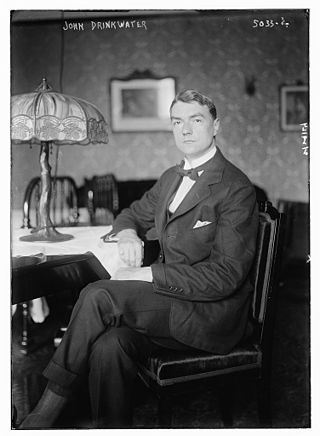
John Drinkwater was an English poet and dramatist. He was known before World War I as one of the Dymock poets, and his poetry was included in all five volumes of Georgian Poetry. After World War I, he achieved fame as a playwright and became closely associated with Birmingham Repertory Theatre.
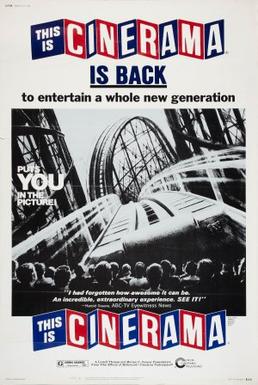
This Is Cinerama is a 1952 American documentary film directed by Mike Todd, Michael Todd Jr., Walter A. Thompson and Fred Rickey and starring Lowell Thomas. It is designed to introduce the widescreen process Cinerama, which broadens the aspect ratio so that the viewer's peripheral vision is involved. This Is Cinerama premiered on September 30, 1952, at the Broadway Theatre in New York City.
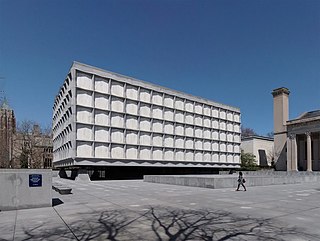
The Beinecke Rare Book & Manuscript Library is the rare book library and literary archive of the Yale University Library in New Haven, Connecticut. It is one of the largest buildings in the world dedicated to rare books and manuscripts and is one of the largest collections of such texts. Established by a gift of the Beinecke family and given its own financial endowment, the library is financially independent from the university and is co-governed by the University Library and Yale Corporation.

The University of Oregon is a public research university in Eugene, Oregon. Founded in 1876, the university also has the Ballmer Institute for Children's Behavioral Health in Portland; the Oregon Institute of Marine Biology in Charleston; and Pine Mountain Observatory in Central Oregon.
Jack Douglas was an American comedy writer who wrote for radio and television while additionally writing a series of humor books.
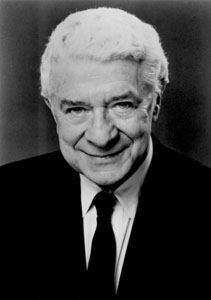
David Howard Susskind was an American producer of TV, movies, and stage plays and also a TV talk show host. His talk shows were innovative in the genre and addressed timely, controversial topics beyond the scope of others of the day.
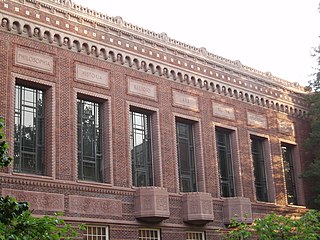
Knight Library is the main facility of the University of Oregon's (UO) library system. It is located on the university's campus in Eugene, Oregon, United States. The library design is emblematic of the architecture of the university's older buildings, and it serves as a hub of student activity. As of 2008 it has a collection of more than 3 million volumes. The library also holds collections of primary sources such as photographs and manuscripts on various topics at the Special Collections & University Archives. It is also a depository for the Federal Depository Library Program. The library was previously known as the Main Library and it was renamed the Knight Library in 1988, in honor of the family of Phil Knight.

Thunder Rock is a 1939 play by Robert Ardrey.
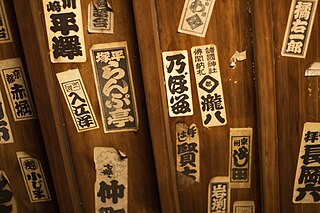
Senjafuda are votive slips, stickers or placards posted on the gates or buildings of Shinto shrines and Buddhist temples in Japan. Unlike ofuda, which bear the name of the shrine, senjafuda bear the name of the worshipper, and can be purchased pre-printed with common names at temples and shrines throughout Japan, as well as at stationery stores and video game centres. Senjafuda were originally made from wooden slats, but have been made of paper since the Edo period.
Craig B. Fisher was an American network and cable television producer. He spent more than 25 years with ABC, CBS, and NBC News Division in New York and Washington, D.C., and more than two decades as a freelance writer and producer. Fisher was responsible for over one thousand hours of live, film and videotape, studio and location television and corporate productions.

The University of Oregon Museum of Natural and Cultural History is a natural history museum on the University of Oregon campus, in Eugene, Oregon, United States of America. The museum headquarters and public spaces are located at 1680 East 15th Avenue in a building inspired by the design of Pacific Northwest Native longhouses.
The University of Oregon has a diverse array of student-run and non-student-run media outlets.
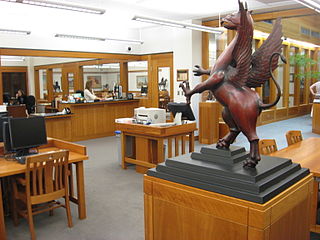
The L. Tom Perry Special Collections is the special collections department of Brigham Young University (BYU)'s Harold B. Lee Library in Provo, Utah. Founded in 1957 with 1,000 books and 50 manuscript collections, as of 2016 the Library's special collections contained over 300,000 books, 11,000 manuscript collections, and over 2.5 million photographs, among many other rare and unique research materials. Since its inception, the special collections have been housed in numerous places including the crawl space of a university building and a wholesale grocery warehouse. Since 2016, the special collections have been located on the first floor of the Harold B. Lee Library and is considered to hold "the finest collection of rare books in the Intermountain West and the second finest Mormon collection in existence".
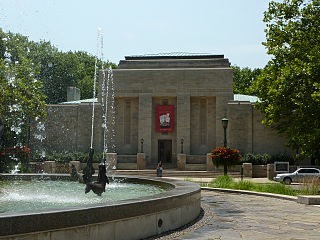
The Lilly Library, located on the campus of Indiana University in Bloomington, Indiana, is an important rare book and manuscript library in the United States. At its dedication on October 3, 1960, the library contained a collection of 20,000 books, 17,000 manuscripts, more than fifty oil paintings, and 300 prints. Currently, the Lilly Library has 8.5 million manuscripts, 450,000 books, 60,000 comic books, 16,000 mini books, 35,000 puzzles, and 150,000 sheets of music.
Richard J. Collins was an American producer, director and screenwriter prominent in Hollywood during the 1940s, 1950s and 1960s. He worked on several notable television programs including Bonanza, General Electric Theater, Matlock and Bob Hope Presents the Chrysler Theatre. He was married to actress Dorothy Comingore from 1939 until 1945. One of the characters in the film Guilty by Suspicion was based on his character although he and Dorothy Comingore were long divorced before the HUAC hearings.
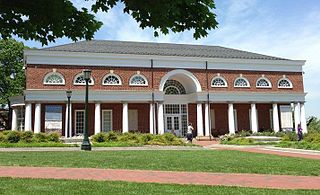
The Albert and Shirley Small Special Collections Library at the University of Virginia is a research library that specializes in American history and literature, history of Virginia and the southeastern United States, the history of the University of Virginia, Thomas Jefferson, and the history and arts of the book. The library is named after Albert and Shirley Small, who donated substantially to the construction of the library's current building. Albert Small, an alumnus of the University of Virginia, also donated his large personal collection of "autograph documents and rare, early printings of the Declaration of Independence." This collection includes a rare printing of the Dunlap broadside of the Declaration of Independence. Joining the library's existing Dunlap in the Tracy W. McGregor Collection of American History, Small's copy made U.Va. the only American institution with two examples of this, the earliest printing of the nation's founding document. It also includes the only letter written on July 4, 1776, by a signer of the Declaration, Caesar Rodney. The Albert H. Small Declaration of Independence Collection boasts an interactive digital display which allows visitors to view the historical documents electronically, providing access to children and an opportunity for visitors to manipulate the electronic copies without risk of damage to the original work.

The Wisconsin Center for Film and Theater Research (WCFTR) is a major archive of motion picture, television, radio, and theater research materials. Located in the headquarters building of the Wisconsin Historical Society in Madison, Wisconsin, the WCFTR holds over three hundred collections from motion picture, television, and theater writers, producers, actors, designers, directors, and production companies. These collections include business records, personal papers, scripts, photographs, promotional graphics, and some twenty thousand films and videotapes of motion picture and television productions.

The Rare Book and Manuscript Library at the University of Illinois Urbana-Champaign is located on the 3rd floor of the University Library. The library is one of the largest special collections repositories in the United States. Its collections, consisting of over half a million volumes and three kilometers of manuscript material, encompass the broad areas of literature, history, art, theology, philosophy, technology and the natural sciences, and include large collections of emblem books, writings of and works about John Milton, and authors' personal papers.
Henry S. Kesler was an American assistant director, second unit director, and director on over 240 films and television programs. A grandson of Joseph F. Smith, Kesler was an active member of the Church of Jesus Christ of Latter-day Saints.
Gertrude Bass Warner was an American twentieth-century art collector, with particular interests in Asian art, religious artifacts, daily-life textiles, ceramics, paintings, and photographs. She lived, traveled, and collected art in East Asia from 1904 to 1938. In 1922 she became the curator for life and first director of the University of Oregon Museum of Art at the University of Oregon, helping to design the historic building with famed architect Ellis F. Lawrence. She had the museum built to house the collection of more than 3,700 works of art, the Murray Warner Collection of Oriental Art, named after her late husband, Murray Warner. She donated the collection to the university in 1933. She traveled throughout China, Japan, Korea, and Russia purchasing works of art and artifacts, taking photographs, and writing extensive field notes. She visited thousands of cultural sites and studied Shinto, Buddhism, and Chinese and Japanese etiquette, and the human experience, and became an innovator in the promotion of Asian art and culture appreciation, Asian studies, and multiculturalism. She is considered a female pioneer of museum studies.
"University of Oregon Archives." Guide to Robert Bendicks Papers. N.p., n.d. Web. 18 July 2012. <nwda-db.wsulibs.wsu.edu/findaid/ark:/80444/xv74908>.
Hilmes, Michele. The television history book. London: British Film Institute, 2003. Print.
Bendick, Jeanne, and Robert Bendick. Television works like this. 4th ed. New York: McGraw-Hill, 1965. Print
Kovarik, Bill. Revolutions in communication: media history from Gutenberg to the digital age. New York: Continuum, 2011. Print.
Bendick, Jeanne, and Robert Bendick. Making the movies,. New York: Whittlesey House, McGraw-Hill Book Company, 1945. Print.
Americas Cup Races. Production materials, Robert Bendick Papers, Ax 505, Box 1 Special Collections and University of Oregon Archives, Uo Libraries
Wide Wide World. “Sunday Driver”. Production materials, Robert Bendick Papers, Ax 505, Box 1 Special Collections and University of Oregon Archives, Uo Libraries
Wide Wide World. “Sunday Driver”. Production Materials Robert Bendick Papers, Ax 505, Box 1 Special Collections and University of Oregon Archives, Uo Libraries
“Today in Rome.” Production Materials, Robert Bendick Papers, Ax 505, Box 1 Special Collections and University of Oregon Archives, Uo Libraries
Wide Wide World, “Land of Plenty”. Production Materials, Robert Bendick Papers, Ax 505, Box 1 Special Collections and University of Oregon Archives, Uo Libraries
17th annual emmy awards, Robert Bendick Papers, Ax 505, Box 1 Special Collections and University of Oregon Archives, Uo Libraries

