 | This article has multiple issues. Please help improve it or discuss these issues on the talk page . (Learn how and when to remove these template messages)
|


Robert C. Rore (born 1954 in Berchtesgaden, Germany) is a German artist and illustrator.
| This article has multiple issues. Please help improve it or discuss these issues on the talk page . (Learn how and when to remove these template messages)
|
Robert C. Rore (born 1954 in Berchtesgaden, Germany) is a German artist and illustrator.
Rore did an apprenticeship as an assistant chemist before he studied art history in Munich and was simultaneously admitted to courses in painting nudes at the Academy of Fine Arts, Munich. His first Solo exhibition was in 1982, the same year he became a professional artist. As an illustrator he works for publishers, companies and associations.
Since 1985 he teaches painting in Munich and at summer academies.
He participated in group shows at galleries, museums and Kunstvereine in Germany, Austria, the Netherlands and the USA. He had solo shows in several museums in Bavaria and is regularly shown in galleries in Munich.
Robert C. Rore began in 1970 with surrealistic paintings, moved to pencil and colored pencil before he developed an individual style of Etchings around 1985 that culminated in neobaroque works with surrealistic elements, in a style reminding of Juan Sánchez Cotán.
In the mid 1980s he also added hyper realistic aquarelles of still lifes and landscapes to his portfolio. For the latter he claims John Singer Sargent as model. By the late 1990s he moved to painting humans, mostly the male body. His style became impressionistic and lighter, [1] comparable to the later works of Joaquín Sorolla. His male nudes have been described as ″body cult″ and ″erotic″ works [2] by the Süddeutsche Zeitung.

Carl Spitzweg was a German romantic painter, especially of genre subjects. He is considered to be one of the most important artists of the Biedermeier era.

Ernst Fuchs was an Austrian painter, draftsman, printmaker, sculptor, architect, stage designer, composer, poet, and one of the founders of the Vienna School of Fantastic Realism. In 1972, he acquired the derelict Otto Wagner Villa in Hütteldorf, which he restored and transformed. The villa was inaugurated as the Ernst Fuchs Museum in 1988.

Wilhelm Lehmbruck was a German sculptor. One of the most important of his generation, he was influenced by realism and expressionism.

Károly Klimó is a Hungarian artist, one of the best known Hungarian artists of the present day. He is a non-figurative artist, member of the Széchenyi Academy of Literature and Arts.

Heinrich Kley was a German illustrator, editorial illustrator and painter.
Herbert List was a German photographer, who worked for magazines, including Vogue, Harper's Bazaar, and Life, and was associated with Magnum Photos. His austere, classically posed black-and-white compositions, particularly his homoerotic male nudes, taken in Italy and Greece being influential in modern photography and contemporary fashion photography.
Antonio Saura Atarés was a Spanish artist and writer, one of the major post-war painters to emerge in Spain in the fifties whose work has marked several generations of artists and whose critical voice is often remembered.
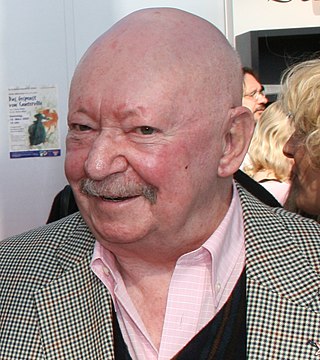
Günter Kunert was a German writer. Based in East Berlin, he published poetry from 1947, supported by Bertold Brecht. After he had signed a petition against the deprivation of the citizenship of Wolf Biermann in 1976, he lost his SED membership, and moved to the West two years later. He is regarded as a versatile German writer who wrote short stories, essays, autobiographical works, film scripts and novels. He received international honorary doctorates and awards.

Ernst Wilhelm Nay was a German painter and graphic designer of classical modernism. He is considered one of the most important painters of German post-war art.
Werner Spies is a German art historian, journalist and exhibition organizer. From 1997 to 2000, he was a director of the Centre Georges Pompidou in Paris. Klaus Albrecht Schröder, director of the Albertina in Vienna, has called Spies "one of the most influential art historians of the 20th century."

Adolf Hitler, dictator of Nazi Germany from 1933 until his suicide in 1945, was also a painter. He produced hundreds of works when he tried to sell his paintings and postcards to earn a living during his Vienna years (1908–1913) but had little commercial success. A number of his paintings were recovered after the Second World War and have been sold at auctions for tens of thousands of dollars. Others were seized by the United States Army and are still in U.S. government possession.

Sabine Moritz is a German painter and graphic designer.

Erwin Pfrang is a German painter, printmaker and poet.

Christian Adam Landenberger was a German Impressionist painter and a professor at the State Academy of Fine Arts Stuttgart. He is especially known for his landscapes.
Norbert Prangenberg was an abstract painter, sculptor, and engraver who was born in Nettseheim, just outside of Cologne, Germany. Though he had no formal training and did not fully engage with art until his 30s, Prangenberg did finally come up with a style that was uniquely his own, not fitting comfortably into the neo-expressionist or neo-geo movements of his time, in the 1970s and 1980s. At this time, he was considered a major figure in contemporary German art. Though he got his start with abstract paintings, he also became known for making sculptures of all sizes; and while his work initially appears abstract, the titles given sometimes allude to the human body or a landscape. As a trained gold- and silversmith, as well as a glassblower, he always showed an attention to materials and how they could be physically engaged with. He was interested in how his own two hands could affect the painting or sculpture's surface. Traces of the artist's hand appear literally throughout his entire oeuvre, before he lost the battle with liver cancer in 2012.
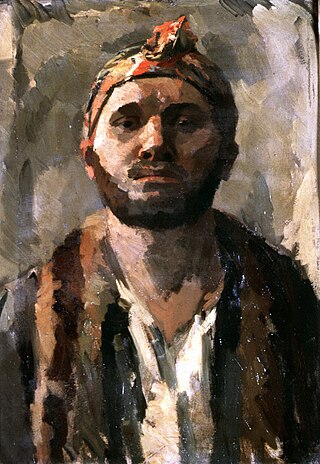
René Beeh was a German draughtsman and painter from Alsace. He was held in high esteem by his contemporaries and called "the coming genius" by art historian Wilhelm Hausenstein, but with his having died prematurely, he has been mostly forgotten.
Rudi Tröger is a German painter and university professor. From 1967 to 1992 he was a professor for painting art at the Academy of Fine Arts, Munich.

Richard Schur is a German artist.

Wolf Röhricht was a German painter. His work was part of the painting event in the art competition at the 1928 Summer Olympics.

Ingo Kühl is a German painter, sculptor and architect.

| International | |
|---|---|
| National | |
