Related Research Articles

Measles is a highly contagious, vaccine-preventable infectious disease caused by measles virus. Symptoms usually develop 10–12 days after exposure to an infected person and last 7–10 days. Initial symptoms typically include fever, often greater than 40 °C (104 °F), cough, runny nose, and inflamed eyes. Small white spots known as Koplik's spots may form inside the mouth two or three days after the start of symptoms. A red, flat rash which usually starts on the face and then spreads to the rest of the body typically begins three to five days after the start of symptoms. Common complications include diarrhea, middle ear infection (7%), and pneumonia (6%). These occur in part due to measles-induced immunosuppression. Less commonly seizures, blindness, or inflammation of the brain may occur. Other names include morbilli, rubeola, red measles, and English measles. Both rubella, also known as German measles, and roseola are different diseases caused by unrelated viruses.
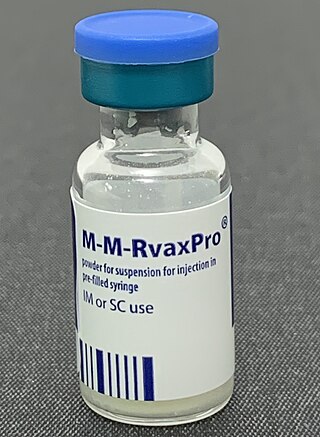
The MMR vaccine is a vaccine against measles, mumps, and rubella, abbreviated as MMR. The first dose is generally given to children around 9 months to 15 months of age, with a second dose at 15 months to 6 years of age, with at least four weeks between the doses. After two doses, 97% of people are protected against measles, 88% against mumps, and at least 97% against rubella. The vaccine is also recommended for those who do not have evidence of immunity, those with well-controlled HIV/AIDS, and within 72 hours of exposure to measles among those who are incompletely immunized. It is given by injection.

Rubella, also known as German measles or three-day measles, is an infection caused by the rubella virus. This disease is often mild, with half of people not realizing that they are infected. A rash may start around two weeks after exposure and last for three days. It usually starts on the face and spreads to the rest of the body. The rash is sometimes itchy and is not as bright as that of measles. Swollen lymph nodes are common and may last a few weeks. A fever, sore throat, and fatigue may also occur. Joint pain is common in adults. Complications may include bleeding problems, testicular swelling, encephalitis, and inflammation of nerves. Infection during early pregnancy may result in a miscarriage or a child born with congenital rubella syndrome (CRS). Symptoms of CRS manifest as problems with the eyes such as cataracts, deafness, as well as affecting the heart and brain. Problems are rare after the 20th week of pregnancy.
The Centers for Disease Control and Prevention, formed in 1946, is the leading national public health institute of the United States. It is a United States federal agency, under the United States Department of Health and Human Services. Its main goal is to protect public health and safety through the control and prevention of disease, injury, and disability in the US and internationally.
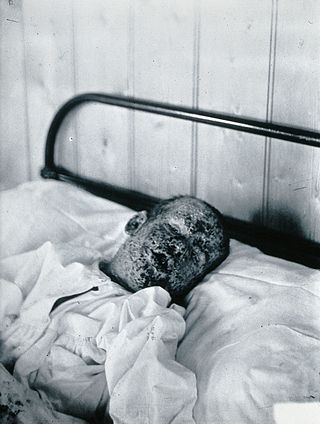
The eradication of infectious diseases is the reduction of the prevalence of an infectious disease in the global host population to zero.

Pakistan is the fifth most populous country in the world with population approaching 225 million. It is a developing country struggling in many domains due to which the health system has suffered a lot. As a result of that, Pakistan is ranked 122nd out of 190 countries in the World Health Organization performance report.
The Expanded Program on Immunization is a World Health Organization program with the goal to make vaccines available to all children.

Seth Franklin Berkley is an American medical epidemiologist and a global advocate of the power of vaccines. He is the founder and former president and CEO of the International AIDS Vaccine Initiative (IAVI) and former CEO of Gavi, the Vaccine Alliance. He is currently a senior advisor to the Pandemic Center at Brown University School of Public Health.
Jean Marie Okwo-Bele is a Congolese physician, public health expert and former Director of the Department of Immunization, Vaccines and Biologicals of the World Health Organization (WHO).

Measles vaccine protects against becoming infected with measles. Nearly all of those who do not develop immunity after a single dose develop it after a second dose. When the rate of vaccination within a population is greater than 92%, outbreaks of measles typically no longer occur; however, they may occur again if the rate of vaccination decreases. The vaccine's effectiveness lasts many years. It is unclear if it becomes less effective over time. The vaccine may also protect against measles if given within a couple of days after exposure to measles.
Rubella vaccine is a vaccine used to prevent rubella. Effectiveness begins about two weeks after a single dose and around 95% of people become immune. Countries with high rates of immunization no longer see cases of rubella or congenital rubella syndrome. When there is a low level of childhood immunization in a population it is possible for rates of congenital rubella to increase as more women make it to child-bearing age without either vaccination or exposure to the disease. Therefore, it is important for more than 80% of people to be vaccinated. By introducing rubella containing vaccines, rubella has been eradicated in 81 nations, as of mid-2020.

The 2009–2010 West African meningitis outbreak was an epidemic of bacterial meningitis which occurred in Burkina Faso, Mali, Niger, and Nigeria since January 2009, an annual risk in the African meningitis belt. A total of 13,516 people have been infected with meningitis, and 931 have died. Nigeria has been the most adversely affected, with over half of the total cases and deaths occurring in the nation. The WHO reported on 27 March 2009 that 1,100 had died and there were 25,000 suspected cases. It is the worst outbreak in the region since 1996, and a third of the world's emergency vaccine stockpile for the bacterial form has been consumed. The GAVI Alliance has been trying to secure more vaccines.
A vaccine-preventable disease is an infectious disease for which an effective preventive vaccine exists. If a person acquires a vaccine-preventable disease and dies from it, the death is considered a vaccine-preventable death.
Jon Andrus, an American physician, epidemiologist and immunization specialist, is the former deputy director of the Pan American Health Organization (PAHO).
The Nigeria Centre for Disease Control (NCDC) is the national public health institute for Nigeria. It is a federal government agency under the Federal Ministry of Health (Nigeria), with its headquarters in Abuja, Federal Capital Territory.

On 20 January 2016, the health minister of Angola reported 23 cases of yellow fever with 7 deaths among Eritrean and Congolese citizens living in Angola in Viana municipality, a suburb of the capital of Luanda. The first cases were reported in Eritrean visitors beginning on 5 December 2015 and confirmed by the Pasteur WHO reference laboratory in Dakar, Senegal in January. The outbreak was classified as an urban cycle of yellow fever transmission, which can spread rapidly. A preliminary finding that the strain of the yellow fever virus was closely related to a strain identified in a 1971 outbreak in Angola was confirmed in August 2016. Moderators from ProMED-mail stressed the importance of initiating a vaccination campaign immediately to prevent further spread. The CDC classified the outbreak as Watch Level 2 on 7 April 2016. The WHO declared it a grade 2 event on its emergency response framework having moderate public health consequences.
In early months of 2019, a measles outbreak occurred in the Portland metropolitan area, including the Clark County, Washington suburbs, in the United States. At the time, the outbreak was the largest outbreak in more than two decades; outbreaks in 2019 in areas including Brooklyn and Rockland County, New York have since seen far greater numbers of cases.

In 2019, a measles epidemic broke out in the Democratic Republic of the Congo (DRC). The epidemic started in early 2019 in the southeast corner of the DRC and then spread to all provinces. By June 2019 the epidemic was reported to have exceeded the death toll of the concurrent Ebola epidemic. By April 2020, it had infected more than 341,000 people and claimed about 6,400 fatalities. This has primarily affected children under the age of five, representing 74% of infections and nearly 90% of deaths.

The 2019 Samoa measles outbreak began in September 2019. As of 6 January 2020, there were over 5,700 cases of measles and 83 deaths, out of a Samoan population of 200,874. Over three per cent of the population were infected. The cause of the outbreak was attributed to decreased vaccination rates, from 74% in 2017 to 31–34% in 2018, even though nearby islands had rates near 99%.

Michael Joseph Ryan is an Irish epidemiologist and former trauma surgeon, specialising in infectious disease and public health. He is executive director of the World Health Organization's Health Emergencies Programme, leading the team responsible for the international containment and treatment of COVID-19. Ryan has held leadership positions and has worked on various outbreak response teams in the field to eradicate the spread of diseases including bacillary dysentery, cholera, Crimean–Congo hemorrhagic fever, Ebola, Marburg virus disease, measles, meningitis, relapsing fever, Rift Valley fever, SARS, and Shigellosis.
References
- ↑ "Measles & Rubella Initiative : Annual Report 2013" (PDF). Who.int. Retrieved 2017-02-24.
- ↑ "Introducing Robert Kezaala, Head of Measles & Rubella, UNICEF - Measles & Rubella Initiative". Measlesrubellainitiative.org. Retrieved 2017-02-24.
- ↑ Reef, Susan E.; Chu, Susan Y.; Cochi, Stephen L.; Kezaala, Robert; Van Den Ent, Maya; Gay, Andrea; De Quadros, Ciro; Strebel, Peter M. (2012). "Reducing the global burden of congenital rubella syndrome" (PDF). The Lancet. 380 (9848): 1145–1146. doi:10.1016/S0140-6736(12)61663-8. PMID 23021280. S2CID 45669933 . Retrieved 2017-02-24.
- ↑ Park, Madison (2015-02-06). "How bad is measles around the world?". CNN.com. Retrieved 2017-02-24.
- ↑ "Measles Outbreak". YouTube. 2015-02-05. Retrieved 2017-02-24.
- ↑ "Eighty-six percent decline in measles cases brings Western Pacific Region closer than ever to measles elimination | Press centre". UNICEF. Retrieved 2017-02-24.
- ↑ "Uganda: Mediocrity Haunts Us". Allafrica.com. Retrieved 2017-02-24.
- ↑ "Subscribers Only". reader.exacteditions.com. Archived from the original on 2 February 2017. Retrieved 14 January 2022.
- ↑ "Entrepreneurs: the new global citizens". Thefreelibrary.com. Retrieved 2017-02-24.
- ↑ "Uganda: Looking Into the Movement And the Future of the State - Part Two". Allafrica.com. Retrieved 2017-02-24.