
Robert Schmutzler was a German art historian known for his work on the development of Art Nouveau that identified new and earlier origins for the style at a time when it was undergoing a revival. [1]
Robert Schmutzler was a German art historian known for his work on the development of Art Nouveau that identified new and earlier origins for the style at a time when it was undergoing a revival. [1]

Schmutzler's major work was his book Art nouveau-Jugendstil (1962) which was developed from his doctoral thesis. [2] It was printed in English in 1964 as Art Nouveau in a translation by Edouard Roditi, published by Thames and Hudson in the United Kingdom and Abrams in the United States.
The English language edition was positively reviewed by Lawrence Gowing in The Observer who pronounced it "fascinating" [3] and by Eric Newton in The Guardian who honoured Schmutzler for disproving the belief that Victor Horta had invented the style, saying "The legend dies hard. In fact only German scholarship could kill it, and only a German scholar, with his complex machinery of philosophical interpretation and aesthetic analysis could manage to relate it to what came before..." [4]
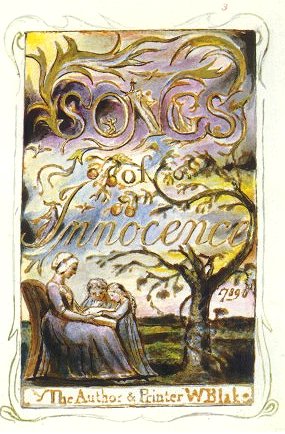
Newton criticised Schmutzler for the untidy organisation of the book and found the omission of Alphonse Mucha inexplicable, but praised him for identifying the British origins of the style in the work of William Blake, the Pre-Raphaelites, and Aubrey Beardsley, as well as in Arthur Mackmurdo's 1881 design for a chair. [4] Schmutzler had already written about the British origins of the style and the influence of William Blake in particular in two articles in Architectural Review in 1955.
Edith Hoffmann on the other hand, in The Burlington Magazine , was less convinced that the eventual development of the Art Nouveau style could be convincingly attributed to the influence of Blake on the Pre-Raphaelites, arguing that his decorative work, derived from Rocaille ornament, was not his most important work. She was still less sure that "proto-Art Nouveau" elements could be found in the work of Palmer, Calvert, and Ingres as postulated by Schmutzler. [5]
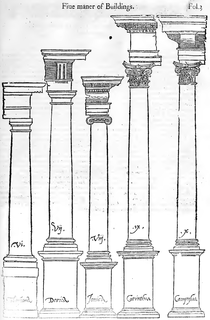
Classical architecture usually denotes architecture which is more or less consciously derived from the principles of Greek and Roman architecture of classical antiquity, or sometimes even more specifically, from the works of the Roman architect Vitruvius. Different styles of classical architecture have arguably existed since the Carolingian Renaissance, and prominently since the Italian Renaissance. Although classical styles of architecture can vary greatly, they can in general all be said to draw on a common "vocabulary" of decorative and constructive elements. In much of the Western world, different classical architectural styles have dominated the history of architecture from the Renaissance until the second world war, though it continues to inform many architects to this day.

Art Nouveau is an international style of art, architecture, and applied art, especially the decorative arts, known in different languages by different names: Jugendstil in German, Stile Liberty in Italian, Modernisme català in Catalan, etc. In English it is also known as the Modern Style. The style was most popular between 1890 and 1910 during the Belle Époque period that ended with the start of World War I in 1914. It was a reaction against the academic art, eclecticism and historicism of 19th century architecture and decoration. It was often inspired by natural forms such as the sinuous curves of plants and flowers. Other characteristics of Art Nouveau were a sense of dynamism and movement, often given by asymmetry or whiplash lines, and the use of modern materials, particularly iron, glass, ceramics and later concrete, to create unusual forms and larger open spaces.

Jugendstil was an artistic movement, particularly in the decorative arts, that was influential primarily in Germany and elsewhere in Europe to a lesser extent from about 1895 until about 1910. It was the German counterpart of Art Nouveau. The members of the movement were reacting against the historicism and neo-classicism of the official art and architecture academies. It took its name from the art journal Jugend, founded by the German artist Georg Hirth. It was especially active in the graphic arts and interior decoration.
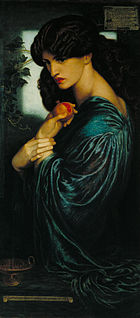
The Pre-Raphaelite Brotherhood was a group of English painters, poets, and art critics, founded in 1848 by William Holman Hunt, John Everett Millais, Dante Gabriel Rossetti, William Michael Rossetti, James Collinson, Frederic George Stephens and Thomas Woolner who formed a seven-member "Brotherhood" modelled in part on the Nazarene movement. The Brotherhood was only ever a loose association and their principles were shared by other artists of the time, including Ford Madox Brown, Arthur Hughes and Marie Spartali Stillman. Later followers of the principles of the Brotherhood included Edward Burne-Jones, William Morris and John William Waterhouse.

The Vienna Secession is an art movement, closely related to Art Nouveau, that was formed in 1897 by a group of Austrian painters, graphic artists, sculptors and architects, including Josef Hoffman, Koloman Moser, Otto Wagner, and Gustav Klimt. They resigned from the Association of Austrian Artists in protest against its support for more traditional artistic styles. Their most influential architectural work was the Secession Building designed by Joseph Maria Olbrich as a venue for expositions of the group. Their official magazine was called Ver Sacrum, which published highly stylised and influential works of graphic art. In 1905 the group itself split, when some of the most prominent members, including Klimt, Wagner, and Hoffmann, resigned in a dispute over priorities, but it continued to function, and still functions today, from its headquarters in the Secession Building. In its current form, the Secession exhibition gallery is independently led and managed by artists.

Franz Metzner was an influential German sculptor, particularly his sculptural figures integrated into the architecture of Central European public buildings in the Art Nouveau / Jugendstil / Vienna Secession period. His style is difficult to classify.

Sir Alan Bowness CBE was a British art historian, art critic, and museum director. He was the director of the Tate Gallery between 1980 and 1988.

The Modern Style is a style of architecture, art, and design that first emerged in the United Kingdom in the mid-1880s. It is the first Art Nouveau style worldwide, and it represents the evolution of Arts and Crafts movement which was native to Great Britain. Britain not only provided the base and intellectual background for the Art Nouveau movement which was adapted by other countries to give birth to local variants; they also played an over-sized role in its dissemination and cultivation through the Liberty department store and The Studio magazine. The most important person in the field of design in general and architecture, in particular, was Charles Rennie Mackintosh. He created one of the iconic symbols of the movement, known as the Mackintosh rose or Glasgow rose. The Glasgow school was also of tremendous importance, particularly due to a group closely associated with Mackintosh, known as The Four. The Liberty store nurturing of style gave birth to two metalware lines, Cymric and Tudric.

Richard Riemerschmid was a German architect, painter, designer and city planner from Munich. He was a major figure in Jugendstil, the German form of Art Nouveau, and a founder of architecture in the style. A founder member of both the Vereinigte Werkstätte für Kunst im Handwerk and the Deutscher Werkbund and the director of art and design institutions in Munich and Cologne, he prized craftsmanship but also pioneered machine production of artistically designed objects.
William Gaunt was a British artist and art historian, best known for his books on British 19th-century art.
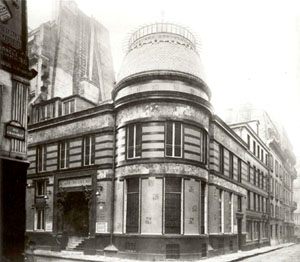
The Maison de l'Art Nouveau, abbreviated often as L'Art Nouveau, and known also as Maison Bing for the owner, was a gallery opened on 26 December 1895, by Siegfried Bing at 22 rue de Provence, Paris.
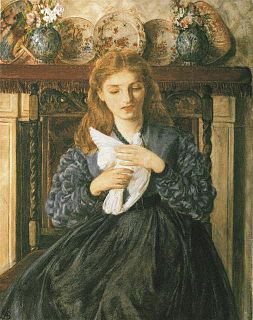
Rebecca Solomon was a 19th-century English Pre-Raphaelite draftsman, illustrator, engraver, and painter of social injustices. She is the second of three children who all became artists, in a prominent Jewish family.

Ecce Ancilla Domini, or The Annunciation, is an oil painting by the English artist Dante Gabriel Rossetti, first painted in 1850 and now in Tate Britain in London. The Latin title is a quotation from the Vulgate text of the first chapter of the Gospel of Saint Luke, describing the Annunciation, where Mary accepts the message brought to her by the Angel Gabriel that she would give birth to a child (Jesus) by God.

The Beloved is an oil painting on canvas by English artist Dante Gabriel Rossetti, first painted in 1865 and now in Tate Britain.

Pia de' Tolomei is an oil painting on canvas by English artist Dante Gabriel Rossetti, painted around 1868 and now in the Spencer Museum of Art, on the campus of the University of Kansas in Lawrence, Kansas.

Furniture created in the Art Nouveau style was prominent from the beginning of the 1890s to the beginning of the First World War in 1914. It characteristically used forms based on nature, such as vines, flowers and water lilies, and featured curving and undulating lines, sometimes known as the whiplash line, both in the form and the decoration. Other common characteristics were asymmetry and polychromy, achieved by inlaying different colored woods.

Rosa Brett, was a Pre-Raphaelite painter and sister of landscape artist John Brett. Their mother was Ann Brett and their father was an army surgeon, Captain Charles Curtis Brett (1789–1865). Rosa grew up in Dublin, but was known to travel on the continent, spending 1854–55 in Belgium for her health.

The Pendant with Saint George is a gold and enamel pendant designed and created by Lluís Masriera i Rosés, now in the permanent collection of the National Art Museum of Catalonia in Barcelona.

Castel Henriette was a villa designed by the Art Nouveau architect Hector Guimard in Sèvres, France, in 1899. It was completed in 1900 and modified in 1903 with the removal of the look-out tower, and was demolished in 1969.

Art Nouveau posters and graphic arts flourished and became an important vehicle of the style, thanks to the new technologies of color lithography and color printing, which allowed the creation of and distribution of the style to a vast audience in Europe, the United States and beyond. Art was no longer confined to art galleries, but could be seen on walls and illustrated magazines.
 Media related to Art Nouveau at Wikimedia Commons