Related Research Articles

Infrared is electromagnetic radiation (EMR) with wavelengths longer than that of visible light but shorter than microwaves. The infrared spectral band begins with waves that are just longer than those of red light, so IR is invisible to the human eye. IR is generally understood to include wavelengths from around 750 nm (400 THz) to 1 mm (300 GHz). IR is commonly divided between longer-wavelength thermal IR, emitted from terrestrial sources, and shorter-wavelength IR or near-IR, part of the solar spectrum. Longer IR wavelengths (30–100 μm) are sometimes included as part of the terahertz radiation band. Almost all black-body radiation from objects near room temperature is in the IR band. As a form of electromagnetic radiation, IR carries energy and momentum, exerts radiation pressure, and has properties corresponding to both those of a wave and of a particle, the photon.

Heating, ventilation, and air conditioning (HVAC) is the use of various technologies to control the temperature, humidity, and purity of the air in an enclosed space. Its goal is to provide thermal comfort and acceptable indoor air quality. HVAC system design is a subdiscipline of mechanical engineering, based on the principles of thermodynamics, fluid mechanics, and heat transfer. "Refrigeration" is sometimes added to the field's abbreviation as HVAC&R or HVACR, or "ventilation" is dropped, as in HACR.

A heat pump is a device that consumes energy to transfer heat from a cold heat sink to a hot heat sink. Specifically, the heat pump transfers thermal energy using a refrigeration cycle, cooling the cool space and warming the warm space. In cold weather, a heat pump can move heat from the cool outdoors to warm a house ; the pump may also be designed to move heat from the house to the warmer outdoors in warm weather. As they transfer heat rather than generating heat, they are more energy-efficient than other ways of heating or cooling a home.

A thermostat is a regulating device component which senses the temperature of a physical system and performs actions so that the system's temperature is maintained near a desired setpoint.

Infrared thermography (IRT), thermal video or thermal imaging, is a process where a thermal camera captures and creates an image of an object by using infrared radiation emitted from the object in a process, which are examples of infrared imaging science. Thermographic cameras usually detect radiation in the long-infrared range of the electromagnetic spectrum and produce images of that radiation, called thermograms. Since infrared radiation is emitted by all objects with a temperature above absolute zero according to the black body radiation law, thermography makes it possible to see one's environment with or without visible illumination. The amount of radiation emitted by an object increases with temperature; therefore, thermography allows one to see variations in temperature. When viewed through a thermal imaging camera, warm objects stand out well against cooler backgrounds; humans and other warm-blooded animals become easily visible against the environment, day or night. As a result, thermography is particularly useful to the military and other users of surveillance cameras.
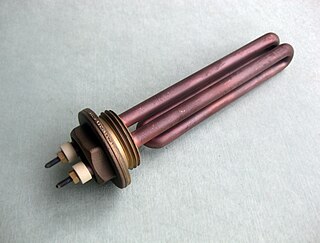
A heating element is a device used for conversion of electric energy into heat, consisting of a heating resistor and accessories. Heat is generated by the passage of electric current through a resistor through a process known as Joule heating. Heating elements are used in household appliances, industrial equipment, and scientific instruments enabling them to perform tasks such as cooking, warming, or maintaining specific temperatures higher than the ambient.
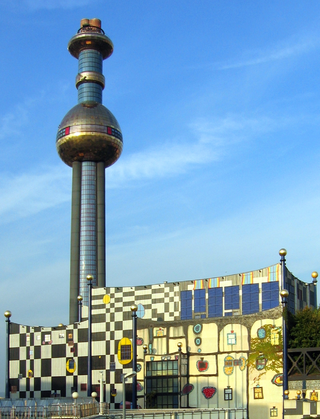
District heating is a system for distributing heat generated in a centralized location through a system of insulated pipes for residential and commercial heating requirements such as space heating and water heating. The heat is often obtained from a cogeneration plant burning fossil fuels or biomass, but heat-only boiler stations, geothermal heating, heat pumps and central solar heating are also used, as well as heat waste from factories and nuclear power electricity generation. District heating plants can provide higher efficiencies and better pollution control than localized boilers. According to some research, district heating with combined heat and power (CHPDH) is the cheapest method of cutting carbon emissions, and has one of the lowest carbon footprints of all fossil generation plants.

Electric heating is a process in which electrical energy is converted directly to heat energy. Common applications include space heating, cooking, water heating and industrial processes. An electric heater is an electrical device that converts an electric current into heat. The heating element inside every electric heater is an electrical resistor, and works on the principle of Joule heating: an electric current passing through a resistor will convert that electrical energy into heat energy. Most modern electric heating devices use nichrome wire as the active element; the heating element, depicted on the right, uses nichrome wire supported by ceramic insulators.
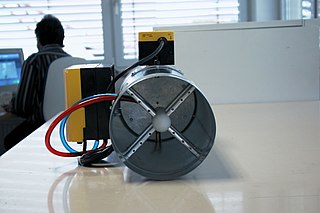
Variable air volume (VAV) is a type of heating, ventilating, and/or air-conditioning (HVAC) system. Unlike constant air volume (CAV) systems, which supply a constant airflow at a variable temperature, VAV systems vary the airflow at a constant or varying temperature. The advantages of VAV systems over constant-volume systems include more precise temperature control, reduced compressor wear, lower energy consumption by system fans, less fan noise, and additional passive dehumidification.
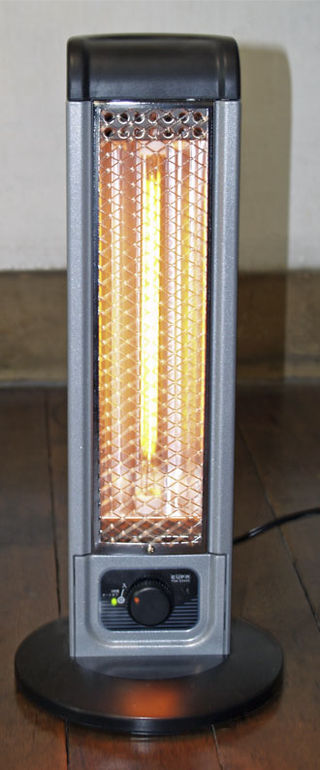
A space heater is a device used to heat a single, small- to medium-sized area. This type of heater can be contrasted with central heating, which distributes heat to multiple areas.
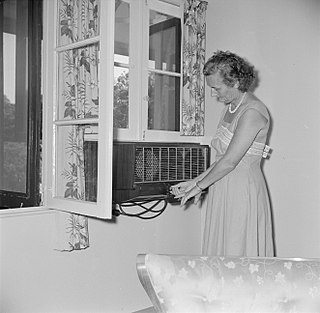
Air conditioning, often abbreviated as A/C (US) or air con (UK), is the process of removing heat from an enclosed space to achieve a more comfortable interior temperature and in some cases also controlling the humidity of internal air. Air conditioning can be achieved using a mechanical 'air conditioner' or by other methods, including passive cooling and ventilative cooling. Air conditioning is a member of a family of systems and techniques that provide heating, ventilation, and air conditioning (HVAC). Heat pumps are similar in many ways to air conditioners, but use a reversing valve to allow them both to heat and to cool an enclosed space.
An infrared heater or heat lamp is a heating appliance containing a high-temperature emitter that transfers energy to a cooler object through electromagnetic radiation. Depending on the temperature of the emitter, the wavelength of the peak of the infrared radiation ranges from 750 nm to 1 mm. No contact or medium between the emitter and cool object is needed for the energy transfer. Infrared heaters can be operated in vacuum or atmosphere.
Infrared lamps are electrical devices which emit infrared radiation. Infrared lamps are commonly used in radiant heating for industrial processes and building heating. Infrared LEDs are used for communication over optical fibers and in remote control devices. Infrared lamps are also used for some night vision devices where visible light would be objectionable. Infrared lamp sources are used in certain scientific and industrial instrument for chemical analysis of liquids and gases; for example, the pollutant sulfur dioxide in air can be measured using its infrared absorption characteristics. IR radiant energy emitted by lamps cover a wide spectrum of wavelengths, ranging from 0.7 μm (micrometers) to a longer wavelength of 400 μm.

Radiators and convectors are heat exchangers designed to transfer thermal energy from one medium to another for the purpose of space heating.

The Viessmann Group is a German manufacturer of heating and refrigeration systems headquartered in Allendorf (Eder), Germany. With 22 production companies in 12 countries, distribution companies and representative offices in 74 countries and 120 sales offices throughout the world, Viessmann is international in its orientation. More than 54 percent of turnover is generated abroad. Since January 2022, the company is led by Martin Viessmann, Maximilian Viessmann (Group-CEO) and Ulrich Hüllmann (CFO). In April 2023, Viessmann announced that it would sell its heat pump division to its US competitor Carrier Global for €12 billion. The transaction was completed in January 2024, Max Viessmann joins the Board of Carrier Global
HVAC is a major sub discipline of mechanical engineering. The goal of HVAC design is to balance indoor environmental comfort with other factors such as installation cost, ease of maintenance, and energy efficiency. The discipline of HVAC includes a large number of specialized terms and acronyms, many of which are summarized in this glossary.
Variable refrigerant flow (VRF), also known as variable refrigerant volume (VRV), is an HVAC technology invented by Daikin Industries, Ltd. in 1982. Similar to ductless mini-split systems, VRFs use refrigerant as the primary cooling and heating medium, and are usually less complex than conventional chiller-based systems. This refrigerant is conditioned by one or more condensing units, and is circulated within the building to multiple indoor units. VRF systems, unlike conventional chiller-based systems, allow for varying degrees of cooling in more specific areas, may supply hot water in a heat recovery configuration without affecting efficiency, and switch to heating mode during winter without additional equipment, all of which may allow for reduced energy consumption. Also, air handlers and large ducts are not used which can reduce the height above a dropped ceiling as well as structural impact as VRF uses smaller penetrations for refrigerant pipes instead of ducts.
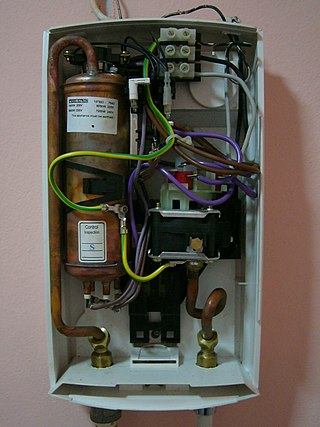
Tankless water heaters — also called instantaneous, continuous flow, inline, flash, on-demand, or instant-on water heaters — are water heaters that instantly heat water as it flows through the device, and do not retain any water internally except for what is in the heat exchanger coil unless the unit is equipped with an internal buffer tank. Copper heat exchangers are preferred in these units because of their high thermal conductivity and ease of fabrication. However, copper heat exchangers are more susceptible to scale buildup than stainless steel heat exchangers.
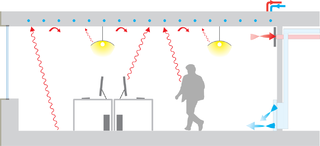
Radiant heating and cooling is a category of HVAC technologies that exchange heat by both convection and radiation with the environments they are designed to heat or cool. There are many subcategories of radiant heating and cooling, including: "radiant ceiling panels", "embedded surface systems", "thermally active building systems", and infrared heaters. According to some definitions, a technology is only included in this category if radiation comprises more than 50% of its heat exchange with the environment; therefore technologies such as radiators and chilled beams are usually not considered radiant heating or cooling. Within this category, it is practical to distinguish between high temperature radiant heating, and radiant heating or cooling with more moderate source temperatures. This article mainly addresses radiant heating and cooling with moderate source temperatures, used to heat or cool indoor environments. Moderate temperature radiant heating and cooling is usually composed of relatively large surfaces that are internally heated or cooled using hydronic or electrical sources. For high temperature indoor or outdoor radiant heating, see: Infrared heater. For snow melt applications see: Snowmelt system.

Passive daytime radiative cooling (PDRC) is the use of unpowered, reflective/thermally-emissive surfaces to lower the temperature of a building or other object.
References
- ↑ "Company Overview of Roberts-Gordon, LLC". Bloomberg Businessweek. Retrieved November 13, 2012.
- ↑ "The Sterling Group Completes the Acquisition of Roberts-Gordon LLC". Sterling Group. 2014-07-02. Retrieved 2024-12-10.
- ↑ "Joe Patterson named VP and GM of new Heat Group". Mechanical Business. 2023-12-13. Retrieved 2024-12-10.