
Peerages in the United Kingdom form a legal system comprising both hereditary and lifetime titles, composed of various ranks, and within the framework of the Constitution of the United Kingdom form a constituent part of the legislative process and the British honours system. The British monarch is considered the fount of honour and is notionally the only person who can grant peerages, though there are many conventions about how this power is used, especially at the request of the British government. The term peerage can be used both collectively to refer to the entire body of titled nobility, and individually to refer to a specific title. British peerage title holders are termed peers of the Realm.

In British heraldry, a coronet is any crown whose bearer is less than sovereign or royal in rank, irrespective of the crown's appearance. In other languages, this distinction is not made, and usually the same word for crown is used irrespective of rank In this use, the English coronet is a purely technical term for all heraldic images of crowns not used by a sovereign, and implies nothing about the actual shape of the crown depicted. A Coronet is another type of crown, but is reserved for the lower ranks of nobility like Marquesses and Marchionesses, Earls and Countesses, Barons and Baronesses, and some Lords and Ladies. The specific design and attributes of the crown or coronet signifies the hierarchy and ranking of its owner.

Bunyoro, also called Bunyoro-Kitara, is a traditional Bantu kingdom in Western Uganda. It was one of the most powerful kingdoms in Central and East Africa from the 13th century to the 19th century. It is ruled by the King (Omukama) of Bunyoro-Kitara. The current ruler is Solomon Iguru I, the 27th Omukama.

Ankole was a traditional Bantu kingdom in Uganda and lasted from the 15th century until 1967. The kingdom was located in south-western Uganda, east of Lake Edward.
Omukama wa Bunyoro Translates to The King of Bunyoro is the title given to rulers of the East African kingdom of Bunyoro-Kitara. The kingdom lasted as an independent state from the 16th to the 19th century. The Omukama of Bunyoro remains an important figure in Ugandan politics, especially among the Banyoro people of whom he is the titular head. He is closely related to the Omukama of Toro Kingdom.

Busoga is a kingdom and one of four constitutional monarchies in present-day Uganda. The kingdom is a cultural institution which promotes popular participation and unity among the people of the region through development programs to improve their standard of living.

The Nyoro people, also known as Banyoro are a Bantu ethnic group native to the kingdom of Bunyoro in Uganda. They live in settlements on a well-watered and fertile plateau. Banyoro are closely related to other Bantu peoples of the region, namely the Batooro, Banyankole, Bakiga and the Bahema peoples.
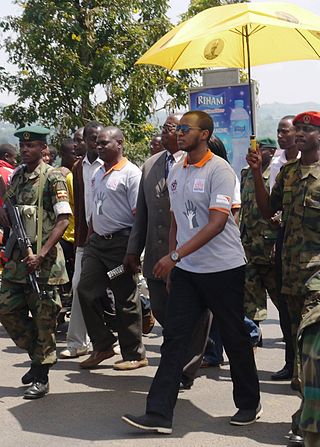
Rukirabasaija Omukama Oyo Nyimba Kabamba Iguru Rukidi IV, commonly known as King Oyo, is the reigning Omukama of Tooro, in Uganda. He was born on 16 April 1992 to King Patrick David Mathew Kaboyo Olimi III and Queen Best Kemigisa Kaboyo. Three and a half years later in 1995, Oyo ascended the throne and succeeded his father to become the 12th ruler of the 180-year-old Kingdom of Tooro.

Portuguese heraldry encompasses the modern and historic traditions of heraldry in Portugal and the Portuguese Empire. Portuguese heraldry is part of the larger Iberian tradition of heraldry, one of the major schools of heraldic tradition, and grants coats of arms to individuals, cities, Portuguese colonies, and other institutions. Heraldry has been practiced in Portugal at least since the 12th century, however it only became standardized and popularized in the 16th century, during the reign of King Manuel I of Portugal, who created the first heraldic ordinances in the country. Like in other Iberian heraldic traditions, the use of quartering and augmentations of honor is highly representative of Portuguese heraldry, but unlike in any other Iberian traditions, the use of heraldic crests is highly popular.
Chwa II Kabalega, was the King or Omukama of Bunyoro in Uganda from 1870 to 1899.
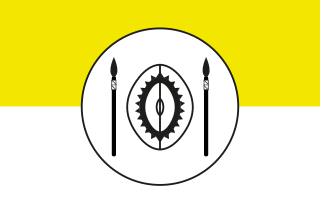
The Chiefdom of Kooki, also known as the Kooki chiefdom, was a pre-colonial African kingdom located within present-day Rakai District of Uganda that existed from approximately 1740 until 1896. The kingdom ceased to exist as an independent state in 1896 when it merged into the British Protectorate of Buganda. Its royal line still continues to this day as a Chiefdom, and is currently led by The Kamuswaga Apollo Sansa Kabumbuli II a hereditary Saza Chief on behalf of the Kabaka of Buganda. In 27 July 2015, the Kooki Kingdom declared independence from Buganda but it wasn't recognized by Buganda or Uganda.
Omukama Rukirabasaija Agutamba Solomon Gafabusa Iguru I is the 27th Omukama of Bunyoro from 1994 to present. The King's traditional alternative name used by family is Amooti.

The Medal of Honor of the Association of the Representatives of Bunyoro-Kitara (ARKBK) is the highest award of the organization, and can only be awarded by the President of the ARKBK. It is bestowed upon members of the ARKBK or to individuals who have distinguished themselves with "extraordinary merits, outstanding achievements and very special contributions to the Kingdom of Bunyoro-Kitara and the ARKBK".

The Royal Order of the Omujwaara Kondo is the oldest and highest royal order of the Bunyoro-Kitara Kingdom and is awarded solely by the Omukama (King) of Bunyoro. It is a single-grade honour, separated into two classes - Class I and Class II. Class I is limited to other royal families of the world and heads of state, while Class II is open to all persons.

The Association of Representatives of the Bunyoro-Kitara Kingdom CLBG(ARKBK) is a non-profit charity and NGO in the West-Ugandan kingdom of Bunyoro-Kitara. It was established by royal charter on August 27, 2009 by Omukama ("King") Solomon Iguru I and is incorporated under the Ugandan Companies Act. Its purpose is to promote the Kingdom internationally and to support development programs for the region. The organisation aims to remain neutral in regards to political and religious matters.
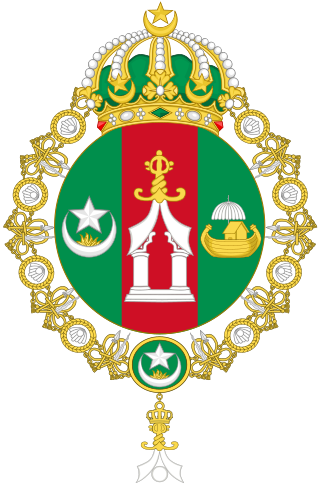
The Royal and Hashemite Order of the Pearl is the dynastic order of the Royal House of Sulu, which serves as the premier institution and the highest personal honour of and in the Royal Sultanate of Sulu. The order is an honourable and nobiliary corporation instituted as a dynastic Order of Datuship analogous to traditional dynastic orders of chivalry, and is in direct continuation from the ancient customs and distinctions of the Royal Sultanate of Sulu and the Court of the Sultan. Ampun Sultan Muedzul Lail Tan Kiram, as Head of the Royal House of Sulu, is the hereditary sovereign who processes the fons honorum and Grand Sayyid of the order, and his heirs and successors as heads of the Royal House of Sulu, shall ever be sovereigns and Grand Sayyids of the order.

The Tooro people, also known as Batooro or Toro people are a Bantu ethnic group, native to the Tooro Kingdom, a subnational constitutional monarchy within Uganda.
The Most Honourable Order of Omukama Chwa II Kabalega is the third highest royal order of merit of the Kingdom of Bunyoro, and is awarded solely by the Omukama of Bunyoro. It is named in honour of Omukama (King) Chwa II Kabalega of Bunyoro, who is famous for resisting colonialism during his reign.

The coat of arms of the Prince of Wales is the official personal heraldic insignia of the Princes of Wales, a title traditionally granted to the heir apparent of the reigning monarch of the United Kingdom of Great Britain and Northern Ireland, formerly the Kingdom of Great Britain and before that the Kingdom of England.

Mparo Royal Tombs also Mparo tombs is a historical royal burial site for Omukama Kabalega II and kings and royals of Bunyoro-Kitara kingdom. The tombs cover six acres of land.


