
Surfing is a surface water sport in which an individual, a surfer, uses a board to ride on the forward section, or face, of a moving wave of water, which usually carries the surfer towards the shore. Waves suitable for surfing are primarily found on ocean shores, but can also be found as standing waves in the open ocean, in lakes, in rivers in the form of a tidal bore, or in wave pools.

Robert Kelly Slater is an American professional surfer, best known for being crowned World Surf League champion a record 11 times. Slater is widely regarded as the greatest professional surfer of all time, and holds 56 Championship Tour victories. He won the Laureus World Action Sportsperson of the Year four-times. Slater is also the oldest surfer still active on the World Surf League, winning his 8th Billabong Pipeline Masters title at age 49.

Laird John Hamilton is an American big-wave surfer, co-inventor of tow-in surfing, and an occasional fashion and action-sports model and actor. He is married to Gabrielle Reece, a former professional volleyball player, television personality, and model.
Interstate 295 (I-295), sometimes called the Providence Beltway, is an auxiliary Interstate Highway in the US states of Rhode Island and Massachusetts. It is maintained by the Rhode Island Department of Transportation (RIDOT) and the Massachusetts Department of Transportation (MassDOT). Spanning nearly 27 miles (43 km), it forms a western beltway around Providence, Rhode Island, and is a bypass of I-95 as it travels through the capital city. I-895 was proposed as a complementary eastern beltway to complete a full loop around the city in the 1960s but was ultimately scrapped in the 1980s.

Interstate 195 (I-195) is an auxiliary Interstate Highway running a combined 44.55 miles (71.70 km) in the US states of Rhode Island and Massachusetts. It travels from a junction with I-95 in Providence, Rhode Island, east to a junction with I-495 and Massachusetts Route 25 in Wareham, Massachusetts. It runs east–west and passes through the cities of Fall River, Massachusetts, and New Bedford, Massachusetts. The portion of I-195 in East Providence is also known as the East Providence Expressway.

Route 4, also known as the Colonel Rodman Highway, is a 10.37-mile-long (16.69 km) numbered state highway located in Washington County and southern Kent County, Rhode Island, United States. The route is a major north–south freeway in the southern Providence metropolitan area, directly linking Providence with eastern Washington County, the beaches of Narragansett and South Kingstown, and the city of Newport. Route 4 begins as a two-lane divided highway at an intersection with U.S. Route 1 in the town of North Kingstown, becoming a limited-access freeway after 1.89 miles (3.04 km). The route has four numbered interchanges before terminating in the city of Warwick, where the northbound lanes merge into Interstate 95 (I-95).

Route 37 is a state highway running 3.47 miles (5.58 km) in Providence County and Kent County, Rhode Island, United States. A freeway for its entire length, it serves the cities of Cranston and Warwick and is also a major east–west freeway in the Providence metropolitan area, linking T. F. Green Airport with Interstate 295. The western terminus of Route 37 is an at-grade intersection with Natick Avenue in Cranston. The freeway has numbered interchanges with I-295, Rhode Island Route 2, Pontiac Avenue, and I-95 before terminating at a trumpet interchange with U.S. Route 1 in Warwick.

Route 99, also known as the Woonsocket Industrial Highway, is a 2.9-mile-long (4.7 km) freeway in Providence County, Rhode Island, United States. Route 99 serves Manville and the Highland Industrial Park, providing freeway access to the city of Woonsocket from Rhode Island Route 146, which bypasses the city. The southern terminus of Route 99 is at a partial interchange with Route 146 in Lincoln. The freeway has one interchange in Manville, a village in Lincoln, before terminating at an at-grade intersection with Rhode Island Route 122 in Woonsocket.
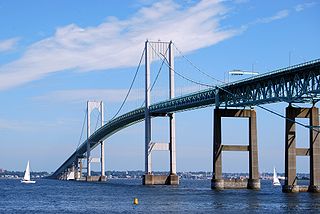
The Claiborne Pell Bridge, commonly known as the Newport Bridge, is a suspension bridge operated by the Rhode Island Turnpike and Bridge Authority that spans the East Passage of the Narragansett Bay in Rhode Island. The bridge, part of RI 138, connects the city of Newport on Aquidneck Island and the Town of Jamestown on Conanicut Island, and is named for longtime Rhode Island U.S. senator Claiborne Pell who lived in Newport. The Pell Bridge is in turn connected to the mainland by the Jamestown Verrazzano Bridge.

The Banzai Pipeline, or simply Pipeline or Pipe, is a surf reef break located in Hawaii, off Ehukai Beach Park in Pupukea on O'ahu's North Shore. A reef break is an area in the ocean where waves start to break once they reach the shallows of a reef. Pipeline is known for huge waves that break in shallow water just above a sharp and cavernous reef, forming large, hollow, thick curls of water that surfers can tube ride. There are three reefs at Pipeline in progressively deeper water farther out to sea that activate according to the increasing size of approaching ocean swells.

Surf movies fall into three distinct genres:

Surf culture includes the people, language, fashion, and lifestyle surrounding the sport of surfing. The history of surfing began with the ancient Polynesians. That initial culture directly influenced modern surfing, which began to flourish and evolve in the early 20th century, with its popularity peaking during the 1950s and 1960s. It has affected music, fashion, literature, film, art, and youth jargon in popular culture. The number of surfers throughout the world continues to increase as the culture spreads.

Siargao is a tear-drop shaped island in the Philippine Sea situated 196 kilometers southeast of Tacloban. It has a land area of approximately 437 square kilometres (169 sq mi). The east coast is relatively straight with one deep inlet, Port Pilar. The coastline is marked by a succession of reefs, small points and white, sandy beaches. The neighboring islands and islets have similar landforms. Siargao is known as the surfing capital of the Philippines, and was voted the Best Island in Asia in the 2021 Conde Nast Travelers Readers awards.

The riding of waves has likely existed since humans began swimming in the ocean. In this sense, bodysurfing is the oldest type of wave-catching. Undoubtedly ancient sailors learned how to ride wave energy on many styles of early boats. Archaeological evidence even suggests that ancient cultures of Peru surfed on reed watercraft for fishing and recreation up to five thousand years ago. However, standing up on what is now called a surfboard is a relatively recent innovation developed by the Polynesians. The influences for modern surfing can be directly traced to the surfers of pre-contact Hawaii.

River surfing is the sport of surfing either standing waves, tidal bores or upstream waves in rivers. Claims for its origins include a 1955 ride of 2.4 km (1.5 mi) along the tidal bore of the River Severn.

The East Bay Bike Path is a 14.5-mile (23.3 km) paved rail trail in Rhode Island. The path originates in Providence and India Point Park, crosses the Seekonk River via the George Redman Linear Park and the Washington Bridge, and continues southeast to Bristol along the shoreline of Narragansett Bay. The path passes through the city of East Providence, the hamlet of Riverside, and the towns of Barrington and Warren. It is part of the East Coast Greenway, a 3,000-mile system of trails connecting the Canada–US border in Maine to Key West, as well as provides access to Haines State Park, Brickyard Pond (Barrington), and Colt State Park.

Pawtucket/Central Falls station is a commuter rail station in Pawtucket, Rhode Island. It opened for MBTA Commuter Rail Providence/Stoughton Line service on January 23, 2023. The station has two side platforms serving the two tracks of the Northeast Corridor. It is also a hub for RIPTA local bus service.

A surf break is a permanent obstruction such as a coral reef, rock, shoal, or headland that causes a wave to break, forming a barreling wave or other wave that can be surfed, before it eventually collapses. The topography of the seabed determines the shape of the wave and type of break. Since shoals can change size and location, affecting the break, it takes commitment and skill to find good breaks. Some surf breaks are quite dangerous, since the surfer can collide with a reef or rocks below the water.

Teahupoʻo is a village on the southeastern coast of the island of Tahiti in French Polynesia, France, in the southern Pacific Ocean. It is known for the large, consistent surf that occurs off its shore, and resulting international surfing competitions.

New Zealand is a popular surfing destination, with a long history of the sport and a varied coastline with locations suitable for all types of surfing. The West coast is notably consistent, with big swells and high winds, whereas the east coast is dominated by cyclone season swells; the North island is notably warmer than the South, but less consistent; mean temperatures range from 7 °C to 20 °C, depending on location and time of year. Winter is more consistent than Summer, with a southeasterly swell. The climate of New Zealand is varied, so different surf conditions are encountered across the islands.
