Ruwenzori hill babbler

Last updated

Ruwenzori hill babbler
Scientific classification Red Pencil Icon.png
Kingdom: Animalia
Phylum: Chordata
Class: Aves
Order: Passeriformes
Family: Sylviidae
Genus: Pseudoalcippe
Species:P. atriceps
Binomial name
Pseudoalcippe atriceps
(Sharpe, 1902)

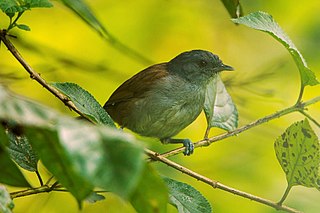
The Ruwenzori hill babbler (Pseudoalcippe atriceps) is a species of passerine bird in the family Sylviidae that is found in Africa.

Passerine Any bird of the order Passeriformes, which includes more than half of all bird species. Sometimes known as perching birds

A passerine is any bird of the order Passeriformes, which includes more than half of all bird species. Sometimes known as perching birds or – less accurately – as songbirds, passerines are distinguished from other orders of birds by the arrangement of their toes, which facilitates perching. With more than 110 families and some 6,409 identified species, Passeriformes is the largest order of birds and among the most diverse orders of terrestrial vertebrates.
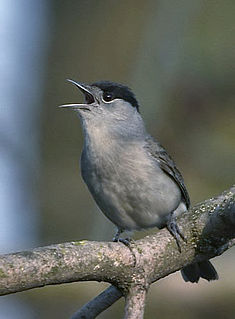
Sylviidae family of birds

Sylviidae is a family of passerine birds that includes the typical warblers, parrotbills, the wrentit, and a number of babblers formerly placed within the Old World babbler family. They are found in Eurasia, Africa, and the west coast of North America.

The Ruwenzori hill babbler was described by the English zoologist Richard Bowdler Sharpe in 1902 and given the binomial name Turdinus atriceps. The type locality is the Rwenzori Mountains on the border between Uganda and the Democratic Republic of the Congo. [2] [3] The specific epithet atriceps is from the Latin ater for "black" and -ceps for "capped" or "headed". [4] The Ruwenzori hill babbler was formerly considered to be a conspecific with the African hill babbler. [5] The species is monotypic. [6]

A species description is a formal description of a newly discovered species, usually in the form of a scientific paper. Its purpose is to give a clear description of a new species of organism and explain how it differs from species which have been described previously or are related. The species description often contains photographs or other illustrations of the type material and states in which museums it has been deposited. The publication in which the species is described gives the new species a formal scientific name. Some 1.9 million species have been identified and described, out of some 8.7 million that may actually exist. Millions more have become extinct.

Richard Bowdler Sharpe British ornithologist

Richard Bowdler Sharpe was an English zoologist and ornithologist who worked as curator of the bird collection at the British Museum of natural history. In the course of his career he published several monographs on bird groups and produced a multi-volume catalogue of the specimens in the collection of the museum. He described several new species of bird including Sharpe's longclaw and Sharpe's pied-babbler which are named in his honour.

Rwenzori Mountains mountain range

The Rwenzori Mountains, previously called the "Ruwenzori Range", is a mountain range of eastern equatorial Africa, located on the border between Uganda and the Democratic Republic of the Congo (DRC). These mountains support glaciers and are one source of the river Nile.


Related Research Articles

Typical warbler genus of birds

The typical warblers are small birds belonging to the genus Sylvia in the "Old World warbler" family Sylviidae.

True thrush genus of birds

True thrushes are medium-sized mostly insectivorous or omnivorous birds in the genus Turdus of the wider thrush family, Turdidae. The genus name Turdus is Latin for "thrush". The term "thrush" is used for many other birds of the family Turdidae as well as for a number of species belonging to several other families.

Akalat genus of birds

The akalats are medium-sized insectivorous birds in the genus Sheppardia. They were formerly placed in the thrush family, Turdidae, but are more often now treated as part of the Old World flycatcher family, Muscicapidae.

James Lee Peters was an American ornithologist.

Socotra sparrow species of bird

The Socotra sparrow is a passerine bird endemic to the islands of Socotra, Samhah, and Darsah in the Indian Ocean, off the Horn of Africa. The taxonomy of this species and its relatives is complex, with some authorities, including BirdLife International, recognising this species and the very similar Abd al-Kuri sparrow, as well as several from mainland Africa, as separate, and others lumping all these species and the probably unrelated Iago sparrow.

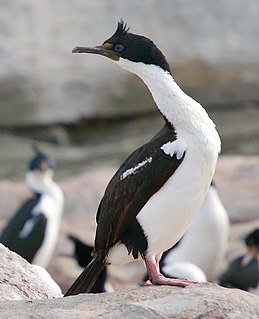
Imperial shag species of cormorant

The imperial shag is a black and white cormorant native to southern South America, primarily in rocky coastal regions, but locally also at large inland lakes. Some taxonomic authorities, including the International Ornithologists' Union, place it in the genus Leucocarbo, others in the genus Phalacrocorax. It is also known as the blue-eyed shag, blue-eyed cormorant and by many other names, and is one of a larger group of cormorants called blue-eyed shags. The taxonomy is very complex, and several former subspecies are often considered separate species.

Chestnut-vented warbler species of bird

The chestnut-vented warbler, chestnut-vented tit-babbler or rufous-vented warbler is an Old World warbler.

The Bornean frogmouth is species of bird in the Podargidae family. Some taxonomists consider it to be a subspecies of the short-tailed frogmouth, but others consider it to be a distinct species. It is found in Indonesia and Malaysia and is endemic to the island of Borneo. Its natural habitats are subtropical or tropical moist lowland forests and subtropical or tropical moist montane forests. It is threatened by habitat loss.

Shining-blue kingfisher species of bird

The shining-blue kingfisher is a species of bird in the family Alcedinidae. It is found in Equatorial Africa.

Brown-headed paradise kingfisher species of bird

The brown-headed paradise kingfisher, also known as the russet paradise kingfisher, is a species of bird in the family Alcedinidae. It is endemic to the lowland forest in south east Papua New Guinea. Its natural habitats are temperate forests and subtropical or tropical moist lowland forests. Like all paradise kingfishers this bird has colourful plumage with a red bill and distinctive long tail streamers.

Goulds shortwing species of bird

The Gould's shortwing is a small species of passerine bird in the family Muscicapidae. It is found in the Himalayas, Yunnan and northern parts of Myanmar and Vietnam. It breeds in the eastern Himalayas in rocky areas above the tree-line and winters at lower altitude in wooded valleys.

Rufous-tailed babbler species of bird

The rufous-tailed babbler is a bird species in the family Sylviidae. It was formerly included with the Old World babblers (Timaliidae) in the genus Chrysomma, but is actually very closely related to the typical warblers (Sylvia). It is endemic to central China.

Dohrns thrush-babbler species of bird

Dohrn's thrush-babbler, also known as Principe flycatcher-babbler and Dohrn's warbler, is a species of passerine bird in the family Sylviidae that is endemic to the island of Príncipe which lies off the west coast of Africa in the Gulf of Guinea.

<i>Neomixis</i> genus of birds

Neomixis is a genus of small forest birds that are endemic to Madagascar.

African hill babbler species of bird

The African hill babbler is a species of bird in the family Sylviidae and it has been suggested that it be placed in the genus Sylvia with such familiar European species as the Eurasian blackcap and common whitethroat.

<i>Pseudoalcippe</i> genus of birds

Pseudoalcippe is a genus of passerine birds in the family Sylviidae that are found in Africa.

Hartlaubs babbler species of bird

Hartlaub's babbler or Angola babbler is a species of bird in the Leiothrichidae family, which is native to south central Africa. The common name and Latin binomial commemorate the German physician and ornithologist Gustav Hartlaub.

<i>Aethomyias</i> Genus of birds in the Acanthizidae family

Aethomyias is a genus of passerine birds in the family Acanthizidae that are endemic to New Guinea.

References

  1. BirdLife International (2016). "Sylvia atriceps". IUCN Red List of Threatened Species . International Union for Conservation of Nature . Retrieved 8 September 2017.
  2. Sharpe, Richard Bowdler (1902). "Turdinus atriceps". Bulletin of the British Ornithologists' Club. 13: 10.
  3. Mayr, Ernst; Paynter, Raymond A. Jr, eds. (1964). Check-list of Birds of the World. Volume 10. Cambridge, Massachusetts: Museum of Comparative Zoology. pp. 412–413.
  4. Jobling, James A. (2010). The Helm Dictionary of Scientific Bird Names. London: Christopher Helm. p. 59. ISBN   978-1-4081-2501-4.
  5. Collar, N.; Robson, C. (2017). del Hoyo, J.; Elliott, A.; Sargatal, J.; Christie, D.A.; de Juana, E., eds. "Ruwenzori Hill-babbler (Sylvia atriceps)". Handbook of the Birds of the World Alive. Lynx Edicions. Retrieved 8 September 2017. (Subscription required (help)).
  6. Gill, Frank; Donsker, David, eds. (2017). "Sylviid babblers, parrotbills & white-eyes". World Bird List Version 7.3. International Ornithologists' Union. Retrieved 7 September 2017.