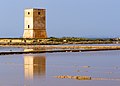
The salt pans of Trapani and Paceco (Italian: Riserva naturale orientata Saline di Trapani e Paceco) are a historic salt-producing landscape and protected wetland in the province of Trapani, western Sicily. Situated between the city of Trapani and the town of Paceco, the area consists of a network of coastal evaporation ponds, canals, and traditional windmills used for sea-salt extraction over many centuries.
Although salt production continues on a reduced scale, the site is also recognised for its ecological importance: the shallow basins provide habitat for numerous migratory and resident bird species and form one of the most significant wetland systems on the island. Established as a nature reserve in 1995 and managed by WWF Italy, the area covers approximately 1,000 hectares and is noted for its distinctive cultural landscape, combining industrial heritage with natural values.
Geography
The salt pans extend along the western Sicilian coast south of Trapani, occupying a flat coastal plain that forms part of an important coastal wetland system in western Sicily.[1][2] Individual basins are arranged in a patchwork pattern between Trapani and Paceco, separated by narrow embankments and supplied with seawater through an artificial system of inlets and canals.[3] Water movement within the complex traditionally relied on wind-powered pumps, whose tower mills remain a characteristic visual feature of the landscape, pumping water between the basins and, historically, powering the grinding of salt.[4][5]
The terrain consists of shallow, highly saline basins shaped by repeated cycles of flooding and evaporation. These conditions reflect the geomorphological context of western Sicily, where low tidal ranges, coastal sedimentation, and human engineering have long favoured salt extraction. The reserve as designated today covers around 1,000 hectares, though the broader salt-working landscape extends beyond the formal boundaries and includes both active and disused basins.[6][7][8][9]
Historically, the saltworks extended closer to the centre of Trapani than they do today. During the 19th century, major coastal engineering works on the southern side of the Trapani peninsula altered the configuration of the shoreline and reduced the northern extent of the salt basins. The construction of the Colombaia breakwater in 1896—built using 50-ton concrete blockwork, the earliest documented use of this technique in Italy—marked the beginning of the area’s transformation from a shallow, marsh-bordered coast into the modern Port of Trapani.[10] The remaining salt pans now occupy a continuous stretch of coastline between Trapani and Paceco.
History
Early salt production
Salt pans at Nubia with Monte Erice in the background
Salt extraction along the coast around Trapani is widely regarded as having very ancient origins. Local historical accounts and interpretive materials describe how the first salt pans in the area were probably created by the Phoenicians, taking advantage of the low, flat coastline, the high salinity of the sea and the hot, dry summers of southwestern Sicily.[11][5] Regional geological documentation similarly notes that salt harvesting in the Trapani and Paceco area "probably" dates back around 3,000 years, to the time of the Phoenicians, and continues today using largely artisanal methods.[12]
The first clear written description of the Trapani saltworks dates to the 12th century. The Arab geographer al-Idrīsī, writing in 1154, records a large salt pan extending from the outskirts of Trapani to the slopes of Mount Erice, indicating that by the Norman period the coastal flats south of the town were already organised for salt production.[11][12] By the late Middle Ages, the salt industry around Trapani had become a significant economic resource for the town and its harbour, laying the foundations for the later expansion of trade in sea salt from western Sicily.[11]
Peak industrial period
The Salt Museum at Nubia
From the early modern period onwards the salt pans of Trapani expanded significantly under successive Spanish and Bourbon administrations. Accounts of the history of the saline note that between the 16th and 18th centuries the industry grew to become one of the most important economic sectors in western Sicily, supported by the region’s climate, the sheltered coastal basins and increasing demand for sea salt across the Mediterranean.[11] During this period many of the evaporation ponds still visible today were constructed or enlarged, giving shape to the characteristic grid of basins divided by low embankments that defined the landscape for the next several centuries.[12]
By the 18th and 19th centuries the salt pans were operated largely by private owners, including long-established local families who controlled both the productive basins and the associated windmills. Among the better-documented examples are the Culcasi family, who remain active in artisanal salt production at Nubia, and the Morana family, whose 19th-century mill now houses the Salt Museum (Museo del Sale) displaying traditional tools and equipment used in the Trapani salt industry.[5]
Salt from Trapani was widely exported during this period. Contemporary and modern accounts describe how large quantities were shipped through the port of Trapani to destinations around the Mediterranean and northern Europe, where it was used particularly for food preservation, including curing fish and meat.[4] By the late 19th century the industry had become heavily integrated with Trapani’s port, which handled the majority of regional exports and contributed to the town’s reputation as one of the principal salt-trading centres of the central Mediterranean.[11]
Modern era
Salina Calcara
During the 20th century the traditional salt industry at Trapani and Paceco experienced a gradual decline. Improved refrigeration, changing commercial networks and competition from industrially produced salt reduced the profitability of the artisanal system, and several of the historic basins were abandoned or fell into disuse.[11] Although mechanised methods were introduced in parts of the saline, much of the production continued to rely on manual techniques and seasonal labour, preserving the characteristic appearance of the landscape even as overall output decreased.[5]
From the late 20th century onwards increasing attention was given to the cultural and environmental value of the salt pans. Their traditional infrastructure, including windmills, canals and low embankments, was recognised as part of the historical heritage of western Sicily, while the shallow, highly saline basins were identified as an important wetland habitat for migratory birds.[4] This dual significance encouraged efforts to conserve the landscape and stabilise the remaining productive areas through restoration and careful management.
In 1995 the area was formally designated as the Riserva naturale orientata Saline di Trapani e Paceco, protecting approximately 1,000 hectares of basins, canals and coastal environments.[6] Since 2011 the reserve has been managed by WWF Italy, which oversees habitat conservation, visitor interpretation and the maintenance of traditional salt-working structures. The protected status has helped preserve both the ecological functions of the wetland and the cultural heritage associated with centuries of salt extraction.[6]
Salt production
Harvested sea salt drying in mounds at Trapani
Salt production at Trapani and Paceco follows a traditional system based on the natural evaporation of seawater. The process begins by drawing water from the coast into wide, shallow intake basins, where the sun and wind initiate the first stage of evaporation. From here the increasingly concentrated brine is moved through a sequence of progressively smaller ponds, each designed to raise salinity step by step as minerals precipitate out of solution.[5][4]
The movement of water between basins was historically controlled by a network of canals, wooden sluices and wind-driven pumps. The distinctive tower mills that still stand throughout the saline were used both to regulate water levels and, in some cases, to grind the harvested salt. Although mechanical pumps are now employed in parts of the complex, several basins continue to operate using traditional methods, maintaining the characteristic appearance of the working landscape.[5][6]
Harvesting takes place in summer, when the final crystallisation ponds produce a compact layer of salt that is raked into mounds and left to drain before storage. The resulting sea salt is valued for its purity and for the slow, low-impact production process that preserves many of the techniques used in the saline for centuries.[11][12]
Ecology
The salt pans of Trapani and Paceco form one of the most important wetland systems in western Sicily. The shallow, highly saline basins, along with the network of canals and embankments, create a mosaic of habitats that support specialised plant communities and large numbers of waterbirds throughout the year.[6] The area is recognised for its ecological significance at both national and international level, forming part of a wider coastal corridor used by migratory species crossing the central Mediterranean.[7]
Fauna
Greater flamingos in the salt pans
The saline are especially noted for their birdlife, attracting both resident species and large numbers of migrants. Waders and waterbirds such as black-winged stilts, avocets, herons and egrets are regular breeders, while the basins also provide feeding habitat for shelducks, gulls and terns.[4] In recent decades the reserve has become known for the increasing presence of the greater flamingo, which uses the ponds as a stopover and, in some years, as a breeding site.[6]
During migration periods the pans support substantial flocks of shorebirds moving between Africa and Europe, and in winter they serve as an important refuge for ducks and other waterfowl. This seasonal concentration of species is one of the reasons the site is listed as a Ramsar wetland of international importance.[7]
Flora and vegetation
Vegetation within the saline is dominated by halophytic, or salt-tolerant, species adapted to the extreme conditions of the evaporation ponds. Among the most characteristic plants are glassworts (Salicornia spp.), saltbushes (Atriplex spp.), and the rare sea marigold (Calendula maritima), a species endemic to western Sicily and closely associated with coastal saline habitats.[12] These communities help stabilise the embankments and provide feeding and resting areas for invertebrates and birds. Patches of reedbed and coastal scrub occur along the margins of the reserve, particularly where freshwater inflows moderate salinity.[9]
Protected status
Pink pans at the Nubia tower
The salt pans have enjoyed formal protection since 1995, when the area was designated as the Riserva naturale orientata Saline di Trapani e Paceco. The reserve covers about 1,000 hectares of basins, canals, embankments and coastal wetland, and has been managed by WWF Italy since 2011.[6] In addition to its regional reserve status, the site is included within the Natura 2000 network as both a Special Area of Conservation and a Special Protection Area, and is recognised as a wetland of international importance under the Ramsar Convention.[7]
In 2025 WWF Italy presented a proposal for the creation of a new Parco nazionale delle Isole Egadi e del Litorale Trapanese, which would unite the Egadi Islands, the Trapani and Paceco salt pans, and parts of the surrounding coastline within a single protected entity. The proposal emphasises the ecological continuity of the coastal and marine habitats, the need to integrate existing protected areas, and the cultural value of the salt-working landscape.[13]
In parallel with national-level proposals, the saline of Trapani and Paceco—together with the nearby Stagnone di Marsala—have been included in a formal nomination for recognition as a UNESCO Man and the Biosphere (MAB) Reserve. The application, promoted by regional institutions and local organisations, highlights the importance of the salt pans as a cultural landscape combining biodiversity conservation, traditional practices and sustainable development.[14]
These overlapping protections and proposals underline the dual identity of the saline as both a productive cultural landscape shaped by centuries of salt extraction and a site of exceptional ecological value.
Gallery
Windmill and salt pans
Torre Nubia near Salina Culcasi of Paceco (Trapani)
This page is based on this Wikipedia article Text is available under the CC BY-SA 4.0 license; additional terms may apply. Images, videos and audio are available under their respective licenses.