
San Francesco a Ripa is a church in Rome, Italy. It is dedicated to Francis of Assisi who once stayed at the adjacent convent. The term Ripa refers to the nearby riverbank of the Tiber.

Cosimo Fanzago was an Italian architect and sculptor, generally considered the greatest such artist of the Baroque period in Naples, Italy.

La Verna is a locality on Mount Penna, an isolated mountain of 1,283 metres (4,209 ft) situated in the centre of the Tuscan Apennines, rising above the valley of the Casentino, central Italy. The place is known especially for its association with Saint Francis of Assisi and for the Sanctuary of La Verna, which grew up in his honour. Administratively it falls within the Tuscan province of Arezzo and the comune of Chiusi della Verna, Italy.

The Basilica of Saint Mary of the Angels is a papal minor basilica situated in the plain at the foot of the hill of Assisi, Italy, in the frazione of Santa Maria degli Angeli.

Gesù Nuovo is the name of a church and a square in Naples, Italy. They are located just outside the western boundary of the historic center of the city. To the southeast of the spire, one can see a block away the Fountain of Monteoliveto and the piazza of the church of Sant'Anna dei Lombardi. The square is a result of the expansion of the city to the west beginning in the early 16th century under the rule of Spanish viceroy Pedro Alvarez de Toledo. The square of Gesù Nuovo contains three prominent landmarks:

Santa Maria la Nova is a Renaissance style, now-deconsecrated, Roman Catholic church and monastery in central Naples. The church is located at the beginning of a side street directly across from the east side of the main post office, a few blocks south of the Church and Monastery of Santa Chiara. Today the adjacent monastery is a meeting site and hosts the Museo ARCA of modern religious art.

Sant'Anna dei Lombardi,, and also known as Santa Maria di Monte Oliveto, is an ancient church and convent located in piazza Monteoliveto in central Naples, Italy. Across Monteoliveto street from the Fountain in the square is the Renaissance palace of Orsini di Gravina.
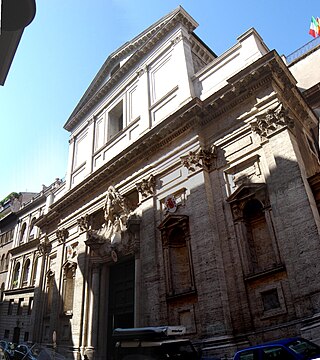
The Spanish National Church of Santiago and Montserrat, known as Church of Holy Mary in Monserrat of the Spaniards is a Roman Catholic titulus church and National Church in Rome of Spain, dedicated to the Virgin of Montserrat. It is located in the Rione Regola, at the intersection of alleyway of Via della Barchetta and the narrow Via di Monserrato, with the facade on the latter street, about three blocks northwest of the Palazzo Farnese.

San Francesco della Vigna is a Roman Catholic church in the Sestiere of Castello in Venice, northern Italy.

Angelina of Marsciano, T.O.R. was an Italian Religious Sister and foundress, and is a beata of the Roman Catholic Church. She founded a congregation of Religious Sisters of the Franciscan Third Order Regular, known today as the Franciscan Sisters of Blessed Angelina. She is generally credited with the founding of the Third Order Regular for women, as her religious congregation marked the establishment of the first Franciscan community of women living under the Rule of the Third Order Regular authorized by Pope Nicholas V.

Pietro Tenerani was an Italian sculptor of the Neoclassic style.

Nicolo Fumo (1647–1725) was an Italian sculptor and architect known for his wooden works. He is also known as Niccolo Fumo or Nicola Fumo.

San Giorgio Maggiore is a basilica church located on the corner of Via vicaria Vecchia and Via Duomo, in central Naples, Italy. The apse of the church lies diagonally across the street from San Severo al Pendino.

Santa Maria della Mercede a Montecalvario is a church located on largo Montecalvario in Naples, Italy.
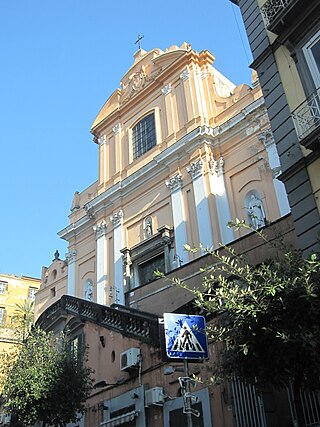
Santa Teresa degli Scalzi is a church in Naples, Italy, located in via Santa Teresa degli Scalzi, a wide street opened during 1806–1810, to connect the historic center of Naples to the zone of Capodimonte. The church is generally closed to the public.
Arcangelo Guglielmelli was an Italian architect and painter, active in his native Naples, Italy, in a late-Baroque style. He was involved in the building and reconstruction of churches, many of which had been damaged by the earthquakes of 1688 and 1694.
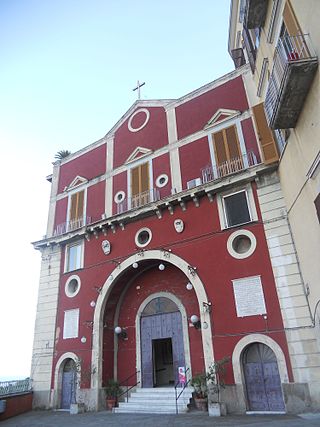
Santa Maria del Parto a Mergellina is a church located in the quartiere of Chiaia in Naples, Italy. The church is peculiarly perched on top of a private building and accessed by a stairway, placed behind a restaurant located in piazza Mergellina.
San Leone is a 12th-century Byzantine church located in Saracena, region of Calabria, Italy.

Santa Maria Egiziaca a Pizzofalcone is a Baroque-style, Roman Catholic, Basilica church on the street of the titular name in the hill of Pizzofalcone, in the historic center of Naples, region of Campania, Italy. The church layout was initially designed by Cosimo Fanzago.


