History and description
The façade by Annibale Bichi, also the benefactor, recalls works by Baldassarre Peruzzi. Other patrons were the Santucci family, hence the name. The convent survived a series of suppressions starting in the 18th-century through the late 19th century. Nuns from other monasteries congregated here. In the early 20th century, the few remaining nuns moved out, and the adjacent convent is used as a professional school.
The interior houses a major altarpiece, a Madonna and Child with Saints, one of the last works of Francesco Vanni who died in 1610, continued by his half-brother, Ventura Salimbeni, who died in 1613, and only finally completed by Sebastiano Folli in 1614. The fresco decorations of the lateral walls were painted by Ventura Salimbeni, and depict episodes in the Life of San Galgano (1614). [2] St Galgano was a soldier who became an eremitic monk. The church once sheltered a silver reliquary, by Pace di Valentino, putatively containing relics of the saint; it is now in the diocesan museum of the Cathedral. The canvas depicting St Cecilia at the organ (early 1600s) is attributed to Antonio Buonfigli. The fresco with an Angelic concert (1613) was painted by Salimbeni. The organ from the church dates to 1531. [3]

Ventura di Archangelo Salimbeni was an Italian Counter-Maniera painter and printmaker highly influenced by the vaghezza and sensual reform of Federico Barocci.

Buonconvento is a comune (municipality) in the Province of Siena in the Italian region Tuscany, located about 70 kilometres (43 mi) south of Florence and about 25 kilometres (16 mi) southeast of Siena in the area known as the Crete Senesi. It is one of I Borghi più belli d'Italia.
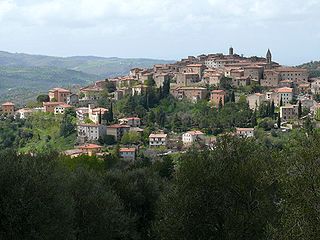
Seggiano is a comune (municipality) in the Province of Grosseto in the Italian region Tuscany, located about 100 kilometres (62 mi) south of Florence and about 40 kilometres (25 mi) northeast of Grosseto.

Bonifazio Bevilacqua Aldobrandini was an Italian Cardinal. He was the uncle of Pope Gregory XIV.

Santa Caterina a Magnanapoli is a baroque church dedicated to St. Catherine of Siena on Largo Magnanapoli on the slopes of the Quirinal Hill in Rome.

Santa Trinita is a Roman Catholic church located in front of the piazza of the same name, traversed by Via de' Tornabuoni, in central Florence, Tuscany, Italy. It is the mother church of the Vallumbrosan Order of Monks, founded in 1092 by a Florentine nobleman. South on Via de' Tornabuoni is the Ponte Santa Trinita over the river Arno; across the street is the Palazzo Spini Feroni.

Galgano Guidotti was a Catholic saint from Tuscany born in Chiusdino, in the modern province of Siena, Italy. His mother's name was Dionigia, while his father's name only appeared in a document dated in the 16th century, when the last name Guidotti was attributed. He is known for the Sword in the Stone relic by the ruins of the Abbey of San Galgano near Siena.

San Maurizio al Monastero Maggiore is a church in Milan, Northern Italy. It was originally attached to the most important female convent of the Benedictines in the city, Monastero Maggiore, which is now in use as the Civic Archaeological Museum. The church today is used every Sunday from October to June to celebrate in the Byzantine Rite, in Greek according to the Italo-Albanian tradition. It is also used as a concert hall.
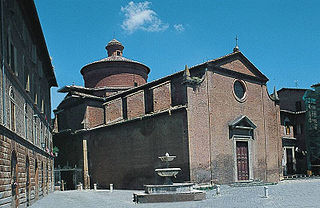
Santo Spirito is a Renaissance style, Roman Catholic church located in piazza Santo Spirito, where Via dei Pispini meets Vicolo del Sasso, in Siena, Italy.

San Raimondo, also called San Raimondo al Refugio, is a Baroque style, Roman Catholic church located on the intersection of Via del Refugio and Via di Fiera Vecchia, in the Terzo of Camollia of the city of Siena, region of Tuscany, Italy. The church is dedicated to St Raymond of Pennafort.

The Basilica of San Domenico, also known as Basilica Cateriniana, is a basilica church in Siena, Tuscany, Italy, one of the most important in the city. The basilica is an example of Cistercian Gothic style.

Sebastiano Folli (1568–1621) was an Italian painter of the late Renaissance period. He was a scholar of Alessandro Casolano, and a native of Siena. He distinguished himself by several frescoes in the churches at Siena, particularly the cupola of Santa Marta, and some subjects from the Life of St. Sebastian, in the church of that saint, painted in competition with Rutilio Manetti, to whose pictures they are in no way inferior. He visited Rome, and was employed in some considerable works for the Cardinal de' Medici, afterwards Leo XI. He died in 1621.

San Niccolò al Carmine, also called Santa Maria del Carmine is a Renaissance style, Roman Catholic church and monastery located in Pian dei Mantellini #30, near the corner of Via della Diana in the Terzo de Citta of Siena, region of Tuscany, Italy. The church now serves as the Oratory for the Contrada of Pantera. Across the street from the belltower is the Palazzo Celsi Pollini. North along Pian dei Mantellini, toward the Arco delle Due Porte, and on the same side of the street are a number of palaces built around what was once the Monastery of the Derelict Women: in order they are the Neoclassical Palazzo Incontri, the Palazzo Ravissa and the Palazzo Segardi.

Santa Petronilla is a 17th-century Roman Catholic church and former convent located near the start of via Camillo Benzo Cavour, corner with via Santa Petronilla 1, in the city of Siena, region of Tuscany, Italy. It is located outside the medieval walls of Siena, near the antiporta of Camollia.

The Certosa di Pontignano, also known as the Certosa di San Pietro, is a Carthusian monastery and church in the neighborhood of Pontignano, within the town limits of Castelnuovo Berardenga, a few kilometers north of the city of Siena, in the region of Tuscany, Italy. The monastic complex, after the expulsion of the monks in 1810, passed through various hands, until it was acquired in 1959 by the University of Siena, and used for academic meetings, conventions, and also hotel and restaurant for events such as weddings and celebrations.

The Monastery of San Girolamo in Campansi is a former convent located on Via Campansi #18 in the city of Siena, region of Tuscany, Italy. The Baroque-style church still stands as an independent chapel; while the monastery has been converted to a nursing home for the elderly. There is a separate Monastery of San Girolamo on via San Girolamo, located in a different contrada of Siena.
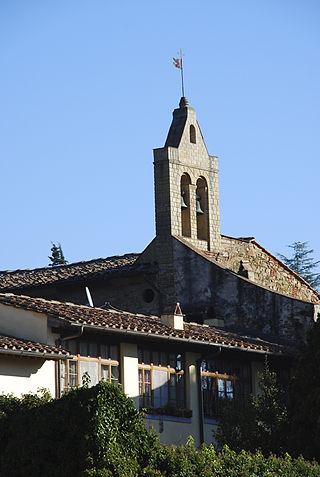
The Church of San Gaggio is a Roman Catholic church located on via Senese in Florence, Italy. It was once associated with a large convent.

The Church of Tau is a 14th-century, deconsecrated Roman Catholic church located on Corso Silvano Fedi #28 in Pistoia, region of Tuscany, Italy. It is located adjacent to Piazza Garibaldi, and across the street from the church of San Domenico.
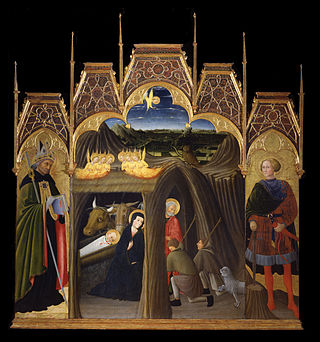
Pietro di Giovanni D'Ambrogio was an Italian painter of the Sienese school.

The Church of the Immaculate Conception, also called Church of Borgo alle Taverne, is located in Chianciano Terme.

